Gamma Nail for Intertrochanteric Femoral Fracture
Source
Surgeon:
Lasse Rämö (orthopedic surgeon)
To access the full video and additional content on this subject, log in or subscribe
Clinician Summary
Focus
Reduction and stable fixation of an intertrochanteric fracture of the proximal femur with immediate restoration of full weight-bearing.
Key elements
Correct nail positioning, femoral neck lag screw placement, distal locking screw placement, final imaging, wound closure, and aftercare.
Indications and Clinical Context
Name of Procedure: Cephalomedullary nailing of an intertrochanteric fracture of the proximal femur using the trochanteric nail.
Goal of Operation
Reduction and stable fixation of an intertrochanteric fracture of the proximal femur with immediate restoration of full weight-bearing.
Problem
Intertrochanteric fracture of the proximal femur.
Diagnosis
Pertrochanteric fracture (ICD-10: S72.1)
Short Pathophysiological Description
Intertrochanteric femoral fractures are usually caused by a same-level fall and are common in elderly people with osteoporosis.
Key Anatomy and Landmarks
Femoral neck
Femoral shaft
Greater trochanter
Deep femoral artery and vein (drilling for insertion of the distal locking screw)
Gamma Nail for Intertrochanteric Femoral Fracture
Step-by-Step Technique
Preparation and fracture reduction
The patient is supine on the operating (fracture) table.
Either general or spinal anesthesia can be used.
The contralateral leg is placed on a leg support and abducted as far as possible to keep it out of the way when taking fluoroscopic images with the C-arm.
The upper body should be bent towards the contralateral side from the fracture to facilitate proper insertion of the nail. The ipsilateral arm should be placed on the trunk for example in a sling so it does not block nail insertion.
Before starting the reduction make sure that appropriate AP and lateral images can be obtained with the C-arm. Change the position of the contralateral leg if necessary.
Apply axial traction.
After restoring limb length, internally rotate the leg (in hip fractures, the injured leg is usually externally rotated as a consequence of the fracture).
It is essential that the leg is brought into slight adduction to allow successful insertion of the nail from the tip of the greater trochanter.
If adequate reduction cannot be achieved using closed reduction, prepare for open reduction. Reduction should be as anatomical as possible.
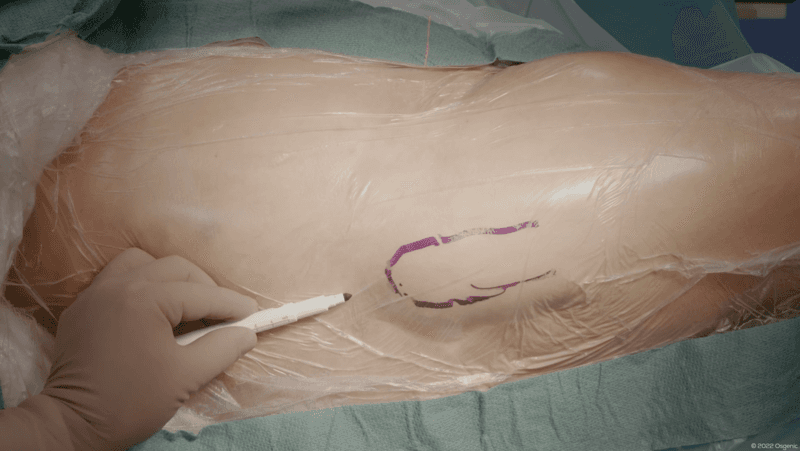
Log in or subscribe to access full content and see all the images.
Planning the incision site
Palpate the landmarks: greater trochanter.
Determine the site of the incision using, for example, the help of a guide wire placed on the skin surface. Since the nail is inserted from the proximal direction, the incision will always be proximal to the greater trochanter.
Skin incision and opening of the fascia
Make an incision proximal to the tip of the greater trochanter.
The incision should follow the longitudinal femoral axis.
Use a blade or diathermy to advance through the subcutaneous fat. Use an Adson retractor to improve visibility. There are no critical anatomical structures just below the skin incision.
Advance distally towards the tip of the greater trochanter and open the fascia using a blade or diathermy.
Palpate the trochanteric tip.
Nail insertion site
Insert the nail from the trochanteric tip and at the junction of the anterior and middle thirds of the trochanter.
Introduce the guide wire to the tip of the trochanter. Confirm the location of the wire from an AP image. Correct the position of the wire if necessary. When the position appears good on the AP view, insert it into the bone approximately 1cm deep and then check the correct location from the lateral view.
For the lateral projection, the C-arm should be tilted about 15 degrees to be in alignment with the femoral neck anteversion to obtain a so called true lateral view. This facilitates evaluation of the position and direction of the guide wire.
Guide wire insertion
Drill the guide wire further into the femur checking by fluoroscopy that it does not end up outside the bone via the fracture site.
Reaming of the proximal femur
Ream the proximal femur using the appropriate reamer and protective reamer sleeve.
Avoid using strong compressive force when reaming as this may spread the fracture fragments apart. This may happen especially if the fracture continues to the tip of the trochanter, which is quite common.
Take fluoroscopic images when reaming to make sure the reamer is advancing correctly.
The reamer automatically stops at the correct depth if the protective reamer sleeve tip is properly placed against the tip of the greater trochanter.
Nail insertion
Choose a nail with the suitable femoral neck angle, based on preoperative measurement.
Insert the nail into the femur initially by hand over the guide wire and, if necessary, tap the nail deeper with the mallet.
Determining the correct nail position
The correct nail rotation and depth are based on correct positioning of the femoral neck lag screw. To facilitate determining the correct location for the lag screw you can use a targeting tool called, the ‘one shot device’, which is connected to the guide sleeve of the lag screw. Set the nail to the correct depth (AP view) and rotation using this device (lateral view).
The femoral neck lag screw should be at the junction of the middle and the lower thirds of the femoral neck in the AP view and in the middle of the femoral neck in the true lateral view.
Femoral neck guide wire
Make a small skin incision where the guide sleeve of the femoral neck lag screw touches the skin.
Open the fascia with a blade or scissors.
Put the guide sleeve against the lateral cortex of the femur.
Using a drill, open the lateral cortex, this will help reduce the risk of guide wire deflection.
Change the trocar of the guide sleeve for the guide wire.
Drill the guide wire close to the subchondral bone aiming to minimize tip-apex distance and confirm the correct location of the guide wire from AP and lateral views.
Measure the length of the lag screw using the appropriate measuring device.
Note: The measure automatically subtracts 10mm to directly give the appropriate lag screw length. However, before choosing the lag screw, evaluate the distance of the guide wire to the joint surface. Keep in mind that the goal is to have a tip-apex distance (TAD) of under 25 mm for the lag screw at the end of the procedure. The TAD is the sum of the distances between the tip of the femoral lag screw and the midpoint of the articular surface as measured from the AP and lateral projections.
Femoral neck lag screw placement
Adjust the step drill in accordance with the planned lag screw length and drill the femoral neck along the guide wire.
If the guide wire comes off while drilling, insert it again and confirm the correct placement by fluoroscopy.
Screw the femoral lag screw into position under fluoroscopy and leave the insertion tool handle either parallel with or perpendicular to the nail.
In basal femoral neck fractures, it is advisable to use a separate, temporarily placed anti-rotation pin to prevent femoral head rotation when placing the femoral lag screw.
Inserting the set screw into the nail
Put the set screw (which prevents rotation of the femoral neck lag screw relative to the nail) using the set screw guide.
First tighten the screw fully and make sure there is no rotational movement on the lag screw handle. Then unscrew the set screw about quarter (¼) of a turn so that there is slight movement allowing the femoral neck screw to slide but preventing it from rotating (unscrewing).
If you think the nail may need to be removed in the future, you can place an end cap on the upper end of the nail so as to prevent bone ingrowth.
Placing the distal locking screw
Before placing the distal locking screw make sure that the nail target device is still tightly in place. Make a small incision at the site where the distal locking screw guide touches the skin. Open the fascia with a blade or scissors.
Using the drill guide, drill a hole through the femur. Take care not to drill too medially (past the medial cortex) to avoid injury to the deep femoral artery or vein.
Measure the appropriate screw length with the help of the scale on the drill and fluoroscopy.
Place the screw into position and check the position by fluoroscopy.
Final images and wound closure
Release the traction and take the final images, AP and true lateral.
Check hemostasis and cauterize bleeds if necessary.
Close the fascia and the subcutaneous layer of the proximal incision with an absorbable braided suture (e.g. Vicryl 0 or 1). The incisions used for placement of the femoral neck lag screw and the distal locking screw can be closed with surgical staples or simple interrupted skin sutures.
To access the full video and additional content on this subject, log in or subscribe
Piftalls and Complications
Pitfalls
Incorrect Incision Site
The incorrect incision site will make it difficult to achieve correct placement of the guide wire into the trochanteric tip and parallel with the femoral diaphysis. You can use fluoroscopy and a guide wire placed on top of the skin to determine the correct site of incision.
Inadequate Knowledge of Anatomy and Inadequate Planning
The anatomy of the femoral neck and the neck-shaft angle vary between patients. The varus/valgus angle and the ante/retroversion of the femoral neck are also unique to the individual. This is why planning of the operation and choosing the correct implant is important. Preoperative planning is done using the hip AP X-ray of the intact contralateral side.
Inadequate Understanding of Biomechanics
The aim is to achieve a biomechanically stable fixation. For stability, it is vital to achieve good (anatomic) reduction and correct positioning of the nail and the femoral lag screw. Incorrect placement of the nail or the femoral lag screw carries the risk of fracture dislocation and cut-out of the screw through the femoral head articular surface. The location of the nail and the femoral lag screw is determined by the guide wire placement, which must be done with care.
The sum of the distances between the tip of the femoral lag screw and the midpoint of the articular surface as measured from the AP and lateral projections must be <25 mm (TAD = tip-apex distance) in order to minimize the risk of the lag screw cutting out and fixation failure.
Intraoperative Orientation Challenges
Pay special attention to the lateral projection, since it may be deceiving when taking intraoperative fluoroscopic images. In uncertain cases, an instrument can be placed in the image area to confirm correct orientation (anterior vs. posterior), especially when adjusting the rotation of the nail while positioning the femoral neck guide wire.
Careless Tissue Handling
The deep femoral artery can be injured during guide wire placement or drilling the distal locking screw. Fluoroscopy will help you avoid placing the guide wire too medially and thus endangering the medial structures. Drilling through the medial femoral cortex in placement of the distal locking screw must be done carefully, not drilling with too much force and injuring the deep femoral artery.
Complications
Deep Femoral Artery Injury
Careless drilling of the femur after penetrating the medial cortex causes a risk of blood vessel injury (deep femoral artery).
Loosening of the Implant and Loss of Fracture Reduction
Inadequate reduction causes an increased risk of implant loosening and fixation failure. If a closed reduction does not result in an anatomically satisfactory result, an open reduction should be performed. Malreduction may also result from incorrect positioning of the nail guide wire or the femoral lag screw guide wire, eventually resulting in incorrect positioning of the implant.
Incorrect Nail Positioning
If the guide wire is inserted into the trochanter too laterally, the lateral wall of the trochanter may be injured during reaming and this will compromise fracture stability.
Incorrect Femoral Lag Screw Positioning
Incorrect positioning of the femoral lag screw guide wire is caused by the incorrect depth and/or rotation of the nail. This results in incorrect positioning of the femoral lag screw (>25 mm distance between the screw tip and the femoral head apex). An incorrectly placed femoral lag screw makes the implant prone to loosening, loss of fracture reduction, and cut-out of the screw tip through the articular surface of the femoral head. This can be avoided by ensuring the correct depth and rotation of the nail and by placing the femoral neck guide wire carefully into the correct position close to the subchondral bone of the articular surface of the femoral head.
Postoperative Hematoma and Bleeding
To avoid the risk of postoperative hematoma and bleeding, good intraoperative hemostatic control is vital. A check should be made before wound closure to ensure that there is no significant bleeding.
Soft Tissue Irritation
A femoral neck lag screw that is too long may cause lateral soft tissue irritation. To avoid this, the screw length must be determined correctly. Before choosing the lag screw, evaluate the distance of the guide wire to the joint surface. If the guide wire is very close to the subchondral bone, do not round up when choosing the length of the lag screw.
Aftercare
General Guidelines
Full weight-bearing is usually allowed immediately, particularly in elderly patients.
FAQ
What is the goal of the operation?
The goal is reduction and stable fixation of an intertrochanteric fracture of the proximal femur with immediate restoration of full weight-bearing.
Where should the femoral neck lag screw be positioned?
The femoral neck lag screw should be at the junction of the middle and lower thirds of the femoral neck in the AP view and in the middle of the femoral neck in the true lateral view.
What tip-apex distance is the goal for the lag screw?
The goal is to have a tip-apex distance (TAD) of under 25 mm for the lag screw at the end of the procedure.
What aftercare is usually allowed immediately?
Full weight-bearing is usually allowed immediately, particularly in elderly patients.
To access the full video and additional content on this subject, log in or subscribe