Total Knee Arthroplasty Mechanical Alignment: Technique, Operative Steps
Source
Surgeon:
Mikko Rantasalo (orthopedic surgeon)
To access the full video and additional content on this subject, log in or subscribe
Clinician Summary
Focus
Total knee arthroplasty using mechanical alignment to replace the distal femur and proximal tibia with a prosthesis aligned to the mechanical axis of the limb.
Key elements
Patient positioning, medial parapatellar exposure, distal femoral and tibial cuts, component sizing and trialing, balancing, cementing, closure, pitfalls, and complications.
Indications and Clinical Context
Medical experts: Mikko Rantasalo (orthopedic surgeon)
Name of procedure: Total knee replacement (TKR), total knee arthroplasty (TKA), knee replacement.
Goal of Operation
The goal is to replace the distal femur and proximal tibia with a prosthesis to restore the function of the knee. In addition, the goal is to align the prosthesis with the mechanical axis of the limb.
Problem
Wear of articular knee cartilage causes pain and/or restriction in range of motion, significantly reducing the patient’s quality of life.
Diagnosis
Osteoarthritis of knee (ICD-10: M17)
Short Pathophysiological Description
Knee osteoarthritis causes the cartilage on the knee to wear down. This leads to bone-on-bone contact, causing inflammation, pain, swelling, stiffness, and difficulty in movement.
Though nonoperative treatment methods are preferable, the natural course of chondral damage is to advance in time. Possible deformities develop because of the osteoarthritis. In total knee arthroplasty, the damaged parts of the knee joint—the distal end of the femur, proximal end of the tibia, and sometimes part of the patella—are replaced with prostheses. These prostheses are designed to mimic the function of a healthy knee, reduce pain, and improve mobility.
Key Anatomy and Landmarks
Bones
Femur
Tibia
Patella
Muscles and tendons
Quadriceps femoris
Patellar tendon
Popliteus
Ligaments
Anterior cruciate ligament (ACL)
Posterior cruciate ligament (PCL)
Medial collateral ligament (MCL)
Lateral collateral ligament (LCL)
Joint capsule
Nerves
Tibial nerve
Common peroneal nerve
Infrapatellar branch of the saphenous nerve
Blood vessels
Popliteal artery and vein
Genicular arteries
Total Knee Arthroplasty Mechanical Alignment: Technique, Operative Steps
Step-by-Step Technique
Patient Positioning, Anesthesia, and Preparation
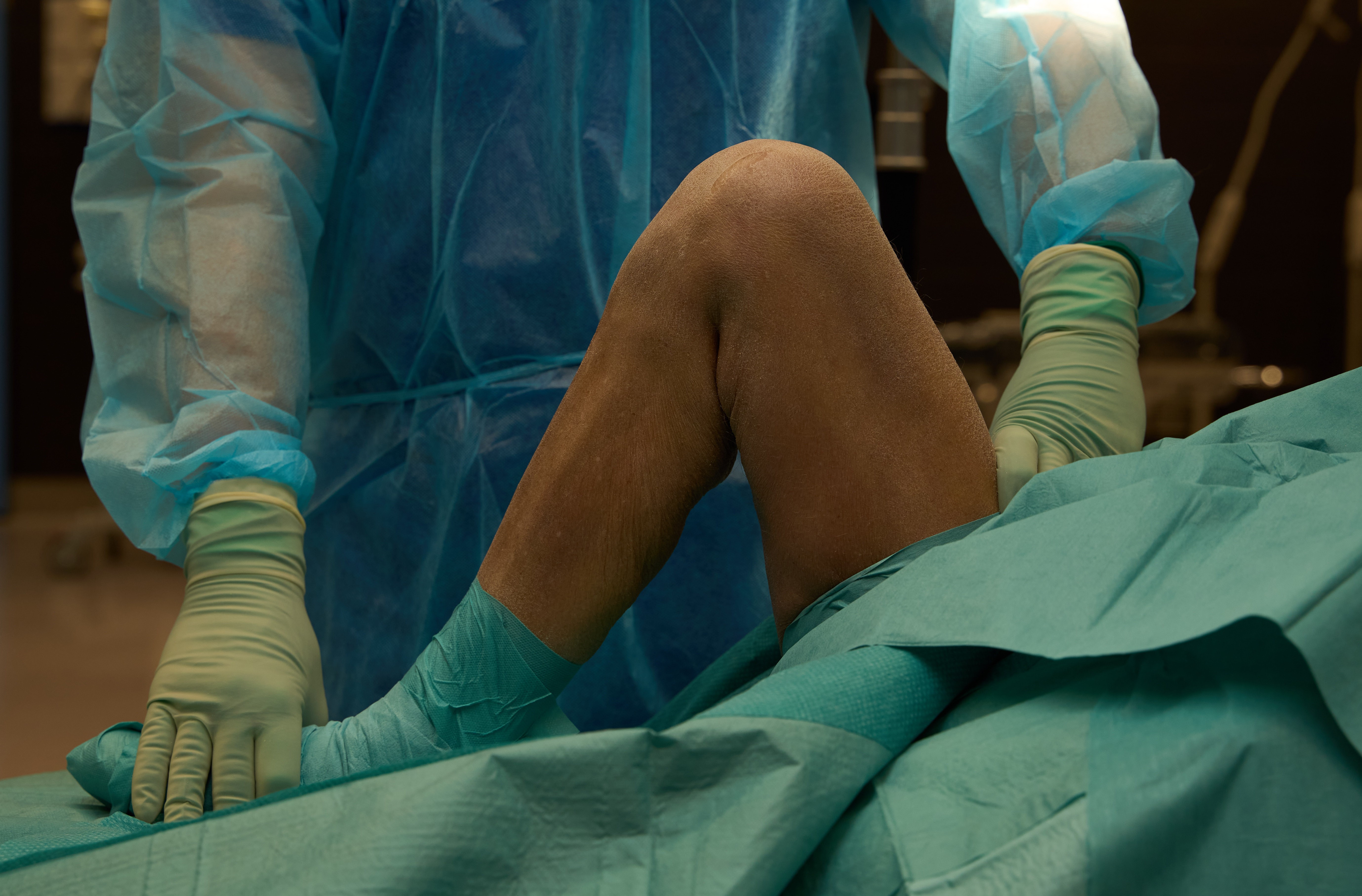
The patient is supine, with the operative knee hyperflexed. Ensure the position allows for full extension when required.
Adjust the lateral support so that the limb maintains vertical positioning and does not rotate. Set the distal leg support to hold the knee at approximately 120 degrees of flexion for optimal exposure.
Use of a tourniquet is optional. If a tourniquet is used, position it as proximally as possible to prevent it from getting into the operating area.
Either general or spinal anesthesia can be used.
To evaluate the preoperative status of the knee, assess the joint’s range of motion and stability in extension and at 30 degrees flexion. Deformities that cannot be manually corrected may indicate a technically more challenging operation. In case of ligament insufficiency, be prepared with more stabilizing components.
Log in or subscribe to access full content and see all the images.
Landmarks and Incision Site
The goal is to plan an incision that provides adequate exposure to the joint surfaces of the femur and tibia and ensures sufficient space for accurate prosthetic sizing and positioning. Using the medial parapatellar approach, access to the joint is achieved medial to the patella.
Landmarks for the skin incision are the patella, the tibial tubercle, and the medial edge of the patellar tendon.
Plan a straight incision slightly medial to the midline, over the patella and next to the patellar tendon, to facilitate medial access to the joint. A too-lateral incision might complicate access to the patella’s medial border.
To achieve proper exposure to the femur, the incision starts 5–10 cm above the patella, adjusted for subcutaneous thickness. Extend it downwards, ending it slightly medial to the tibial tubercle, approximately 5 cm below the joint line for sufficient tibial access.
Typically, these measurements ensure adequate exposure of the joint while minimizing unnecessary dissection of the surrounding tissues. A too-short incision can limit joint exposure, making the procedure more challenging.
Skin Incision and Advancing to the Fascial Layer
The aim is to expose the fascia layer while avoiding damage to underlying structures: vastus medialis muscle, quadriceps tendon, and the patellar tendon.
Incise the skin perpendicularly with a scalpel or diathermy.
The infrapatellar branch of the saphenous nerve is typically located in the area of the incision and is commonly affected during this approach. However, this usually results only in temporary sensory symptoms, such as numbness, on a small skin area.Utilize a retractor to provide countertraction and visibility. Proceed directly downwards through the subcutaneous tissue and prepatellar bursa, taking care not to drift too medially or laterally. Coagulate any bleeding vessels.
The scalpel can be angled to separate the tissue layers, but excessive release of the subcutaneous tissue from the fascia should be avoided to ensure proper wound healing.
The exposure is sufficient when the landmarks for the arthrotomy are identifiable: the quadriceps tendon and the vastus medialis are visible, and the medial border of the patella along with the patellar tendon can be distinctly palpated.
Exposure of the Joint
The goal is to incise the knee capsule so that the distal femur and its condyles, as well as the proximal tibia, are exposed enough to ensure precise and safe saw cuts. Additionally, the arthrotomy must be extensive enough to enable patella eversion.
Begin from the quadriceps tendon, leaving a small margin next to the vastus medialis for closure. Curve the incision around the patella and along the patellar tendon’s medial border, ensuring a margin for closure and to prevent tendon damage.
The arthrotomy can be performed with a single incision down to the joint space.
Continue the arthrotomy distally, medial to the patellar tendon, incising Hoffa’s fat pad and the anterior horn of the medial meniscus perpendicular to the tibial plateau.
Perform a subperiosteal release on the anteromedial aspect of the tibial medial condyle to expose the bone surface and aid the patella eversion by releasing the soft tissue attachments. Extend the release distally for 2–3 cm and medially to the level of the femoral medial condyle.
Then extend the knee to remove the tension from the patellar tendon and evert the patella. Check for possible adhesions and release if there are any.
Keep the patella everted using gauze and flex the knee carefully to achieve full patellar dislocation. Be careful during flexion as excessive force could potentially lead to tendon avulsion from the tibial tubercle, particularly in cases of patella baja, where the patella is situated lower than usual.
Partially removing Hoffa’s fat pad enhances visibility. Complete removal is not recommended as it may affect the blood supply to the patellar tendon and cause scarring or shortening. The resection should be done in the direction of the patellar tendon fibers to minimize the risk of tendon damage, and the tendon should be palpated to verify its location.
Often, when the fat pad is resected, the anterior horn of the lateral meniscus is split.The joint is now adequately exposed, and the degree of osteoarthritis medially, laterally, and in the patellofemoral joint can be assessed.
The size of osteophytes is also assessed around the joint. If there are a large number of osteophytes in the PCL insertion site, they should be removed to help determine the accurate entry point for the intramedullary guide.
Lastly, expose the anterior cortex of the femur. This step allows for a later estimation of the femoral component size, ensuring there is no tissue interfering with the bone measurement.
Extend the knee and perform a Y-incision in the synovial membrane. If needed, due to inflammation, perform a partial or extensive synovial membrane resection.
Determining the Angle of the Distal Femoral Cut
In a mechanically aligned arthroplasty, the goal is to perform a distal femoral cut perpendicular to the femur’s mechanical axis, not its anatomical one. However, the mechanical axis is not directly observable during surgery. Instead, we utilize the femur’s anatomical axis as a reference, using the intramedullary guide. The resection angle is determined by the difference in anatomical and mechanical axes calculated from preoperative imaging; in this case, 5 degrees.
In addition to the angle, we also determine the thickness of the distal femoral resection using the cutting block.
To utilize the anatomical axis of the femur, identify the entry point to the intramedullary canal.
This is located 10 mm anterior and 5 mm medial to the femoral PCL insertion site, as this position aligns with the anatomical axis of the femur.Mark the entry point with a sharp instrument.
Align the drill with the longitudinal, anatomical axis of the femur and drill into the intramedullary canal.
Evaluate the canal with a rod to ensure it is in the intramedullary canal and aligned with the longitudinal axis of the femur.
Check that the preoperatively measured angle between the anatomical and the mechanical axes matches the angle set in the intramedullary alignment guide.
Introduce the intramedullary rod into the canal and ensure that the alignment guide is fully in contact with the femur. Improper contact can cause an imprecise resection thickness on the distal femoral cut.
Attach the cutting block to the intramedullary guide and align it flush to the most prominent condyle. In varus knees this is usually the medial condyle.
Secure the cutting block in place using three pins. Start by drilling two pins anteriorly through the 0-holes on the block. These holes guide the standard distal femoral resection thickness, which is typically predefined by the prosthesis design provided by the manufacturer. The cutting block also has additional holes +/- 2 mm, which allow for an adjustment of the resection thickness, if necessary, based on intraoperative findings.
A third pin should be inserted from the lateral side to ensure the block is firmly held in place.
Remove the intramedullary guide and fully insert the third pin.Use the angel wing to verify the set thickness of the resection. It should remove cartilage from both condyles without being so deep as to risk damaging surrounding structures.
Distal Femoral Cut
The aim of the distal femoral cut is to safely perform the planned resection and confirm that the desired angle, which should be perpendicular to the mechanical axis, has been achieved.
Protect the medial and lateral structures with retractors during the saw cut.
Advance the saw slowly with full power to cut through sclerotic bone and get an even surface.
Use the angel wing to confirm that the surface is even.
Remove the pins and the cutting block. Introduce the intramedullary guide back into the canal to ensure that the cut is in the desired angle, i.e. the guide is flush with the bone surface.
Determining the Rotation and Size of Anterior and Posterior Cuts
The goal is to have the anterior and posterior femoral cuts parallel to the tibial cut to ensure a stable flexion gap. Also, having the cuts parallel will ensure correct rotation of the femoral component to ensure proper patellar tracking. The anterior cut will also define the component size.
Identify the transepicondylar axis (TEA) by palpating the epicondyles. This is the primary reference point for setting the rotation of the femoral component.
Position the sizing guide flush against the resected surface of the distal femur. Align the posterior blades with the posterior condyles. Remove any osteophytes that interfere with instrument positioning.
Align the rotation of the guide along the TEA, which is usually 3 to 4 degrees external rotation in relation to the posterior condylar axis (PCA).
If the patient has anatomical variation of condylar size, typically lateral condylar hypoplasia, you need to adjust the angle accordingly.To measure the femoral component size and the size of the 4-in-1 cutting block, set the tip of the sizing stylus on the anterior cortex of the femur. Use the lateral side of the anterior cortex, since it is more prominent. Using the medial side might lead to cutting under the cortex on the lateral side.
Read the femoral size off from the guide. In this case, the size is 9. If the guide indicates a size that falls between two options, it is advisable to select the larger size, as it will lead to initially thinner anterior cut. It is easier to further resect bone if needed than to deal with an excess removal situation.
Mark the position of the sizing guide with drill holes, with rotation set with TEA. Then remove the sizing guide and pins.
Verify the correct rotation with TEA and AP axis, Whiteside’s line: a line from the deepest part of the trochlear groove anteriorly to the center of the intercondylar notch posteriorly. Ensure that the drill holes are on the transepicondylar axis and that the AP line is perpendicular to that.
After you are satisfied with the rotation, insert the cutting block into the drill holes. Tap the cutting block flush with the distal femoral surface.
Secure the cutting block in place using pins or screws.
Assess the anterior and posterior cuts using the angel wing. Avoid notching, i.e. cutting under the anterior femoral cortex.
Going up a size in the cutting block will make the anterior cut thinner, but it will not change the posterior cut thickness. Too thin anterior resection can lead to overstuffing. If you are uncertain about the correct size, when the guide indicates between sizes, opt for the larger guide initially to prevent notching, since a larger guide will cut a smaller piece.
Anterior, Posterior, and Chamfer Cuts
The goal is to perform the 4-in-1 cuts safely in planned rotation and thickness.
During the anterior cut, the anterior tissues are protected with a retractor. Advance the saw slowly and with full power from medial to lateral direction so that the depth of the saw’s passage can still be assessed during the cut.
Posterior cut: Protect both medial structures (MCL) and lateral structures (LCL and popliteal tendon). Advance the saw slowly and with full power. You will feel the resistance decrease as you proceed to the correct depth. Avoid advancing the saw blade too posterior to keep the popliteal tendon, posterior capsule, popliteal artery, and posterior nerves unharmed.
Posterior chamfer cut: Protect the medial and lateral structures as in the posterior cut previously. Start centrally and continue laterally with both chamfer cuts to avoid uncontrolled “fracture” of the epicondyle. Do the cuts in a controlled manner to avoid cutting into the tibial plateau.
Anterior chamfer cut: Protect the skin, the quadriceps tendon, and muscle tissues. Advance the saw slowly and with full power.
After the four cuts are completed, remove the cutting block. Remove the loose bone resects and any remaining osteophytes on the femur, especially the medial and lateral posterior corners and the femoral sulcus.
Exposure for the Tibial Cut
The goal is to subluxate the tibia anteriorly for better exposure. Additionally, the lateral and medial meniscus and the ACL are resected to enhance visibility and to ensure there will not be any impingement with the components.
Flex the knee to near-full flexion to properly visualize the tibial surface.
Resect the posterior horn of the lateral meniscus if it is still attached to the tibia. Both lateral and medial menisci are later fully removed to make sure there will be no impingement with the components. Also, resect the ACL from its tibial insertion to enable the subluxation of the tibia.
Position a concave retractor against the posterior surface of the tibia, sliding it until you encounter the posterior edge. It is crucial to ensure the retractor is held against the bone surface. Failure to do so could potentially result in damage to the neurovascular structures located behind the tibia, such as the popliteal artery.
Push the tibia anteriorly with the retractor and release the soft tissue behind the intercondylar eminence to allow the tibia to move a bit more forward for better visualization. Stay right next to the bone with your scalpel.
Readjust the retractor after the release of the tissue while simultaneously flexing the knee fully to move the tibia more anteriorly.
Expose the lateral part of the tibia by sliding a retractor carefully on the bone surface. Make sure to assess the tension on the patellar tendon insertion so that it does not tear from the tibia.
Resect the lateral meniscus under direct visualization following the edge of the meniscus to avoid risking damage to the popliteal tendon. If the lateral meniscus is not entirely visible, resect only the visible parts and complete the resection later.
Then resect the visible parts of the medial meniscus. To protect the MCL, stay right next to the edge of the meniscus. A small counter-pull makes the resection easier.
If necessary, use a rongeur to even out the intercondylar eminence for the instrumentation.
Determining the Angle, Slope, and Thickness of the Tibial Cut
The goal is to cut the tibia perpendicular to the mechanical axis using an extramedullary guide to ensure even flexion and extension gaps to enable proper functioning of the knee. In the tibia, the mechanical axis is parallel to the anatomical axis.
The angle and thickness of the tibial resection affects both extension and flexion gaps.
When we cut perpendicular to the mechanical axis, we take more of the lateral side in the tibia. In flexion, that is compensated by setting the posterior femoral cut rotation to TEA.
In flexion, the femur is mostly in contact with the posterior part of the tibia and in extension the anterior part of the tibia. The tibia has a natural posterior slope of 5–7 degrees, which varies, and some implants recreate it and some require the tibia to be cut in a slope.
Position the extramedullary guide along the axis of the tibia. The distal clamp is placed proximal to the malleoli level, and the rotation is set in the middle of the ankle joint, 4–5 mm medial to the point between lateral and medial malleoli.
Proximally, the rotation is aligned with the medial third of the tibial tubercle.Next, to adjust the thickness of the resection, the pointer of the guide is used. Here, a 10 mm resection referencing the lateral side is used. This method varies between manufacturers. Place the pointer against the most prominent part of the tibial surface on the lateral side.
Secure the proximal part of the extramedullary guide in place so that it allows slight adjustments vertically. Ensure that the pointer is still against the most prominent part of the lateral surface.
Adjust tibial slope with the guide. The further the distal part is moved, the greater the angle of the posterior slope gets.
Re-check that the angles, rotation, and the resection thickness are how they should be and pin the saw guide in place using 2 pins. Use the 0-holes to allow 2–4 mm adjustments vertically, if necessary.
Use the angel wing to assess the slope and thickness of the tibial resection.
Add a third pin diagonally to secure the guide in place.
Tibial Cut
Retractors medially, laterally, and posteriorly protect the posterior neurovascular structures, MCL, patellar tendon, LCL, and PCL. Do not use excessive force on retractors to avoid causing damage to the soft tissues.
Advance the saw slowly and with full power from medial to posterior side and then lateral to posterior side. Visualize the saw blade at all times.
Disassemble the guide but leave the guide pins for potential additional cuts.
While removing the resected bone, carefully detach all the soft tissue attached to it under direct visualization.
Estimate the tibial component size using the resected piece of the tibia.
Preparations for Component Trialing
The goal is to ensure that the joint surfaces are free of any obstructions such as osteophytes or remaining cartilage. This is important for accurate interpretation of component size and position, proper attachment of the components, and optimal knee flexion.
Slightly release the medial structures along the tibia to visualize any potential osteophytes. Keep the scalpel on the bone surface.
Remove all remaining osteophytes from the medial side of the tibia with a rongeur. All osteophytes should be removed because any remaining ones could result in an overestimation of the tibial surface, potentially leading to an oversized or malpositioned tibial component.
Resect the remaining part of the medial meniscus. Use a retractor to add tension to the tissues for easier resection. Cauterize any bleeding vessels, such as the medial inferior genicular artery, while removing the meniscus since the vessels tend to pull back posteriorly after the removal.
Resect the remaining part of the lateral meniscus. Avoid incising the popliteal tendon. The lateral inferior genicular artery is usually found in this area, which should be cauterized.
Place the joint spreader against the tibia and the medial posterior femoral condyle. This creates space on the lateral side to enable removing the posterior cartilage.
Chisel the posterior cartilage to make room for the posterior part of the femoral component.
Verify with a finger that the posterior condyle is cleared of cartilage fragments and osteophytes.
Then remove the posterior femoral cartilage from the medial side, doing the previous 3 steps on the opposite side. Typically, some osteophytes can be found in the lateral side of the medial condyle, which can be removed with the chisel. Again, verify that the posterior condyle is cleared of cartilage and osteophytes with your finger.
Leave the joint spreader in place and remove the ACL remnant with a scalpel or diathermy so it will not interfere with the prosthesis positioning. Be cautious not to damage the PCL.
The joint is now ready for trialing with the osteophytes cleared and posterior space cleaned out.
Initial Assessment of the Balance
The goal is to examine if there is any need for additional cuts or soft tissue releases so that the knee is stable. The knee should have unrestricted range of motion, symmetrical laxity, and the tibial and femoral cuts should be parallel.
Assess the medial and lateral laxity at 90, 60, and 30 degrees flexion and fully extended. There should be symmetric laxity on both sides. In addition to tactile feedback using the fingers, there are also implant-specific instruments, not seen here, to assess the balance.
Assess the axis of the knee by pushing the tibial and femoral bone surfaces against each other with the knee extended.
If there is any asymmetry in these stability tests, ensure that the saw cuts are as desired. Make the adjustments with additional cuts if necessary.
Inserting the Trial Components
The goal is to accurately position and verify the sizes of the trial components, ensuring a reliable trialing process. The correct size trial components in correct position will then be used to guide the placement of the final components.
Place the tibial trial component on the tibial surface. The trial should match the edges of the tibia. If the tibial component is undersized, it might sink into the tibia.
Align the trial with the medial third of the tibial tubercle, external rotation, to ensure proper patellar tracking. Rotational malalignment of the tibial component can cause component incongruity, patella maltracking, and altered leg alignment, known as in/out toeing.
Improper positioning or oversizing of the tibial component can result in complications such as persistent pain, impingement, or irritation. These issues are challenging to manage and might need a re-operation.After the trial is positioned and aligned correctly, it can be pinned down.
Confirm that the rotation of the trial is still aligned with the medial third of the tibial tuberosity. Use diathermy to mark the spot of the tibial tuberosity in case the component happens to turn in the soft bone during femoral trialing.
Place a plastic spacer on top of the tibial base plate.
Place the femoral trial. Make sure that it aligns mediolaterally with the femur. Using a mallet, impact it securely onto the bone surface.
Trialing
The goal of trialing is to find the correct size of the tibial insert and to check if there is any instability in any position.
Test for range of motion. The goal is to have full extension and flexion to 120 degrees or more. Notice that with morbidly obese patients, posterior fat tissue decreases flexion.
Be cautious when extending the knee for the first time with trial components. Forceful extension under tension could lead to a ligament tear. Switch to a smaller plastic spacer if needed.Assess the mediolateral stability in 90 degree flexion by internally and externally rotating the knee. The goal is that the knee feels stable and both medial and lateral sides feel symmetrical. In the images below, the gaps are 2–3 mm larger than desired on both sides.
In full extension, assess the axis of the limb and that the components are aligned, with congruency.
Check the mediolateral stability of the extended knee. Again, the knee must feel stable, and both medial and lateral should seem symmetrical.In semiflexion, the tissue laxity on both sides can be tested, for example, using a Semb rasp.
If necessary, switch to larger plastic spacers until the knee is in balance in both extension and flexion.
Turn the patella to its anatomical place and check the patellar tracking. The patella should glide in its groove without any issues.
Test also that anteroposterior balance feels stable.
Balancing Techniques (If Necessary)
The goal is to fix the imbalance or asymmetry in the knee with additional saw cuts or soft tissue releases if needed.
It is important to check the saw cuts before doing any soft tissue releases/balancing. If the stability is not restored with additional cuts, then soft tissue releasing might be needed. Sometimes asymmetry occurs despite perfect bone cuts due to soft tissue imbalance.
Signs of incorrect saw cuts:
Distal femoral cut — minor flexion preferred over minor extension
Excessive valgus cut: increased lateral gap in extension and medial tightness
Excessive varus cut: increased medial gap in extension and lateral tightness
4-in-1 femoral cuts
Excessive external rotation: increased medial gap in flexion, component incongruency
Excessive internal rotation: increased lateral gap in flexion, component incongruency
Tibial cut
Excessive valgus cut: increased lateral gap through the flexion arc and medial tightness
Excessive varus cut: increased medial gap through the flexion arc and lateral tightness
Tibial malrotation: incorrect patella tracking, component incongruency, and incorrect sagittal balance
Soft tissue releases, if necessary:
The LCL, anterolateral ligament (ALL), provides lateral stability through the flexion arc.
Release of the LCL decreases excessive tightness in extension and flexion laterally.
Methods: dissection, 1/0 effect, sliding osteotomy.
The MCL provides medial stability through the flexion arc. Releasing the anterior or posterior part of the MCL affects the knee differently.
Release on anterior part of the MCL decreases excessive tightness in flexion medially.
Release on posterior part of the MCL decreases excessive tightness in extension medially.
Methods: subperiosteal gradual release, pie crust.
The PCL provides anteroposterior stability. It facilitates roll-back, posterior movement of the femur on the tibia during knee flexion, and prevents posterior tibial sliding in relation to the femur during flexion (sag sign). The PCL is also a secondary medial stabilizer in flexion.
Fully removing the PCL increases laxity in flexion, the flexion gap. Partial release, usually anterolateral band, decreases excessive roll-back or tightness in flexion. Methods: pie crust, releasing AL band.
The popliteal tendon provides lateral stability in flexion. Lateral overhang of the tibial component can lead to impingement during flexion.
Release of the popliteus decreases excessive tightness laterally in flexion.
Methods: dissection, 1/0 effect.
The posterior capsule inhibits overextension and stabilizes the knee in extension. Overextension is difficult to control.
Subperiosteal release from posterior femur increases extension. Method: subperiosteal release.
The iliotibial tract provides lateral stability in extension/flexion.
Release decreases lateral tightness. Method: pie crust.
Preparing for the Final Components
The aim is to prepare the femur so that the femoral component is correctly placed mediolaterally, and the tibia so that the tibial component is placed in the correct rotational alignment to ensure proper function of the knee.
Check that the femoral trial is still aligned mediolaterally with the femur and drill holes for the femoral component. Make sure that the drill goes all the way into the bone on both sides. The depth of the hole depends on the size of the component.
Remove the femoral trial component and the plastic spacer. Bring the tibia anteriorly for better visibility.
Use the previously made orientation mark to ensure the trial is still aligned with the medial third of the tibial tubercle. Secure the trial in place with a pin.
Attach a drill guide to the tibial trial and use a reamer to drill a hole for the tibial component’s stem. Make sure that the drill goes all the way into the bone.
Use a mallet to drive the keel punch into the tibia. The keel ensures the correct rotational alignment of the tibial component. Make sure to hit it all the way down so that the tibial component fits correctly.
If the bone is very sclerotic, an additional saw cut can be made to the sclerotic side of the keel to avoid fracturing the tibia.Remove the tibial trial.
Cementing and Implanting
The goal is to firmly fixate the components to the washed bone surfaces to ensure that the components do not prematurely loosen or dislocate.
Before cementing, the knee should be washed to remove all fat and blood from the bone surfaces. This will ensure that the cement attaches to the spongy bone properly. Fat cells beneath the cement substantially diminish its tensile strength.
After the wash, dry the bone surfaces thoroughly. The surfaces can be covered with gauze. Introduce a bone plug into the femoral medullary canal. This prevents the cement from dripping into the medullary canal.
Before starting the actual cementing, make sure that all the necessary instruments are available and the components are ready at hand. The cement hardens in about 11–12 minutes, and in approximately 6 minutes after mixing the cement, the components should already be in place.
Careful planning of the cementing process and its stages with all surgical staff members ensures that the components will be inserted within the time limit.Re-check that there is no tissue getting in between the bone surface and the components. Remove any tissue, if necessary.
Start the cementing by covering the surfaces of both components.
Then cover the surface of the tibia, while the tibia is subluxated anteriorly. Make sure to also cover the hole for the tibial component’s stem and keel.
Carefully put the tibial component in place while making sure that the rotation of the component is in the wanted position. Tap the component in with a mallet. Check that it sits snug against the bone surface.
Remove excess cement around the component, especially around the posterolateral corner, where it is easily left behind. Also, remember to scrape away any excess cement after all upcoming steps as well.
Install a definitive or temporary plastic spacer according to the trialing and remove excess cement.
Reposition the tibia and cover the surface of the femur with cement.
Put the femoral component in its place. Make sure that it sits snug against the bone surface.
Carefully remove the excess cement around the component.
After the components are in place, carefully bring the knee in full extension. Check the congruency of the joint. Also, test that the knee is stable in extension and 90, 60, and 30 degree flexion, and that the patellar tracking is immaculate. Remove any excess cement.
Patellar resurfacing if necessary.
Closure
Aim for a watertight closure of the arthrotomy. With the knee extended, start the capsule closure with two so-called reinforcement sutures to the upper medial corner to help with apposition of the edges. Mattress sutures can be used, for example.
Use continuous sutures for the capsule starting from the distal part. The first suture should be inverted to avoid the formation of a suture fistula, since the area has minimal subcutaneous tissue.
As the sutures bypass the proximal patellar edge, the knee is brought to flexion and suturing is continued proximally. The position change will help with the assessment of watertightness of the closure.Check the hold of the sutures by flexing and extending the knee.
The subcutaneous layer is closed using 3-0 absorbable suture. Either interrupted or continuous sutures can be used. Intracutaneous sutures should be avoided because of the risk of cut-out.
After passing the proximal part of the patella, move the knee to semiflexion, and continue proximally to get the adequate tension on the wound so that it will not tear during flexion.
The skin is closed in flexion position using single or continuous sutures or with skin staples. Make sure that the skin edges align.
To access the full video and additional content on this subject, log in or subscribe
Piftalls and Complications
Pitfalls
Insufficient Understanding of Knee Biomechanics and Procedure Goal
Most challenges are related to implant positioning, which are again related to rightly placed and angled saw cuts. Understanding the basic principles of mechanical alignment and how the anatomical axis of the femur and tibia are related to the mechanical axis are crucial for avoiding complications.
Additionally, the rotation of the implant in relation to landmarks, such as the transepicondylar line, is critical to understand to avoid malrotation of the components.
It is critical to achieve a properly balanced knee, which is mainly achieved through well-planned and executed saw cuts. It is important to check the saw cuts before doing any soft tissue releases/balancing. If the stability is not restored with additional cuts, then soft tissue releasing might be needed. Sometimes asymmetry occurs despite perfect bone cuts due to soft tissue imbalance.
Incorrect Site of Incision
If the incision is made too laterally, extensive dissection of subcutaneous tissue attached to the patellar tendon is needed to reach the medial border of the patella.
If the incision is made too medially, extensive dissection of subcutaneous tissue attached to the vastus medialis is needed to reach the medial border of the patella.
Make sure to place the skin incision over the patella, slightly medially from the midline, to get adequate visibility of the medial border of the patella for the arthrotomy.
Careless Tissue Handling
Extensive dissection of the subcutaneous tissue can produce problems with circulation and thus wound healing. Make sure to position the incision correctly to reduce the amount of subcutaneous dissection.
Inadequate placement or lack of retractors can lead to soft tissue damage during the saw cuts. Ensure that the retractors are correctly placed to protect all surrounding structures during saw cuts. Otherwise, neurovascular structures such as the popliteal artery and common peroneal nerve, or ligaments such as MCL and LCL, may be damaged.
If using the tourniquet, the recommendation is to use 100 mmHg above systolic pressure for max 90–120 minutes to avoid possible nerve damage.
Incorrect Sizing and Alignment
Incorrectly sizing or aligning the components can lead to instability, limited range of motion, early wear, patellar maltracking and luxation, and potential failure of the prosthesis. Preoperative planning and precise surgical techniques are crucial to avoid these issues.
Improper Cementing Technique
Poor cementing can compromise the fixation of the prosthesis, leading to early loosening.
The cement hardens in about 11–12 minutes, and in approximately 6 minutes after mixing the cement, the components should already be in place. Careful planning of the cementing process and its stages with all surgical staff members ensures that the components will be inserted correctly within the time limit.
Complications
The complications of a TKA are mostly related to challenges in component positioning, which are mainly induced by improper saw cuts. There are also severe neurovascular complications that can occur during a TKA, which you can read through below.
Complications Related to Challenges in Positioning of Components
Malalignment: Components not aligned with mechanical axis of the limb
When aiming for mechanical alignment, the prosthesis should align with the mechanical axis of the lower limb. Misalignment can lead to an imbalance of forces on the joint, causing deformity, increased wear, instability, pain and discomfort, and potential premature failure of the prosthesis.
Alignment is determined by preoperative templating, accurate bone cuts, and careful placement of the prosthesis components, guided by alignment guides or navigation systems.
Malrotation: Components not in a biomechanically feasible rotation
The femoral and tibial components of the knee prosthesis must be aligned accurately not just in the frontal and sagittal planes, but also rotationally. In the femur, the rotation should be aligned according to the transepicondylar axis. In the tibia, the rotation of the component is usually referred to the tibial tuberosity. Incorrect rotational alignment can lead to patellar maltracking, component incongruency, or instability.
Component Size Related Issues
Inadequate size of tibial or femoral component
A prosthesis that is too large can cause overstuffing of the joint, leading to pain, reduced range of motion, and potentially even damage to surrounding tissues. On the other hand, a prosthesis that is too small may not provide sufficient stability to the joint, leading to instability and increased wear, potentially resulting in premature failure of the implant.
Wrong size tibial plastic
Mostly, the issue is related to choosing a too-thin tibial plastic inlay, which can result in instability of the knee.
Neurovascular Injuries
Popliteal artery injury
Popliteal artery injury is a rare but serious complication that could lead to amputation. During bone resection, care should be taken to avoid deep or misaligned cuts that could inadvertently harm the popliteal artery. Make sure to always visualize the saw blade and not use excessive force with retractors. Also, when placing the retractors, make sure to slide them gently along the surface of the tibia until you feel the posterior edge.
Common peroneal nerve injury
The common peroneal nerve can be damaged during the procedure either with saw cuts or with a posterolateral retractor placement. Make sure to always visualize the saw blade and not use excessive force with retractors.
Collateral Ligament/Tendon Injury
Medial collateral ligament (MCL) and lateral collateral ligament (LCL) injuries
The MCL and LCL can both be damaged during the surgery. This should be kept in mind during all saw cuts that are close to the collaterals. Thus, the collateral ligaments should be adequately protected with retractors during the saw cuts. Additionally, the pressure retractors themselves can damage the collateral ligaments, so excessive force should be avoided when protecting ligaments/creating sufficient visibility.
The MCL should also be kept in mind when removing the medial meniscus, as it could be damaged in the process if done carelessly.
Popliteal tendon injury
When removing the lateral meniscus, the popliteal tendon can be injured. Make sure to resect the lateral meniscus with care in direct visualization.
Patellar Tendon Injury
The patellar tendon can be damaged when exposing the joint. Make sure to stay medial to the patellar tendon in the distal part of the arthrotomy when making the incision.
Also, if removing part of Hoffa’s fat for visibility, patellar tendon injury should be avoided.
The tibial insertion of the patellar tendon can avulse during flexion and while protecting the lateral structures with a retractor. Make sure to assess the tension on the patellar tendon while flexing the knee and pulling the lateral structures aside.
Failure of the Components
Inadequate cementing or component placement or incorrectly sized components can lead to premature wear, loosening, or dislocation of the implant component. The cement hardens in about 11–12 minutes, and in approximately 6 minutes after mixing the cement, the components should already be in place. Remember to assess the angle of each cut. Check the range of motion of the knee during the procedure.
Periprosthetic Fracture
A periprosthetic fracture can occur during saw cuts, component fitting, or during final placement of the components. Tibial fractures can occur on sclerotic bone, e.g. while making the hole for the keel of the component. Cutting the sclerotic bone before punching in the keel guide will reduce the risk of fracture.
A nondisplaced fracture can go unnoticed during the procedure and might not be seen in postoperative imaging. If a fracture is detected, it should be treated. In case of a fracture, weightbearing should be reduced for 6–8 weeks to ensure proper healing.
Postoperative Infection
Careless soft tissue handling and patient-related risk factors predispose wound healing problems and lead sometimes to severe infections.
Follow your local protocols for periprosthetic joint infection diagnostics and treatment.
Neuroma Formation
Damage to the infrapatellar branch of the saphenous nerve is common, generally unavoidable, with midline incision since the branches run across the incision site. Usually, this leads to transient sensory symptoms, e.g. numbness, but can in some cases lead to painful neuromas. Postoperative pain should be assessed accordingly.
Aftercare
General Guidelines
Follow your local protocols. Immediate ambulation with full weight bearing and physiotherapy is recommended postoperatively.
Thromboprophylaxis should be considered after evaluating individual risk factors.
FAQ
What is the goal of total knee arthroplasty with mechanical alignment?
The goal is to replace the distal femur and proximal tibia with a prosthesis to restore knee function and align the prosthesis with the mechanical axis of the limb.
Which diagnosis is listed for this procedure?
The diagnosis listed is osteoarthritis of knee, ICD-10: M17.
What are the landmarks for the skin incision?
The landmarks for the skin incision are the patella, the tibial tubercle, and the medial edge of the patellar tendon.
What is the goal during trialing?
The goal of trialing is to find the correct size of the tibial insert and to check if there is any instability in any position.
To access the full video and additional content on this subject, log in or subscribe