How to Perform a Anterior Cruciate Ligament (ACL) Reconstruction
Source
Surgeon:
Lasse Rämö (orthopedic surgeon)
To access the full video and additional content on this subject, log in or subscribe
Summary
Focus: Anterior cruciate ligament reconstruction replaces the torn ACL with a graft to restore knee stability and function.
Key elements: The procedure includes arthroscopic evaluation, femoral and tibial tunnel placement, hamstring graft harvesting and preparation, graft passage, graft fixation, final stability assessment, closure, and postoperative rehabilitation.
Indications and Clinical Context
General
Medical expert: Lasse Rämö, orthopedic surgeon
Name of procedure: Anterior cruciate ligament (ACL) reconstruction, anterior cruciate ligament repair, ACL replacement
Goal of Operation
To restore the stability and functionality of the knee and to prevent further damage to the knee joint by replacing the torn ACL with a graft.
Problem
Instability and pain resulting from a fully or partially torn ACL.
Diagnosis
Rupture of the anterior cruciate ligament of the knee (ICD-10: S83.5)
Short Pathophysiological Description
The ACL connects the femur to the tibia and plays a crucial role in stabilizing the knee and preventing the tibia from sliding out in front of the femur. The ACL can be damaged by direct trauma, a sudden change in direction, or a sudden stop while running. An ACL tear may not occur in isolation and can also involve damage to the surrounding tissues, primarily other ligaments and the menisci or bone contusions. When the ACL is damaged or torn, it can lead to knee instability and pain, impact a patient's quality of life, limit their ability to participate in certain activities or sports, and potentially lead to long-term disability.
Non-surgical treatment methods such as physical therapy and bracing may be used for minor ACL tears or for patients who are less active. However, surgery is often required for complete ACL tears, especially for athletes or active individuals who wish to return to their previous activity levels.
In ACL reconstruction surgery, the torn ACL is replaced with a graft, which can be taken from the patient's own body (autograft) or from a donor (allograft). Autografts can be taken from different parts of the patient's body, commonly from the hamstring tendons, the patellar tendon, or quadriceps tendon. Typically, the ACL tears from its femoral insertion and might adhere to the PCL. In such instances, it is possible to preserve the residual tissue (remnant-sparing). Consequently, the patient is left with a combination of a graft and a remnant-sparing ACL.
The reconstruction aims to restore the stability of the knee and allow the patient to gradually return to their previous activities following a period of physical rehabilitation.
Key Anatomical Structures
Femur
Medial and lateral femoral condyle
Intercondylar space
Lateral intercondylar wall
Lateral intercondylar ridge (resident's ridge)
Bifurcate ridge
Tibia
Patella
Patellar tendon
Medial and lateral menisci
Anterior cruciate ligament (ACL)
Femoral footprint
Tibial footprint
Posterior cruciate ligament (PCL)
Semitendinosus muscle
Gracilis muscle
Saphenous nerve
Step-by-Step Technique
Patient Positioning, Anesthesia, and Preparation
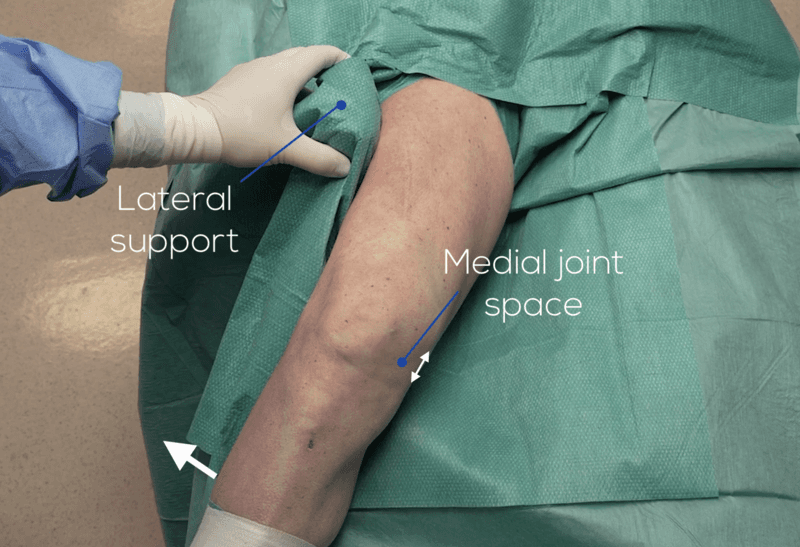
The patient is in a supine position with the knee flexed to 90 degrees. This provides optimal access to the knee joint for arthroscopy, as this opens the lateral and medial articular gaps.
The distal leg support should be placed to maintain the knee at 90 degrees of flexion. Full extension and flexion should still be achievable.
The lateral thigh support enables the application of valgus stress, which opens the medial joint space and improves visualization during diagnostic arthroscopy.
Make sure to have enough room to move the leg during diagnostic arthroscopy, for example, in a figure-of-four position when examining the lateral side.
Before draping, but post-anesthesia, knee stability should be tested and compared to the opposite knee. These initial tests can serve as a reference for graft stability later.
Approximately 15 cm of operating space should be left both proximally and distally when draping. This ensures sufficient room for femoral tunnel drilling and graft harvesting at the pes anserinus.
The use of a tourniquet is optional. If used, the tourniquet can be placed proximally on the thigh and deployed if bleeding obstructs the visual field during arthroscopy.
Either spinal or general anesthesia can be used.
Log in or subscribe to access full content and see all the images.
Landmarks and Portal Placement
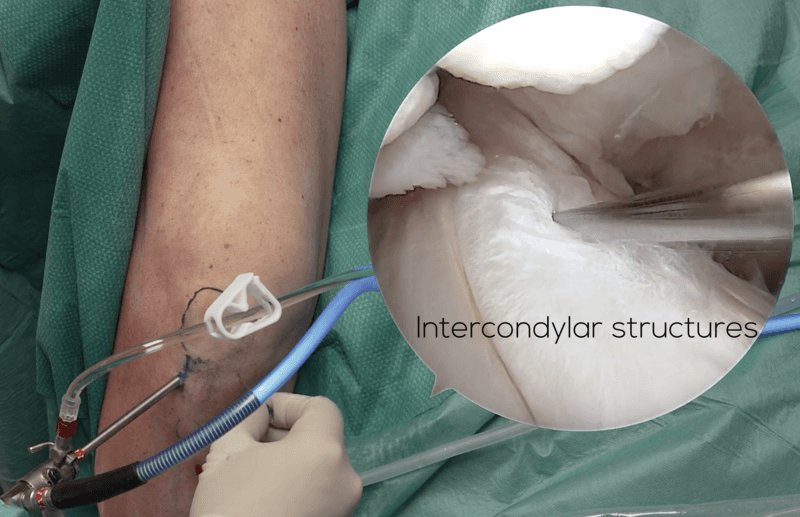
Correct placement of the portals significantly impacts the visualization of the surgical area and the maneuverability and reach of the instruments. The anterolateral (AL) portal is primarily used for visualization, providing a clear view of the intercondylar structures, including the ACL. The anteromedial (AM) portal is used for instrument passage, offering better access for femoral tunnel drilling, for example.
In addition to these standard portals, accessory portals are also sometimes created.
The landmarks for portal placement are the patella, the patellar tendon, and the tibial tuberosity.
The palpable soft spots on the lateral and medial side of the patellar tendon are used to verify the correct level of the portals without damaging the menisci or the articular surface.Plan the placement of the AL portal on the lateral soft spot close to the patellar tendon, either vertically or horizontally.
Avoid placing the portal too laterally, as it can limit visibility of the lateral part of the intercondylar space. Too distal placement risks injury to the anterior horn of the lateral meniscus.Use a scalpel to make a 1 cm incision through the skin into the knee joint. Keep the scalpel pointed upwards to avoid damaging the lateral meniscus.
Insert a blunt trocar into the knee joint through the incision. Make sure not to damage the lateral meniscus or the lateral femoral condyle while inserting the trocar.
Extend the knee and bring the trocar to the suprapatellar recess for arthroscope introduction.Remove the trocar and insert the arthroscope. Infuse saline into the knee joint to expand the capsule, improving visualization and creating more space.
Place the anteromedial (AM) portal in visual control using a long needle to mark the intended location through the medial soft spot close to the patellar tendon.
Avoid positioning the AM portal too medially to prevent damage to the anterolateral border of the medial femoral condyle (MFC) during femoral tunnel drilling. Also, avoid placing the AM portal too proximally to prevent obstruction of visualization of the posterior part of the medial meniscus by the medial femoral condyle.Assess the trajectory of the portal with the needle. The AM portal should provide a good trajectory to the posterior part of the lateral intercondylar wall for femoral tunnel drilling, and good access for diagnostic arthroscopy. Make sure that the needle can reach all the way to the posterior part of the medial meniscus.
Again, make a 1 cm incision, keeping the scalpel pointed upwards. Insert a blunt trocar to establish a path for the instruments.
Log in or subscribe to access full content and see all the images.
Diagnostic Arthroscopy
The goal is to systematically examine the joint: confirm the ACL tear, evaluate the extent of the injury, and identify any associated injuries such as meniscal tears or chondral lesions, which might need additional surgical interventions. Note that not all damage can be seen on MRI, and due to a potential considerable time gap between MRI and surgery, unseen secondary injuries may occur.
Examination order of structures varies among surgeons. Adjust the leg position as needed to facilitate access. If necessary, use a shaver carefully for the soft tissue fluff to enhance visibility.
Look for signs of secondary injuries: loose bodies, cartilage injuries, or meniscal injuries. Use a probe from the AM portal to assess the stability and intactness of the structures.Lateral gutter and suprapatellar recess.
Patellofemoral joint cartilage and patellar tracking, and medial gutter.
Medial compartment and the medial meniscus. Knee in valgus opens up the medial joint space. By turning the camera, the corpus area and anterior part of the medial meniscus can be visualized.
The posteromedial compartment is examined using the Gillquist maneuver, where the arthroscope is moved posteriorly, passing between the medial femoral condyle (MFC) and the PCL. This allows examination of the posterior structures of the knee, including the posterior horn of the medial meniscus.
ACL tears cause anterior tibial shift, stressing and often damaging the medial meniscus' posterior horn. Damage may not be visible in AP view, so intercondylar examination is done.The lateral compartment, including the lateral meniscus, cartilage, and popliteal tendon, is examined with the knee in figure-of-four position. If needed, the arthroscope can be switched to the AM portal, which can improve visualization of the anterior horn of the lateral meniscus.
The intercondylar space is examined with the knee at 90 degrees. ACL here intact.
Probe showing the femoral attachment site of intact ACL on the posterior part of lateral intercondylar wall, viewed from the AL portal.
ACL tibial insertion, shown with a probe, fuses with the anterior horn of the lateral meniscus.
Preparation for Femoral Tunnel Placement
The goal is to prepare the ACL femoral insertion site for drilling the femoral tunnel, ensuring proper visibility of anatomical landmarks and clearing the working space.
It is advisable to keep the knee in 90 degrees of flexion to properly visualize the intercondylar space, placing the entry point for the femoral tunnel in the right trajectory.
Usually, the ACL tears from the femoral insertion.
The remnant can adhere to the PCL and, in some cases, it can be preserved (remnant-sparing), since the remnant can provide stability. In these cases, the patient will end up with a graft and a remnant-sparing ACL.Debride the ACL remnant to an extent that you have sufficient visibility to the lateral intercondylar wall for the correct placement of the femoral tunnel. Make sure not to damage the posterior horn of the lateral meniscus or the PCL while debriding.
If the ACL remnant is left undebrided, it can cause a cyclops lesion. This is a bulging mass anterior to the new graft that can lead to anterior knee pain and restricted extension.
Leave a small stump of the ACL on the tibia to facilitate later tibial tunnel placement.Adjust the arthroscope so that you can visualize the lateral wall of the intercondylar space, specifically the posterior part. This is the area where the femoral tunnel will be placed.
Use electrocautery to clean up the area around the ACL femoral footprint to precisely position the femoral tunnel.
Ensure proper visualization and reach of the posterior part of the intercondylar space by accessing the posterolateral area.
With insufficient view, you may mistakenly identify the lateral intercondylar ridge, known as the resident's ridge, as the posterior border of the lateral intercondylar wall, leading to a misplaced, too anterior femoral tunnel.
Marking the Femoral Tunnel Location
The femoral tunnel is used to anchor the femoral end of the graft into the femur, aiming to replicate the functionality of the original ACL. Incorrect positioning of this tunnel can potentially result in graft failure. The specific placement of the tunnel depends on the surgical technique employed, the thickness of the graft, the patient's individual anatomy, the type of graft used, and the patient's activity level. Over time, research has led to changes in the preferred placement of the tunnel.
For landmarks, identify the posterior border of the lateral intercondylar wall. Also identify the resident's ridge, or lateral intercondylar ridge, and the bifurcate ridge if visible.
Here, the entry point for the femoral tunnel is positioned below the resident's ridge, but not so low as to risk damaging the cartilage. The goal is also to place it posterior to the bifurcate ridge, if visible, but not too posterior. Care is taken to ensure that 2–4 mm of the posterior wall remains intact.Using the anteromedial portal, make a preliminary mark to the center of the ACL footprint with a curved awl.
Examine the placement of the tunnel through the AM portal with the arthroscope. This gives a different viewing angle from the drilling view.
Ensure that the tunnel is correctly positioned in reference to the posterior border of the lateral intercondylar wall. Note that the tunnel diameter will be at least 8 mm, and 2–4 mm of posterior wall should be left intact. Placing the tunnel too posteriorly can cause laxity or posterior wall blowout, leading to loss of graft fixation or early graft failure.
A femoral tunnel placed too anteriorly, anterior to the bifurcate ridge, limits range of motion and can lead to graft failure.
The tunnel should not be placed too low either. It should not be placed too close to the chondral edge, potentially interfering with the articular surface.Note that the drill needs to reach the marked spot from the AM portal without damaging the surrounding structures, such as the MFC.
Graft Harvesting
The goal is to obtain a suitable graft from the patient's tendons (autograft) to recreate the function of the ACL. Here, a hamstring graft is demonstrated, i.e., the gracilis and semitendinosus muscles are harvested. Harvesting the tendinous parts of these muscles does not affect the function of the muscles. Also, usually the semitendinosus and gracilis tendons tend to regenerate over time.
Locate the pes anserinus on the proximal anteromedial side of the tibia by palpating. This is the insertion of the semitendinosus and gracilis tendons.
Make a 3–4 cm skin incision slightly above the tendons, along their trajectory. The same incision will be used later for drilling the tibial tunnel.
Dissect through the subcutaneous tissue to the fascia. Coagulate bleeding vessels.
The infrapatellar branches of the saphenous nerve or the great saphenous vein might run in the area. Try to avoid damaging these, but, if necessary, these can be cut to get better access to the surface of the fascia.Bluntly make space on top of the fascia. The tendons are palpable through the fascia.
Use retractors to gain better visibility and make a small incision on the fascia along the palpable tendons. Be careful not to damage the tendons.
Locate the first tendon, here gracilis, under the fascia and prepare it for harvesting by elevating it and freeing it from accessory tendinous bands, also known as vinculae, with a finger or scissors.
The length and number of the accessory bands vary between patients. It is important to identify and free these bands to prevent the tendon stripper from deviating into these and cutting the tendon prematurely, resulting in an inadequate graft.Place the tendon in the tendon stripper and harvest the graft by pushing the stripper along the tendon proximally.
Typically, the tendon detaches by itself without using the cutting function of the stripper. Leave the distal end of the tendon attached to the tibia.
Remove any visible muscle tissue from the tendons to ensure good fit of the graft. Leaving large muscle tissue lumps on the tendon can affect the graft's width, leaving it loose in the tunnels on the narrower parts of the graft.
Repeat the procedure on the other tendon, the semitendinosus. Pulling on the first tendon helps to locate the other tendon.
Place whipstitch sutures at the proximal ends of the two tendons. Advance forward on the other side by 3–4 cm and then return back on the opposite side.
Assess the hold of the whipstitch suture by pulling on the thread.Release the distal part of the tendons from the tibia. A small part of the periosteum can be left on the distal part of the tendons. Detaching the two tendons together at the tibial footprint reduces whipstitch suturing from four to three.
Graft Preparation
The graft is next prepared, folded, and measured in thickness and length to ensure the graft is the correct size and fit for the intended area.
Place a whipstitch suture in the distal end as well to facilitate graft preparation. Assess the hold of the whipstitch sutures by pulling on the thread.
Measure the folded tendon graft's thickness for drill size determination. Aim for at least 8 mm to prevent graft failure, folding the semitendinosus twice if necessary. Larger patients might need a thicker graft.
If the femoral side of the graft is thicker, use that measurement for both tunnels, as the graft passes through the tibial tunnel first. Usually, the femoral side is 0.5–1 mm narrower.Place the graft in the cortical fixation device.
This leaves a cortical fixation button on the femoral end, which is used to anchor the graft on the femur.Measure the length of the graft. The length should be at least 90 mm to properly restore the function of the ACL.
Mark the graft on the 20 mm line in the femoral end of the graft. This acts as a visual aid to ensure that enough of the graft gets placed into the femoral tunnel.Place the graft in a vancomycin 1 mg/ml solution for 10 minutes. This may reduce the risk of postoperative infection.
Drilling the Femoral Tunnel
The goal is to drill the femoral tunnel in the correct angle and depth.
The tunnels can be drilled outside-in or inside-out, i.e., drilled from the cortex to the knee joint or vice versa. Here, the femoral tunnel is drilled inside-out, and later, the tibial tunnel is drilled outside-in.
Start by locating the previously marked place of the femoral tunnel in the intercondylar notch. Assess the placement once more and adjust if necessary according to the obtained graft thickness.
Place a guide wire at the marked spot through the AM portal and hyperflex the knee to more than 120 degrees of flexion. Flexing the knee alters where the guide wire exits the lateral femoral cortex, providing greater depth for the tunnel. Ensure that the guide wire stays in the correct location.
To define the depth of the tunnel, drill the guide wire first to the lateral femoral cortex and read the measurement from the guide wire. Typically, this length, the thickness of the femoral bone, is between 35–45 mm. Enough intact bone needs to be left on the cortex after the tunnel has been created.
Continue to drill the guide wire through the skin. The guide wire pierces the skin, so make sure that the draping is not in the way.
Proceed to drill the femoral tunnel along the guide wire. The tunnel should be as wide as the thickness of the femoral end of the graft.
Be cautious when passing the drill along the guide wire inside the joint to avoid damaging the cartilage of the medial femoral condyle.Here, the tunnel is drilled to a depth of 25 mm. This ensures that enough of the femoral cortex remains intact while providing sufficient graft placement within the femur.
Place a pulling suture in the eyelet of the guide wire and pull the guide wire out from the lateral side, leaving the suture to hang outside on both sides of the femoral tunnel. This will be used later to pull the ACL graft in place.
Remove any excess bone debris from the joint with a shaver.
The prepared femoral tunnel is assessed through the AM portal and an intact posterior wall is confirmed.
Drilling the Tibial Tunnel
The goal is to position the tibial tunnel so that the ACL graft will replicate the function of the native ACL with the femoral tunnel. It should align properly with the femoral tunnel and allow for optimal placement and tensioning of the graft. It should ideally replicate the original attachment site of the ACL.
Identify the tibial ACL insertion. Debride the ACL remnant if it is not done already or left as a remnant-sparing graft. If the ACL remnant is left undebrided, it can lead to a cyclops lesion, i.e., a painful anterior knee mass associated with loss of extension.
Place the proximal end of the tibial drilling guide at the center of the tibial ACL insertion through the AM portal and the distal end on the tibial surface at the graft harvest site.
Using the graft harvesting incision site as the entry point, drill the guide wire from the tibial cortex into the knee joint. Stop the drill once the guide wire pierces the tibial joint surface.
Note that since the surgeon is holding the arthroscope in one hand and the drill guide in the other, the assistant is doing the actual drilling.Remove the drill guide and assess the guide wire placement at the tibial ACL insertion site. Ensure it is centrally placed at the ACL footprint to avoid impingement, if placed too anteriorly, or a vertical graft causing instability, if placed too posteriorly.
Extending the knee, assess that there is enough space for the graft to prevent the roof of the intercondylar space from impinging on it. Also, confirm sufficient bone between the tibial tunnel and anterior tibial cortex to prevent breakage.Drill the actual tibial tunnel along the guide wire using the appropriate drill size according to graft thickness. Be careful when penetrating the intra-articular side of the tibia. A protective instrument, such as clamps through the AM portal, can be used to prevent the drill from causing damage to the cartilage.
Remove the drill and the guide wire and debride the tibial tunnel with a shaver. Pull the distal end of the previously placed pulling suture out of the tibial tunnel, so that the pulling suture extends through both tunnels.
Graft Passage
The goal is to position the harvested graft within the previously drilled femoral and tibial tunnels, ensuring it is situated deep enough and fixated securely on the femoral side.
Place the threads from the femoral end of the graft, with the cortical fixation button, on the tibial side of the pulling suture and pull from the femoral side.
The graft should slide into the knee. Ensure that the graft is not twisted.Viewing from the AM portal, pull the graft further so that the cortical fixation button passes through the femoral tunnel and achieves good fixation on the femoral cortex. A click can be felt when the button flips.
Verify the fixation by using the arthroscope to ensure that there is no thread movement occurring within the tunnel. If any give is observed, the button may be through the lateral fascia, compromising rigidity. If needed, a C-arm can be used for certainty in button placement.
Using the correct threads, slowly pull the graft inside the femoral tunnel while keeping a bit of tension on the graft from the tibial end.
Use the arthroscopic view from the AL portal to verify that the 20 mm mark on the graft goes inside the femoral tunnel, ensuring proper graft placement.After positioning the femoral end fully into the femoral tunnel, extend the knee to ensure the graft does not impinge at the intercondylar space.
Graft Tightening and Tibial Fixation
The goal is to secure the graft in place on the tibial side, ensuring that it is properly tensioned to replicate the function of the native ACL.
Tie the threads on the tibial end to form loops, creating handles from where to pull and tighten the graft.
Make several cycles of knee flexions and extensions while simultaneously tightening the graft by pulling on the threads. The graft should be tensioned to ensure it is taut, but not overly tight. Over-tightening the graft in flexion can result in insufficient extension.
Insert a guidewire into the tibial tunnel for interference screw placement. Typically, a screw 1 mm larger than the tunnel diameter is used for soft tissue grafts.
Mimic ACL tension by flexing the knee 10–20 degrees and pressing down on the tibia while the assistant lifts the femur. This posterior drawer position ensures graft tensioning so that the PCL is tight when the ACL is being fixated, leading to less movement of the tibia in the AP direction. Insert the screw along the guidewire, maintaining graft tension for proper function.
Final Inspection and Verification of Outcome
Assess the knee stability, for example with the Lachmann test, looking for firm endpoints and small amplitude, and ensure that tension-free terminal extension has been achieved.
Inspect the intra-articular side with the arthroscope, ensuring the interference screw does not protrude into the joint. Adjust if needed. Use a probe to verify graft tautness.
Ensure that there is no impingement of the graft on the roof of the intercondylar space in full extension. Impingement could be due to incorrect tunnel placement or, in some cases, osteophytes at the edges of the intercondylar space.
If impingement is observed, creating new tunnels is not recommended. Instead, consider performing a notchplasty, which involves removing bone or osteophytes from the roof. This can potentially allow the graft to fully extend.
Finally, remove excessive fluid from the joint.
Closure
Cut the loose threads at the proximal end as close to the skin as possible and push the ends into the soft tissue.
The excess tendon on the tibial end can be cut out or fixed with a cortical device.
Close the graft harvest wound in layers using absorbable sutures in the subcutaneous tissue and non-absorbable sutures or staples on the skin.
Close the skin in the arthroscopy portals using either staples or sutures.
Wrap an elastic bandage from the foot all the way above the knee. Wrapping only the knee will lead to venous stasis, leading to swelling below the bandage.
To access the full video and additional content on this subject, log in or subscribe
Piftalls and Complications
Pitfalls
Incorrect Portal Placement Site
If the anterolateral (AL) portal is positioned too far laterally, it may restrict the view of the lateral region of the intercondylar space.
If the placement of the anteromedial (AM) portal is excessively medial, there is a risk that the medial femoral condyle could obstruct the drilling site or potentially sustain damage from the drill.
Stay close to the patellar tendon and evaluate the portal's placement using a needle or probe, ensuring visibility and trajectory to the lateral intercondylar wall.
Careless Tissue Handling
Damage to the intra-articular surfaces and menisci during portal placement can be avoided with careful technique. The blade should preferably be facing up when creating the portals, so as not to damage the menisci.
The AM portal can be positioned under direct arthroscopic visualization to minimize the risk of intra-articular injury.
Damage to the saphenous nerve during graft harvesting should be avoided.
Incorrect Femoral Tunnel Placement
If the femoral tunnel entry point is too anterior, it might lead to tightness and possible graft failure in flexion. Too posterior placement leads to the opposite effect, i.e., tightness and possible graft failure in extension. Too posterior tunnel placement may result in an incomplete tunnel, endangering graft integration. Also, too thin a posterior wall may lead to wall blowout, leading to graft loosening, especially if an interference screw is used for graft fixation.
If the tunnel is too high, it leads to a vertical ACL graft and causes rotational instability. Too low positioning might damage the cartilage surface.
Too Deep Femoral Tunnel Drilling
Too deep femoral tunnel drilling through the lateral cortex of the femur endangers cortical fixation, as the button may slip to the femoral tunnel when the patient uses the knee. If you notice that you drilled through the cortex, you may use a larger button to secure the cortical fixation of the femoral side.
Incorrect Tibial Tunnel Placement
An anteriorly placed tibial tunnel can cause the graft to impinge on the roof of the intercondylar notch, while a posteriorly placed tunnel may compromise knee stability. To avoid these issues, use accurate anatomical positioning.
Too Small Graft Size
If the graft is less than 8 mm thick, it is more likely to lead to graft failure. Fold the grafts adequately to ensure proper graft thickness.
Improper Graft Tension
Improper graft tensioning during ACL reconstruction can lead to knee instability or a limited range of motion. Over-tightening the graft in flexion may result in inadequate extension.
Fixation of the graft is typically done with the tibia in a posterior drawer position. This ensures that the PCL is tight when the ACL graft is being fixated, reducing the likelihood of instability post-operation.
To ensure correct graft tensioning, test the range of motion and provocation. The graft should be firm but not excessively tight. Verification is performed through arthroscopic examination.
Failure to Identify and Treat Associated Injuries
ACL injuries often occur in conjunction with other knee injuries, such as meniscal tears or cartilage damage. Failure to identify and treat these associated injuries can lead to ongoing instability or arthritis. Make sure to thoroughly examine the knee during arthroscopy to identify and treat any associated injuries.
Mobilizing Too Early
A too early return to sports can lead to graft failure. High-impact activities and sports are generally avoided until the graft has fully healed and strength and stability have been restored to the knee. This timeframe can vary, but it is typically around 9 months post-surgery.
Inadequate Rehabilitation
Postoperative rehabilitation is crucial for a successful ACL reconstruction. Inadequate rehabilitation can result in stiffness, weakness, or re-injury. To avoid this, the patient should be educated about the importance of rehabilitation, and a physical therapist should oversee the rehabilitation program.
Complications
Meniscal Injury
Too low portal placement may lead to meniscal injury. Pointing the scalpel upwards when entering the joint reduces the risk of damaging the menisci. Also, careless use of a shaver may cause iatrogenic damage to the menisci.
Chondral Injury
Careless use of the arthroscope or arthroscopic instruments may cause iatrogenic lesions to the chondral surface.
Graft Failure
This can occur if the tunnels are positioned incorrectly, or the graft is too thin or poorly fixated. Make sure that the graft is 8 mm thick or thicker and the tunnels recreate the course of the anatomical ACL.
Alternatively, mobilizing too early can lead to graft failure. To avoid this, patients are advised to adhere to the rehabilitation program and avoid any strenuous activity until the graft has fully healed and muscles strengthened.
Laxity
Laxity after ACL reconstruction may be caused by graft loosening, typically wrong femoral tunnel placement, or re-rupture.
Decreased Range of Motion
This can occur if the femoral or tibial tunnels are incorrectly placed, leading to graft impingement. Additionally, the formation of scar tissue around the knee joint post-surgery can restrict movement. The development of a cyclops lesion can also contribute to a reduced range of motion. Also, improper graft tensioning can limit the knee's ability to fully extend or flex, leading to a decreased range of motion. It is crucial to ensure the graft is tensioned correctly.
Infection
Postoperative deep surgical site infections can necessitate replantation of the graft. Placing the graft in vancomycin solution for 10 minutes after harvest may reduce the risk of postoperative infections.
Aftercare
General Guidelines
Aftercare of ACL reconstruction surgery is a crucial part of the recovery process and may differ according to individual needs and institutional guidelines. A protective brace may be provided to protect the graft. Weight-bearing is typically allowed within the limits of pain-free movement, and crutches may be used to assist with mobility for the first few weeks. After six weeks, gradual muscle exercises are initiated.
Physical therapy is a key part of aftercare following ACL reconstruction surgery. In the early phases, attention is paid to the return of the range of motion of the knee, and subsequently, more attention is given to the return of muscle strength. High-impact activities and sports are generally avoided until the graft has fully healed and strength and stability have been restored to the knee to avoid re-injury. This timeframe can vary, but it is typically around 9 months post-surgery.
FAQ
FAQ
What is the goal of ACL reconstruction?
The goal is to restore the stability and functionality of the knee and to prevent further damage to the knee joint by replacing the torn ACL with a graft.
What graft is demonstrated in this ACL reconstruction technique?
A hamstring graft is demonstrated. The gracilis and semitendinosus tendons are harvested and prepared as the graft.
Why is diagnostic arthroscopy performed?
Diagnostic arthroscopy is performed to systematically examine the joint, confirm the ACL tear, evaluate the extent of injury, and identify associated injuries such as meniscal tears or chondral lesions that may require additional surgical intervention.
What graft thickness is targeted?
The folded tendon graft is measured for drill size determination. The target thickness is at least 8 mm to help prevent graft failure.
Why is the femoral tunnel position important?
The femoral tunnel anchors the femoral end of the graft into the femur. Incorrect positioning can potentially result in graft failure, laxity, posterior wall blowout, limited range of motion, or interference with the articular surface.
What can happen if the ACL remnant is left undebrided?
If the ACL remnant is left undebrided, it can cause a cyclops lesion, a bulging mass anterior to the new graft that can lead to anterior knee pain and restricted extension.
When are high-impact activities and sports generally avoided until?
High-impact activities and sports are generally avoided until the graft has fully healed and strength and stability have been restored to the knee. This timeframe can vary, but it is typically around 9 months post-surgery.
To access the full video and additional content on this subject, log in or subscribe