How to perform a lumbar microdiscectomy
Source
To access the full video and additional content on this subject, log in or subscribe
Summary
Focus: Removal of herniated disc material compressing the nerve root while preserving normal neural anatomy and spinal stability.
Key elements: Prone positioning, fluoroscopic level confirmation, laminotomy, ligamentum flavum removal, nerve root protection, hernia removal, decompression verification, hemostasis, and closure.
Indications and Clinical Context
General
Surgeon: Ville Puisto (spine surgeon)
Medical experts: Ville Puisto (spine surgeon)
Name of procedure: Lumbar microdiscectomy
Goal of Operation
To remove the herniated disc material that is compressing the nerve root while preserving normal neural anatomy and spinal stability.
Problem
Nerve root compression caused by herniated disc material.
Diagnosis
Lumbar and other intervertebral disc disorders with radiculopathy (ICD-10: M51.1)
Short Pathophysiological Description
Disc herniation occurs when the inner nucleus pulposus breaches the outer annulus fibrosus due to age-related degeneration, increased intradiscal pressure, or mechanical stress. With paracentral herniation, the extruded disc material migrates posterolaterally into the spinal canal, where it mechanically compresses the traversing nerve root in the lateral recess. This compression causes direct mechanical irritation and triggers an inflammatory cascade involving cytokines and inflammatory mediators. The combination of mechanical compression and chemical inflammation disrupts normal nerve conduction, resulting in pain, numbness, weakness, and sensory disturbances that follow the affected nerve root's dermatomal and myotomal distribution.
Key anatomical structures
L4 and L5 vertebra
Lamina
Spinous process
Pars interarticularis
Medial facet
Spinal canal
Dural sac and cauda equina
Traversing nerve root
Exiting nerve root
Posterior longitudinal ligament
Intervertebral disc
Nucleus pulposus
Annulus fibrosus
Ligamentum flavum
Paraspinal muscles
Erector spinae muscles
Multifidus
Thoracolumbar fascia
Step-by-Step Technique
Patient positioning, anesthesia, and preparation
The patient is positioned prone on a spine table with flexed knees and hips to open up interlaminar spaces.
Verification of flattened lumbar lordosis ensures that the distance between posterior vertebral arches is increased, enhancing access to the spinal canal.
The abdomen hangs free to reduce intra-abdominal pressure, which in turn decreases epidural venous congestion and aids in maintaining visibility. Adequate padded supports are used.
The surgeon and microscope stand on the side of the prolapse herniation to have a direct trajectory. The C-arm is typically on the opposite side, and it needs to be easily maneuvered to achieve lateral projections.
The patient is under general anesthesia.
Anatomical pathway
The approach should allow exposure and sufficient room for removal of the herniated part of the intervertebral disc while protecting the adjacent compressed nerve root and the dural sac.
This is accomplished by advancing through the skin, subcutis, and thoracolumbar fascia near midline; lateral retraction of the paraspinal musculature, primarily the erector spinae and multifidus; partial removal of the inferior and superior lamina at the affected level; and resection of the ligamentum flavum on the symptomatic side to expose the dural sac and the compressed nerve root, which are retracted medially to expose the herniated disc material underneath.
In this case, the herniated disc is located between the L4 and L5 vertebrae on disc level. On transverse MRI, a left-sided paracentral disc herniation is seen at the L4-L5 level, causing compression of the traversing left L5 nerve root.
The L4 nerve root remains unaffected because it has already exited the spinal canal through the L4-L5 foramen before reaching the herniation site. The L5 nerve root travels downward posterior to the L4-L5 disc toward the L5-S1 foramen, making it vulnerable to compression from paracentral disc herniation.
Incision level and site
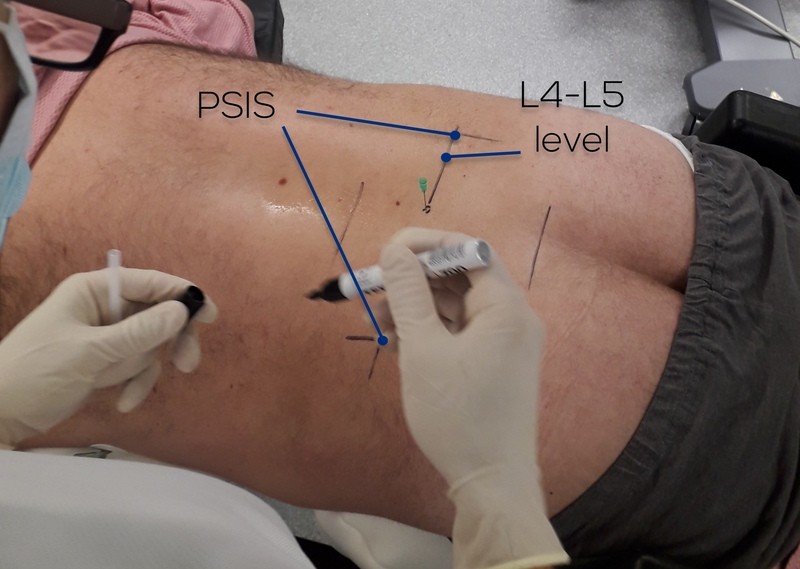
The skin incision level is identified using fluoroscopy and a needle inserted into the midline of the estimated interspinous space at the level of pathology. This verification ensures the approach targets the intended level, L4-L5, reducing the risk of wrong-level surgery.
Sometimes anatomical variants such as lumbarized S1 vertebrae or sacralized L5 can cause misinterpretation, so preoperative imaging should be correlated with the C-arm image.The correct level is marked on the skin. Posterior superior iliac spines are palpated and marked for mediolateral awareness. The surgical field for draping purposes is marked.
Microscopic view:
A longitudinal incision is planned either directly along the midline or slightly lateral on the side corresponding to the disc herniation. The incision extends from the palpable L4 spinous process level to the L5 spinous process level, typically measuring 3-4 cm in length.
This should provide exposure of the L4 lamina, the L4-L5 interlaminar space, and the superior aspect of the L5 lamina, and ultimately provide the field to perform the hernia removal.The incision site is infiltrated with local anesthetic and a sterile adhesive drape is applied to the operative field.
Log in or subscribe to access full content and see all the images.
Skin incision and advancing to fascia
The skin incision is made with a scalpel along the planned line to the subcutaneous fat level.
A retractor is placed to improve visibility.
The subcutaneous tissue is incised using electrocautery until the fascia becomes visible.
Palpating the spinous processes of L4 and L5 and the space between helps with maintaining orientation, especially in cases of thicker subcutis.When the thoracolumbar fascia becomes visible, the subcutaneous tissue can be slightly mobilized with an elevator to enhance exposure.
A retractor is placed deeper to improve visibility for the fascial incision.
Opening the fascia and initial muscle exposure
The fascia incision is placed following the same landmarks as for the skin incision. The aim is to access the paraspinal muscles at their medial attachment to the spinous process and midline, establishing the plane for subperiosteal dissection.
Electrocautery is used to make the incision.
The spinous processes and the space between them can be palpated to confirm the correct direction and length.Once the fascial incision is completed, the paraspinal musculature is visible underneath. These muscles are then further detached from their attachments at the spinous processes and laminae using subperiosteal dissection.
Paraspinal muscle mobilization and retraction
The aim is to elevate the paraspinal musculature from its bony attachments, providing exposure of the laminar anatomy.
The muscle layer is detached from the midline structures and retracted laterally using an elevator.
When dissecting on the middle part of the wound over the interlaminar space, care must be taken to avoid accidentally damaging the underlying ligamentum flavum, which could lead to inadvertent dural injury.
Also, in the lateral direction, one needs to be careful not to damage the facet joints while dissecting near them.Muscle preparation is adequate when the bone surfaces of the lateral spinous process, superior and inferior laminar borders, and medial facet border laterally in the wound can be felt by palpating.
Exposing the laminae surface
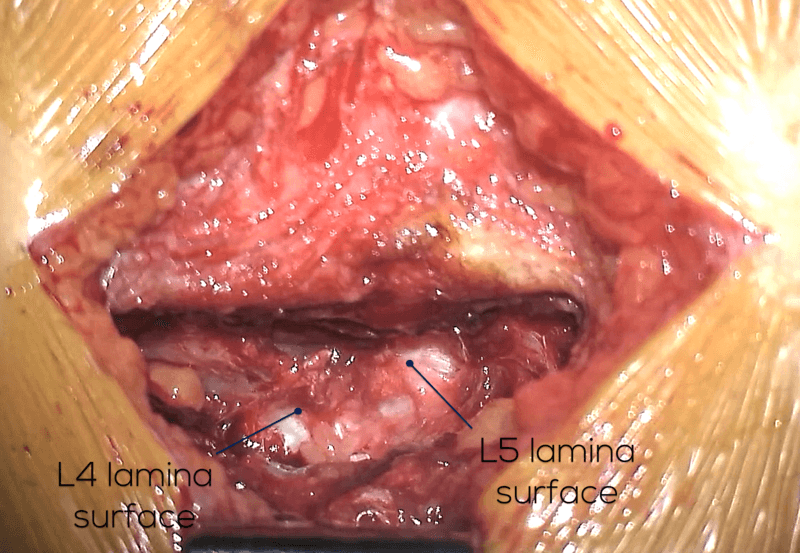
The aim is to provide and maintain visibility to the inferior portion of the L4 lamina at the cranial wound end, the superior edge of the L5 lamina at the caudal wound end, and the interlaminar space between them.
A McCulloch retractor system is placed to hold the fascia and muscle layer aside. Careful positioning of the lateral blade is important to ensure it does not exert excessive pressure on the facet. Forceful retraction can potentially cause a fracture.
Both blades should be positioned without compressing deep soft tissues.
The frame is connected to the blades and the retractor is opened gradually.
Any residual soft tissue is cleared to provide visibility to the inferior half of the L4 lamina surface. A rongeur is used to clear out soft tissue attachments.
A Kerrison rongeur can also be utilized, particularly when dissecting over the interlaminar space, as it removes tissue only at its insertion level with controlled bites, with its blunt tip protecting deeper structures.
The superior edge of the L5 lamina is identified with a dissector and exposed only as much as is needed for the laminotomy.
Once exposure of the inferior portion of the L4 lamina, the superior edge of the L5 lamina, and the interlaminar space is achieved, the landmarks for laminotomy have been established.
Log in or subscribe to access full content and see all the images.
Laminotomy
The goal of laminotomy is to remove enough bone to release the underlying ligamentum flavum from its attachments on the operative side and access the herniation site.
The laminotomy size is determined by ligamentum flavum attachments: superiorly to the anterior L4 lamina at mid-height, and inferiorly to the superior L5 lamina margin. Medially, the spinous process base serves as the landmark. Laterally, the pars interarticularis should be preserved.
Laminotomy is performed using a high-speed burr requiring precise control of bone thickness, or more safely with Kerrison rongeurs that remove controlled bone bites. The lamina can be thinned with a burr and completed with Kerrison, or performed entirely with Kerrison alone.
The drilling of bone is started at the base of the spinous process along the inferior edge of the L4 lamina. This starting point enables following the lamina-flavum interface cranially, maintaining the ligamentum flavum intact at this point. The inferior lamina bone averages 6-8 mm thick, varying between individuals.
Drilling, or alternatively using Kerrison rongeurs, proceeds cranially with controlled passes progressively thinning the bone.
The ligamentum flavum thins as it approaches its attachment point at approximately the midpoint of the superior lamina, making it a particularly vulnerable area for dural injury, so precise control with the instrument is needed.Irrigation removes bone debris, enhancing visualization throughout this process.
When the laminar bone is breached, the yellow hue of the ligamentum flavum becomes visible.
A dissector is used to verify detachment of the superior attachment of the ligamentum flavum. Often, the separation of the flavum from its laminar attachment is also visually apparent.
The laminotomy is completed superiorly using a Kerrison rongeur until the ligamentum flavum is fully detached from its superior attachments.
A dissector is used to separate the inferior attachment of the ligament from the superior edge of the L5 lamina.
When the ligament is breached, the inferior attachment is released fully by taking small bites with the Kerrison of the L5 laminar bone, which is relatively thin, 1-2 mm, at its superior portion.
The ligamentum flavum is now free from its superior and inferior attachments.
Removing the ligamentum flavum
The goal is to detach the ligamentum flavum medially and laterally and remove it to gain access to the spinal canal.
A dissector is used to carefully separate possible adhesions of the flavum to dura.
Complete removal requires mobilizing the lateral attachment by dissecting along the bone-flavum interface, typically necessitating removal of 1-2 mm of the medial facet edge. Care must be taken to preserve the pars interarticularis of the posterior vertebral arch when extending the laminotomy laterally.
A blunt-tipped nerve hook is used to free the remaining medial attachments and verify that no adhesions between the flavum and dura exist.
In visual control, the Kerrison is used to remove the final medial attachments.
In most cases, the ligamentum flavum is not removed as a single piece, as seen here, but rather resected in multiple segments.
After the removal of the ligament, epidural fat, and typically also the dural sac, becomes visible underneath, and access to the spinal canal is gained.
Exposing the dural sac and the nerve root
After access to the spinal canal has been made, the goal is to expose the lateral margin of the dural sac and the shoulder region of the traversing L5 nerve root, where it emerges from the sac.
These structures need to be exposed enough to allow their safe medial retraction, providing access to the herniated disc material located ventrally.
Residual ligamentum flavum and partly the medial edge of the facet joint are still limiting the initial visualization of the dural sac. The Kerrison is used to obtain exposure laterally while keeping the neural structures protected.
The ball tip hook can be used to gently explore the spinal cavity anatomy to locate the traversing nerve root and the herniation.
Some of the epidural fat is removed to provide better visualization of the dural sac.
As additional tissue is carefully removed from the medial facet inferiorly, the traversing L5 nerve root begins to emerge. A ball-tipped dissector is used to gently protect the neural structures at all times when working with the Kerrison near the neural structures.
Adequate exposure has been achieved when the traversing nerve root and the lateral margin of the dural sac are clearly visualized and can be gently retracted medially from the shoulder region of the nerve root, revealing the herniation site underneath.
Retracting the dural sac and nerve root
Medial mobilization of the neural structures is performed at the shoulder level of the nerve root. This level of retraction provides optimal exposure to the underlying disc space, where the herniation is located in this case.
Retraction is applied gently at the shoulder level of the nerve root with a retractor, just enough to reveal and access the herniation site.
Gentle handling is crucial to prevent dural tear or neurological stretch injuries. If the neural elements resist mobilization, this typically indicates compression by the herniated disc material. In such cases, additional working space can be created by extending the exposure laterally with careful resection of the medial facet margin, rather than applying excessive retraction force.The neural elements are now adequately retracted and the disc herniation site is in view.
Exposing the disc herniation site
The visible surface of the herniated disc should be cleared and any overlying veins coagulated. This is done to ensure that no neural elements remain in the incision field and to prevent obscuring bleeding when the disc capsule, or annulus fibrosus, is opened.
Suction is used to maintain visibility.
Bipolar electrocautery forceps coagulate the overlying small veins.
With coagulation complete and neural structures protected, the herniation site is now prepared for safe incision of the annulus fibrosus.
Removing the hernia
The goal is to remove the herniated disc fragment and decompress the nerve root, not to evacuate the disc space itself. In a contained disc herniation, the extruded nuclear material remains covered by intact but bulging annular fibers or the posterior longitudinal ligament. A precise incision through this outer layer is required to access the herniated nucleus pulposus.
A small incision is made on the annulus using a long bayonet-handled blade, while the neural elements are protected medially.
The herniated disc fragment is grasped with pituitary rongeurs and carefully mobilized to release it from adhesions, maintaining awareness of potential connections to the disc space.
Once the fragment is freed from surrounding tissue, it is extracted with the help of another pair of rongeurs.
The extracted material consists of herniated nucleus pulposus.
All herniation fragments should be extracted from the pocket.
Occasionally, a communication exists between the herniation cavity and the intervertebral disc space. Only loose fragments at this junction should be carefully extracted. Intrusion into the actual disc space must be avoided, as the unnecessary removal of intact nucleus pulposus can lead to disc height collapse, altered biomechanics, and increase the risk of recurrent herniation at the same level.
Advancing too far anteriorly into the actual disc space carries additional rare but serious risks, including potential injury to major vascular structures such as the aorta, iliac vessels, and inferior vena cava, which lie directly anterior to the anterior longitudinal ligament of the lumbar spine.
Verification of decompression
The herniation pocket should be thoroughly explored to reduce the risk of incomplete hernia removal and residual compression.
The ball-tipped probe gently palpates beneath and around the neural structures to confirm adequate decompression.
The annular defect and surrounding area are probed to ensure removal of extruded disc fragments while preserving intact nucleus pulposus.
The retractor is removed and the successful decompression is verified by observing unrestricted passage of the neural structures. Typically, pulsation of the dural sac resumes once decompression has been achieved.
A probe is passed under the bony margins, ensuring no residual compression remains.
Fluoroscopy with a radiopaque marker positioned at the surgical site documents the level of disc herniation addressed.
Hemostasis
Before closure, careful evaluation of possible bleeding sources is essential to prevent postoperative epidural hematoma formation that can compress the nerves, requiring emergency reoperation for evacuation to prevent permanent ischemic damage.
Evaluation of hemostasis.
Hemostatic agents are not applied routinely but can be used to address small venous oozing, as is done here.
In cases of concern about complete hemostasis, a surgical drain can be placed to prevent hematoma accumulation into the epidural space.
Closure
Closure begins with approximating the fascia with non-absorbable thread.
The subcutaneous layer is closed with absorbable thread in one to two layers, depending on its thickness.
The skin can be closed using staples, absorbable sutures, or non-absorbable sutures.
The wound is covered with wound tape.
To access the full video and additional content on this subject, log in or subscribe
Piftalls and Complications
Pitfalls
Wrong level of procedure
Using fluoroscopy-guided level confirmation before incision minimizes the risk of operating on the wrong level. If the incorrect spinal level is operated on, the actual pathology remains untreated while unnecessary surgical trauma is created.
Insufficient understanding of anatomy
In paracentral disc herniation, located slightly off-center toward one side, the traversing nerve root is compressed, not the exiting nerve root at the same level. This differs from far lateral herniations that compress the exiting nerve root, and central herniations that compress the dural sac. For example, an L4-L5 paracentral herniation compresses the L5 traversing nerve root, not the L4 exiting root.
Careless tissue handling
If the lateral retractor blade of the McCulloch retractor is placed too aggressively, excessive stress on the facet joint can cause fracture or instability.
If drilling during laminotomy proceeds without adequate depth control, accidental breach of the ligamentum flavum and underlying dura can occur, causing dural laceration.
If the ligamentum flavum is removed without recognizing and carefully releasing possible dural adhesions, dissection can cause dural laceration and CSF leak.
If excessive force or prolonged pressure is applied during dural sac and nerve root retraction, permanent nerve injury and persistent radiculopathy can result.
Excessive bone removal during laminotomy
The lamina bone should be removed only as much as is needed to release the ligamentum flavum and provide exposure to the spinal canal. If too much bone is removed during laminotomy, spinal instability can result from weakening the posterior spinal elements. Laterally, the pars interarticularis should be preserved and excessive medial facetectomy avoided.
Inadequate exposure of the dural sac / nerve root
If an insufficient amount of bone and ligamentum flavum are removed, inadequate visualization of the dural sac and nerve root prevents safe identification and removal of disc fragments. Poor exposure increases the risk of neural injury, incomplete disc removal, and persistent symptoms.
Inadequate exposure of disc herniation site
Adequate exposure of the herniation site requires sufficient retraction of the dural sac and the traversing nerve root at the shoulder region of the nerve root. Coagulation of small vessels overlying the annulus prevents bleeding that might obscure the surgical field when making the incision.
Insufficient removal of hernia
If herniated disc material is incompletely removed, persistent nerve compression and continued radicular symptoms might result. This may occur with sequestered herniation, where fragments migrate away from the main herniation site. Careful but thorough exploration of the herniation area and confirmation of free passage of the nerve root is important to identify and remove all loose fragments.
Overly aggressive disc removal
Healthy disc material beyond the herniated fragments should not be removed. Disc removal should be limited to loose fragments and herniated material, avoiding entry into healthy disc tissue to preserve biomechanical function.
Inadequate hemostasis
If bleeding is not properly controlled before closure, epidural hematoma formation can cause severe neurological compression and emergency reoperation. Inadequate hemostasis allows blood to accumulate in the epidural space, creating mass effect on neural structures and potentially causing cauda equina syndrome or severe radiculopathy.
Complications
Nerve root injury
The traversing nerve root is vulnerable to excessive retraction force, so overly aggressive medial retraction should be avoided when exposing the herniation site.
During disc removal, rongeurs can directly lacerate or avulse the nerve root if working without adequate visualization.
Thermal injury from electrocautery used too close to neural structures can cause nerve damage.
Dural tear
Dural tear can occur during careless bone removal when drilling proceeds too deeply, during ligamentum flavum removal when adhesions are present, or during disc fragment extraction with aggressive retraction. These tears result in cerebrospinal fluid leak, potential meningitis risk, persistent headaches, and may require immediate repair or reoperation if not recognized and addressed intraoperatively.
Epidural hematoma
Poor hemostasis or coagulopathy can contribute to continued bleeding after wound closure. Local hemostatic agents or a surgical drain should be considered if the small bleeding is not controlled. Blood accumulation into the epidural space creates mass effect on neural structures. This results in severe back pain, progressive neurological deficits, cauda equina syndrome, or complete loss of motor and sensory function, often requiring emergency reoperation for hematoma evacuation.
Vascular injury
Although rare, vascular injury can occur during disc herniation removal when instruments penetrate too deeply through the anterior annulus and anterior longitudinal ligament. Inferior vena cava and iliac vessels lie directly anterior to the ALL at the L4-L5 level.
Recurring herniation/symptoms
Recurrent herniation can result from incomplete removal of loose fragments during the initial surgery, progressive degeneration of remaining disc material, or normal wear of a previously weakened disc. It is not uncommon to have recurring herniation due to new disc material herniating at the same level.
Postoperative spinal instability
Postoperative spinal instability develops when excessive bone removal during laminotomy compromises the structural integrity of the posterior spinal elements. Over-resection of the lamina, facet joints, or pars interarticularis disrupts normal load-bearing capacity and allows abnormal segmental motion.
Aftercare
General guidelines:
The aftercare protocols may vary between units.
Typically, the patient can be mobilized immediately after surgery, except in cases of dural tear where bed rest for 24 hours is recommended.
For 4 weeks postoperatively, extreme spinal flexion/extension and lifting more than 1-2 kg should be avoided.
FAQ
What is the goal of lumbar microdiscectomy?
The goal is to remove the herniated disc material that is compressing the nerve root while preserving normal neural anatomy and spinal stability.
Which nerve root is compressed in an L4-L5 paracentral disc herniation?
In the described L4-L5 paracentral disc herniation, the traversing left L5 nerve root is compressed. The L4 nerve root remains unaffected because it has already exited the spinal canal through the L4-L5 foramen before reaching the herniation site.
Why is fluoroscopy used before incision?
Fluoroscopy is used with a needle inserted into the estimated interspinous space to confirm the correct level of pathology. This helps target the intended L4-L5 level and reduce the risk of wrong-level surgery.
Why should the disc space itself not be evacuated?
The goal is to remove the herniated disc fragment and decompress the nerve root, not to evacuate the disc space itself. Only loose fragments at a communication between the herniation cavity and intervertebral disc space should be carefully extracted. Intrusion into the actual disc space should be avoided because unnecessary removal of intact nucleus pulposus can lead to disc height collapse, altered biomechanics, and increased risk of recurrent herniation at the same level.
How is decompression verified?
Decompression is verified by gently palpating beneath and around the neural structures with a ball-tipped probe, probing the annular defect and surrounding area, observing unrestricted passage of the neural structures after removing the retractor, checking for resumed dural sac pulsation, passing a probe under the bony margins, and documenting the level with fluoroscopy and a radiopaque marker.
What aftercare restrictions are described?
Aftercare protocols may vary between units. Typically, the patient can be mobilized immediately after surgery, except in cases of dural tear where bed rest for 24 hours is recommended. For 4 weeks postoperatively, extreme spinal flexion/extension and lifting more than 1-2 kg should be avoided.
To access the full video and additional content on this subject, log in or subscribe