How to perform a olecranon fracture tension band fixation
Source
Surgeon:
Ville Vänni (trauma surgeon)
To access the full video and additional content on this subject, log in or subscribe
Summary
Focus: Open reduction and internal tension band fixation of an olecranon fracture.
Key elements: Restoring elbow anatomy and joint function through fracture reduction, K-wire fixation, figure-eight tension band wiring, verification of motion, wound closure, and postoperative mobilization.
Indications and Clinical Context
General
Medical experts: Ville Vänni (trauma surgeon), Robert Björkenheim (orthopedic surgeon), Anna Ikonen (orthopedic surgeon)
Name of Procedure: Open reduction and internal (tension band) fixation of olecranon fracture
Goal of Operation
To restore elbow anatomy, especially the joint surface, and joint function after olecranon fracture by reducing the fracture and fixating the bone fragments to ensure adequate healing of the fracture site. The objective of the tension band technique is to convert the tension force on the posterior side of the bone to a compression force on the anterior side, thereby neutralizing the pulling force of the triceps over the fracture site.
Problem
A fracture of the olecranon resulting in functional impairment of the elbow joint.
Diagnosis
Olecranon fracture (ICD-10: S52.0)
Short Pathophysiological Description
Olecranon fractures are common, typically caused by either a direct blow or a fall on an outstretched arm. The main following functional impairment is an inability to extend the elbow. Depending on the fracture type, it can also cause elbow instability. In general, tension band fixation is used for fixating simple, transverse olecranon fractures.
Key Anatomical Structures
Humerus
Radius
Ulna
Triceps
Ulnar nerve
Anterior interosseous nerve
Olecranon bursa
Ulnar artery
Step-by-Step Technique
Patient Positioning, Anesthesia and Preparation
The patient is in a prone position with the affected limb positioned laterally, arm abducted to 90 degrees and supported by a radiolucent foam/padding on a radiolucent table. The elbow is flexed, and the forearm is hanging freely off the table. Alternatively, the patient can be in a supine position with the arm draped and positioned on the chest. The patient can also be in a lateral decubitus position, with the arm supported by a radiolucent foam.
General anesthesia with or without brachial plexus block is applied. Alternatively, the operation can be performed under sedation and brachial plexus block with additional local lidocaine administration.
A tourniquet with a pressure setting of 100 mmHg over last systolic reading can be used for hemorrhage control. This could, however, interfere with fracture reduction as the triceps muscle is put under tension by the tourniquet.
Landmarks and Skin Incision
Inspect and palpate the landmarks: triceps tendon, distal humerus, epicondyles, olecranon (including the fracture site), and the shaft of ulna.
Make a longitudinal skin incision, starting approximately 2 cm proximal to the tip of olecranon, in line with the ulnar shaft, but curving laterally (radially) around the olecranon. Making the incision laterally will help in avoiding the possibility of damage to the ulnar nerve. Bear in mind that the tip of the olecranon has to be exposed enough for K-wire insertion and for passing the wire (band) under the triceps tendon. Distally the incision should continue to approximately 4-5 cm distal to the fracture site, in order to drill the distal anchor hole for the wire through ulna.
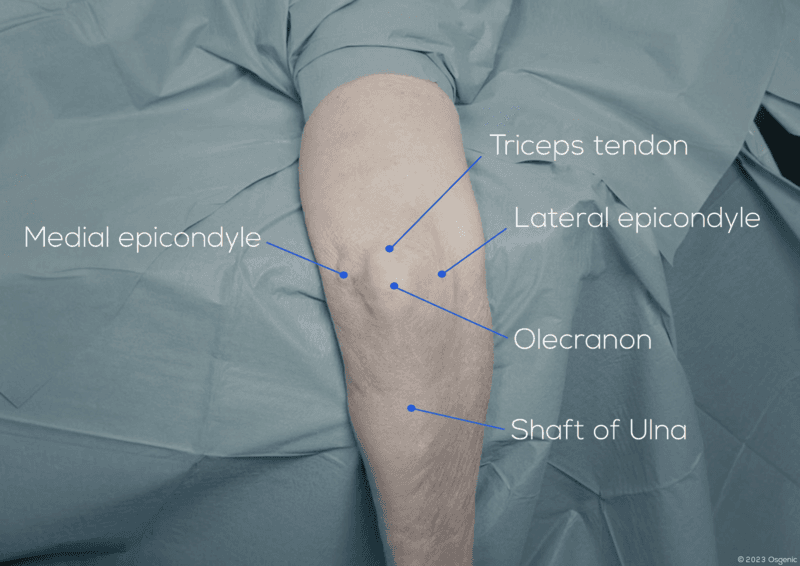
Log in or subscribe to access full content and see all the images.
Expose the Fracture Site
Advance through the olecranon bursa.
Create full thickness skin and subcutaneous tissue flaps.
Place retractors proximally and distally between the bone and soft tissue, or temporarily suture the skin flaps laterally and medially in order to maintain optimal visibility.
Remove hematoma and soft tissue debris from the fracture site. For additional visibility, elevate 1-2 mm of the periosteum from the edges of the fracture. However, keep the periosteum detachment minimal.
Fracture Reduction
Drill a 2.0 mm transverse hole approximately 4 cm distal to the fracture line at the center of the bone. Use a sharp drill guide to avoid the drill sliding on the bone surface. This is the distal anchor hole for the tension band and you can, if necessary, also use it during fracture reduction for attaching the reduction clamp. Alternatively, you can drill an additional small hole in the posterior cortex for the clamp placement.
Next, extend the elbow to assist reduction and place a reduction clamp over the fracture. Place one end of the clamp in the drilled hole in the ulna and firmly attach the other end to the tip of the olecranon. Then close clamp to achieve reduction. Additional reduction clamps can be used if necessary; however, make sure not to block possible K-wire entry points.
Fracture Fixation With the Tension Band Technique
Make sure to have adequate exposure of the tip of the olecranon for inserting two parallel K-wires. The objective of this step is to set the tension band wire (1.0-1.2 mm) in a figure-eight pattern over the fracture site with the proximal end anchored around two K-wires and beneath the triceps tendon, and the distal end anchored to the drill hole in the ulna.
Insert the two K-wires (1.6-2.0 mm) at the proximal side of the fracture, through the proximal end of olecranon.
Use a drill guide to direct the first K-wire towards the anterior cortex. Position the K-wire as close to the joint surface as possible without affecting the joint, and drill through both cortices.
To avoid damage to the anterior interosseous nerve and the ulnar artery, be careful not to drill too deep through the anterior cortex. Placing the wire at a 20-30-degree angle with respect to the ulnar shaft should minimize this risk.
Piercing the anterior cortex too radially may also block the movement of the radius during pro-supination.
Introduce the first K-wire medially, in order to leave room for the second K-wire. Then, use a drill guide to similarly introduce the second K-wire laterally, parallel to the first one. Having two parallel K-wires prevents fragment rotation.Check the K-wire position using the C-arm. If the fracture reduction remains adequate and the position of the wires is satisfactory, retract the K-wires to approximately 1 cm from the anterior cortex, in order to have a margin for advancing the K-wires deeper into the bone again after securing adequate tension. Transcortical fixation of the K-wires through the anterior cortex should reduce the risk of wires backing out and thus loss of tension.
If satisfied with the positioning of the K-wires, remove the reduction forceps.
Pass approximately two thirds of the tension band wire beneath the triceps tendon in a medial-to-lateral (ulnar-to-radial) direction. Use a needle to assist guiding the wire if necessary; however, make sure not to damage the ulnar nerve.
When the tension band wire is passed under the tendon, make a loop on the longer side of the band. Then pull the longer end of the band back to the medial side and pass it through the distal drill hole in ulna, again in a medial-to-lateral direction.
Finally, pull the longer end to meet the shorter end and unite the ends by twisting them. The wire should now have a figure-of-eight pattern.Verify that the ulnar loop and the radial twisting point of the wire ends are not positioned over the hole drilled in the ulna. This is to avoid excessive tension over the hole and also having the loops more proximally will require smaller incisions should the hardware have to be removed in the future.
Tighten the wire first loosely with pliers by twisting the loop and then twisting the wire ends together. Make sure the wires spiral equally around each other. If one wire is spiraling around a straight wire, the twist will give way under force.
Shorten the wires, and further tighten the wires until you have achieved satisfactory tension. The tension should be firm, but not excessive. Especially osteoporotic bone may break if the wires are too tight. It is important to tighten the twists on both sides of the hole simultaneously in order to have equal tension on both sides.
To minimize soft tissue irritation, twist the sharp tips of the wires to face the bone.
Finally, bend the proximal ends of the K-wires by 180 degrees and cut away the excess part, leaving approximately 5 mm. Then sink in the curved ends into the bone, through small cuts in the triceps, in order to prevent the K-wires from backing out. You can additionally close the holes in the triceps to further prevent the wires backing out.
Verify Accomplishment of Goal, Check for Potential Damage and Ensure Hemostasis
Check for adequate reduction and fixation using the C-arm. Make sure to also assess the reduction looking at the joint line from a lateral view.
Verify that the elbow has free motion in extension-flexion and pro-supination. Pay special attention to the pro-supination movement. If pins are placed so that they penetrate the lateral/radial ulnar cortex, they may block the movement of radius.
Release tourniquet, if used, and coagulate any bleeding vessels.
Wound Closure
The wound closure should be done in layers if possible: use e.g. 0 Vicryl for deep closure, 2-0 Vicryl for the subcutis, and 3-0 nylon thread or staples for the skin.
Apply a non-bulky surgical dressing and place the arm in a sling.
To access the full video and additional content on this subject, log in or subscribe
Piftalls and Complications
Pitfalls
Wrong Incision Site
Making the skin incision straight over the olecranon may result in problems with the healing of the wound later on. Flexion of the elbow can cause stretching of the wound and scar formation may result in irritation when the patient is leaning on the elbow. A radially curved incision over the tip of the olecranon is recommended, in order to avoid damage to the ulnar nerve.
Disorientation During Surgery
The ulnar nerve is on the medial side of the olecranon and at risk if critical tissues and layers are not accurately identified. To avoid this, ensure that you can clearly identify the medial and lateral sides of the arm accordingly and are able to maintain correct orientation throughout the surgery.
Misdirected K-wires
Erroneous direction of the K-wires could result in neurovascular damage or piercing of the joint surface. Going through the anterior cortex too radially may also block the movement of radius during pro-supination. Following the anatomical landmarks and using C-arm imaging for orientation are important in preventing such complications.
Placing K-wires Too Deep
Using too long wires or drilling them too far past the anterior cortex could result in damage to ulnar artery or the anterior interosseous nerve. Drill carefully and check with C-arm imaging to assess the correct depth, just piercing the anterior cortex, and pull the wires back approximately 1 cm from the anterior cortex in order to have a margin for sinking the K-wires at the end of fixation.
Inadequate Fixation
K-wire migration and symptomatic hardware are rather common postoperative problems. Therefore, transcortical fixation and additional fixation of the curved proximal ends of the K-wires into the bone is recommended. However, be aware of the neurovascular structures anterior to the bone.
Not Checking for Full Range of Motion
At the end of the operation it is imperative to check the range of motion. If full extension/flexion or pronation/supination cannot be achieved there is cause to suspect that either the K-wire has been placed too far through the anterior cortex of the ulna or penetrates the joint surface.
Complications
Ulnar Nerve Damage
The ulnar nerve passes the olecranon on its medial side, so a radially curved skin incision over the tip of the olecranon is recommended to avoid damage to the nerve.
When visualizing the fracture, careless operating on the medial/ulnar side of the olecranon may also result in damage to the ulnar nerve.
In addition, during fracture fixation, the ulnar nerve could be damaged when drilling the distal wire anchor hole. Make sure to drill in an ulnar-to-radial (medial-to-lateral) direction to avoid this.
Finally, be aware of the location of the ulnar nerve when using a needle to guide the tension band wire under the triceps tendon (medial-to-lateral) to avoid damaging the ulnar nerve.
Ulnar Artery and/or Anterior Interosseous Nerve Damage
Drilling in the K-wires too deep through the anterior cortex could result in damage to the ulnar artery or the anterior interosseous nerve. Drill carefully and direct the K-wires in a 20-30-degree angle with respect to the longitudinal axis of the bone.
Wound Stretching or Scar Formation
Making the skin incision straight over the olecranon may result in problems with the wound healing due to flexion of the elbow stretching the wound and/or scar formation directly where the elbow will rest on surfaces. It is recommended that a radially curved incision over the tip of the olecranon is used.
Aftercare
General Guidelines
For most patients, early postoperative mobilization is recommended, while return to heavy manual labor is allowed progressively after confirmed healing, usually after approximately 8 weeks.
FAQ
What is the goal of olecranon fracture tension band fixation?
The goal is to restore elbow anatomy, especially the joint surface, and joint function after olecranon fracture by reducing the fracture and fixating the bone fragments to ensure adequate healing of the fracture site.
What fracture type is tension band fixation generally used for?
In general, tension band fixation is used for fixating simple, transverse olecranon fractures.
Why is a radially curved incision recommended over the tip of the olecranon?
A radially curved incision is recommended to avoid damage to the ulnar nerve and to reduce problems with wound healing, wound stretching, or scar formation from a straight incision over the olecranon.
Why should K-wires not be drilled too deep through the anterior cortex?
Drilling K-wires too deep through the anterior cortex could result in damage to the ulnar artery or the anterior interosseous nerve.
What should be checked at the end of the operation?
Adequate reduction and fixation should be checked using the C-arm, reduction should be assessed from a lateral view of the joint line, elbow motion in extension-flexion and pro-supination should be verified, and the tourniquet should be released if used with coagulation of bleeding vessels.
To access the full video and additional content on this subject, log in or subscribe