How to perform a patellar fracture fixation with tension band
Source
Surgeon:
Lasse Rämö (orthopedic surgeon)
To access the full video and additional content on this subject, log in or subscribe
Summary
Summary
Focus: Reduction of the patellar joint surface and stable fracture fixation to enable healing of the extensor mechanism of the knee.
Key elements: Supine positioning, anterior midline incision, fracture reduction, K-wire placement, figure-of-eight cerclage wire placement, final fixation, closure, aftercare, pitfalls, and complications.
Indications and Clinical Context
General
Medical experts: Lasse Rämö, orthopedic surgeon
Name of Procedure: Patellar fracture fixation with tension band; tension band wiring (TBW) of the patella; cerclage compression wiring.
Goal of Operation
Reduction of the patellar joint surface and stable fracture fixation to enable healing of the extensor mechanism of the knee.
Problem
Reduced stability and mobility of the knee, leading to impaired knee extension caused by patellar fracture.
Diagnosis
Patellar fracture, fractura patellae (ICD-10: S82.0)
Short Pathophysiological Description
The patella is attached to the quadriceps tendon and aids in the extension of the leg by increasing the leverage of the quadriceps tendon. A patellar fracture disrupts this mechanism, leading to an impaired extension mechanism. The fracture is usually caused by direct trauma, such as a fall onto the knee or a sharp blow in a car accident.
The patella can be fractured either transversely or into multiple fragments. If the fracture is displaced, it might not heal properly. This could result in chronic pain, instability, and loss of knee function. Repairing the fracture surgically and restoring the extensor mechanism can improve the prognosis. If not treated properly, it could lead to osteoarthritis due to abnormal stress on the joint.
Key Anatomical Structures
Patella
Patellar tendon
Quadriceps tendon
Knee joint capsule
Step-by-Step Technique
Patient Positioning, Anesthesia, and Preparation
Patient is in a supine position.
It is recommended to place the knee in slight flexion. This facilitates the drilling of the transpatellar K-wires. Excessive flexion will hinder fracture reduction due to extra tension.
Either spinal or general anesthesia can be used.
Landmarks and Incision Site
The goal is to plan an incision that ensures optimal exposure of the fracture site for precise reduction and fixation, with consideration for the later insertion of K-wires through the patella.
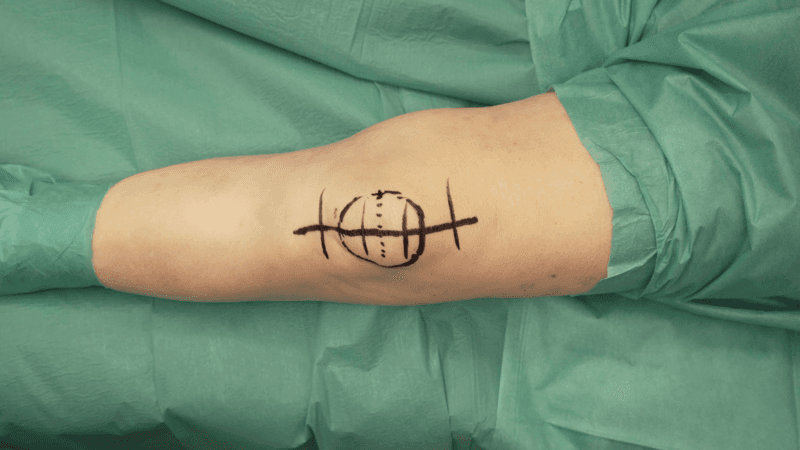
Mark the edges of the patella and the suspected level of the fracture.
The incision is planned anteriorly in the midline. It should extend a few centimeters below the patella's distal border and about 5 cm above the patella's proximal border to leave room for the K-wires' drilling. The horizontal markings on the skin will assist with precise skin closure.
Log in or subscribe to access full content and see all the images.
Skin Incision and Exposing the Fracture Site
Exposing the quadriceps tendon, the patella, and the patellar tendon ensures proper visibility and access for the later positioning and insertion of fixation material.
Incise the skin with a scalpel longitudinally as planned. There are no critical structures directly underneath the skin.
Advance through the subcutaneous and prepatellar bursal tissue to the fascia surface. Cauterize any bleeding vessels.
Use retractors as needed to maintain exposure. In this video, the patella is still intact at this point.
Typically, the bursal tissue on the medial and lateral side of the patella needs to be released to achieve better visualization of the full fracture site.
The exposure is sufficient when the whole patella, along with the proximal part of the patellar tendon and the distal part of the quadriceps tendon, are visible.
Fracture Reduction
The goal is to restore the normal alignment and shape of the patella, ensuring the evenness of the articular surface for optimal joint function.
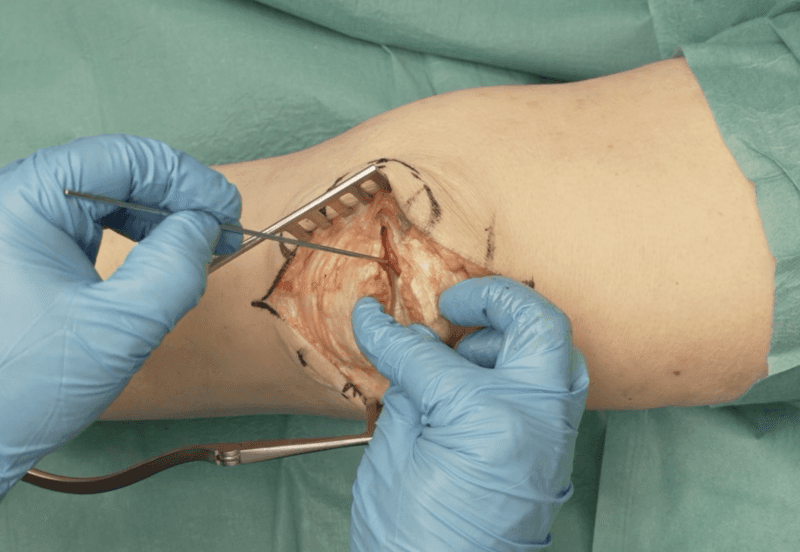
Often, an injury can result in a tear in the joint capsule, either on the lateral or medial side of the fracture. This capsular tear can create a "window" that can be used to assess the fracture reduction.
Remove any small loose fragments from the fracture surface and clear possible hematoma from the fracture site to facilitate anatomic reduction. If necessary, rinse the knee joint with saline.
Use a reduction clamp to secure and maintain the fracture reduction in place.
Confirm the adequacy of the reduction by palpating the evenness of the articular surface through the soft tissue window.
Log in or subscribe to access full content and see all the images.
K-Wire Placement
The goal of the K-wire placement is to secure and maintain the correct alignment of the fractured bone fragments, providing a foundation for the subsequent placement of the cerclage wire. The K-wires should be positioned in a way that ensures stability, without being too close to the cortices or joint line.
There are various methods for inserting K-wires into the patella. Here, two K-wires are drilled in a proximal-to-distal direction across the fracture line.
Position the K-wire approximately 5 mm from the anterior cortex of the patella. The lateral K-wire should be placed longitudinally slightly lateral from the midline and the medial K-wire slightly medial from the midline.
Insert the K-wire through the quadriceps tendon and into the surface of the patella.
Drill the K-wire through the patella. Avoid damaging the skin on the distal side.
Drill a second K-wire parallel to the first one. Leave approximately 1 cm between the two K-wires to provide stability.
Using fluoroscopy, check for proper alignment and reduction of the fracture and verify the correct alignment of the joint line. Assess the symmetry and placement of the K-wires, confirming they are not too close to the cortices or joint line.
Cerclage Wire Placement
The goal is to stabilize the fracture and minimize displacement. This is achieved by placing a cerclage wire in a figure-of-eight configuration beneath the K-wires and as close to the patellar bone surface as possible, providing direct support to the bone structure.
Use a needle to create a horizontal path for the cerclage wire on the proximal aspect of the patella. The tip of the needle can be used to palpate the patellar cortex, aiming to position it as close as possible to the patellar surface.
Ensure that the needle is placed beneath the K-wires.Pass the cerclage wire through the needle while simultaneously pulling out the needle.
Cross the wire ends in the middle to form a figure-of-eight configuration.
Repeat the insertion of the wire distally, again close to the patellar surface and below the K-wires.
Connect the wire ends to complete the figure-eight configuration. Leave sufficient wire length to form the loop on the opposite side.
Gradually tighten these loops, alternating between the two sides to ensure balanced compression. The loops should be tightened in opposite directions—one clockwise and the other counterclockwise—for optimal stability.
Using fluoroscopy, assess the tension band wiring from AP and lateral views. Ensure the reduction remains satisfactory and the cerclage wire is correctly positioned under the K-wires. The wire should be close to the bone surface. Adjust the wire's tension if necessary.
Finalizing the Fixation
Fixation is secured by creating hooks on the ends of the K-wires. These hooks hold both the K-wires and the cerclage wire in place. The aim is to get the K-wire hooks around the tension band wire to prevent it from slipping from the patellar surface.
Bend the proximal ends of the K-wires 180 degrees with pliers to form a hook and cut the excess part.
The hook is turned posteriorly, so make sure that the hook is small enough so that it stays inside the patella when fixed in place.Make small incisions on the quadriceps tendon for the K-wire hooks.
Rotate the hooks 180 degrees and tap the hooks into the patella through the small incisions.
Cut the excess parts of the K-wires distally. Cut them close to the patellar tendon so that distal ends do not poke the skin after closure. A subtle bending of the distal ends of the K-wires can be used to prevent inadvertent retraction of the K-wires. However, excessive bending makes it difficult to remove the K-wires later if needed.
Bend the ends of the twisted cerclage wires into the soft tissue to prevent soft tissue irritation. If necessary, cut any excessive wire.
Assess the fixation with fluoroscopy. The bent K-wires should go around the cerclage wire and the wire should run on the patellar surface, or as close as possible.
Lastly, examine the stability of the fixation. Flex the knee and check that the fracture line is flush, and no separation is detected.
Closure
Use size 2 absorbable sutures to repair the torn capsule, ensuring a watertight joint capsule.
The subcutaneous layer is closed using absorbable size 0 sutures on the deeper layer and size 2-0 sutures on the superficial layer. Either interrupted or continuous sutures can be used.
The skin is closed using single or continuous sutures or with staples.
To access the full video and additional content on this subject, log in or subscribe
Piftalls and Complications
Pitfalls
Misplacement of the K-Wires
Too anterior placement of the K-wires may cause iatrogenic fracture of the anterior cortex of the patella, leading to an unstable fixation. Too posterior placement may cause iatrogenic injury to the patellar articular surface.
Place the K-wires approximately 5 mm from the anterior surface to avoid these injuries.
Misplacement of the Cerclage Wire
If the cerclage wire is not placed under the K-wires at the distal and proximal pole of the patella, or there is no proper tensioning of the wire, this may lead to loss of reduction.
Use fluoroscopy to confirm the correct location of the cerclage wire, the proper tension of the band, and the proper fixation of the tension band with the K-wire hooks.
Mobilizing Too Early
Patients should avoid weight-bearing on a flexed knee in the first 6 weeks, as it might cause a failure of the repair. Use a brace or a cylindrical cast to protect the repair. We recommend following the local rehabilitation protocol.
Complications
Loss of Reduction
Early weight-bearing on a flexed knee within 6 weeks of surgery predisposes to failure of the repair.
Resisted extension training with external weight should generally be started 3 months after the surgery, and maximal extension force should be applied only after 9 months.
Also, incorrect placement of the tension band may lead to loss of reduction.
Wound Healing Problems
Careless soft tissue handling and patient-related risk factors predispose wound healing problems and sometimes lead to severe infections.
Aftercare
General Guidelines
There are often local protocols for the postoperative treatment of patellar fracture.
Generally, weight-bearing with an extended knee is allowed. During the first 6 weeks, weight-bearing on a flexed knee is not recommended. After 6 weeks, extension exercises are started first with the weight of the leg, then gradually increasing the resistance.
We recommend protecting the knee with a hinged knee brace with the knee in extension or a synthetic cylindrical cast.
Thromboprophylaxis should be considered after evaluating individual risk factors.
Sometimes the tension band causes irritation, and the fixation material needs to be removed. If this is the case, you need to first ensure that the fracture has healed properly before taking out the fixation material.
FAQ
What is the goal of patellar fracture fixation with tension band wiring?
The goal is reduction of the patellar joint surface and stable fracture fixation to enable healing of the extensor mechanism of the knee.
Why is the knee placed in slight flexion during preparation?
Slight flexion facilitates drilling of the transpatellar K-wires. Excessive flexion will hinder fracture reduction due to extra tension.
How is fracture reduction assessed?
The adequacy of the reduction is confirmed by palpating the evenness of the articular surface through the soft tissue window.
What K-wire position is recommended?
The K-wire is positioned approximately 5 mm from the anterior cortex of the patella, with the lateral K-wire slightly lateral from the midline and the medial K-wire slightly medial from the midline.
What should patients avoid during the first 6 weeks after surgery?
During the first 6 weeks, weight-bearing on a flexed knee is not recommended because it might cause failure of the repair.
To access the full video and additional content on this subject, log in or subscribe