How to perform a posterior humerus approach
Source
Surgeon:
Robert Björkenheim (orthopedic surgeon)
To access the full video and additional content on this subject, log in or subscribe
Summary
Focus: Safe posterior exposure of the humeral fracture site for reduction and fixation.
Key elements: Patient positioning, posterior incision planning, radial and ulnar nerve protection, lateral and medial exposure options, triceps split approach, closure, pitfalls, complications, and aftercare.
Indications and Clinical Context
General
Medical experts: Robert Björkenheim (orthopedic surgeon), Thomas Ibounig (orthopedic surgeon), Lauri Kavaja (orthopedic resident)
Name of procedure: Posterior humerus approach, lateral paratricipital approach, medial tricipital approach, triceps split approach
Goal of Operation
To safely gain adequate posterior exposure of the humeral fracture site for reduction and fixation.
Problem
Fracture involving the middle or distal part of the humerus.
Diagnosis
Fracture of the shaft of the humerus (ICD-10: S42.3)
Short Pathophysiological Description
Humeral fractures usually result from incidents such as falls or high-energy twisting.
The resulting fracture can lead to a range of complications, including injury to surrounding soft tissues, blood vessels, and nerves, particularly the radial nerve, which is closely associated with the humerus.
The posterior approach is often preferred for fractures involving the posterior aspect of the humeral shaft or the distal humerus, as it provides good visualization and safe access to these areas.
Key Anatomical Structures
Humerus
Lateral and medial epicondyles
Fossa olecranon
Spiral (radial) groove
Cubital tunnel (ulnar groove)
Ulna
Olecranon
Triceps muscle
Lateral head
Long head
Medial head
Deltoid muscle
Brachial fascia
Lateral and medial intermuscular septum
Radial nerve
Ulnar nerve
Axillary nerve
Deep brachial artery
Medial and lateral collateral ligament complex of the elbow
Forearm extensor and flexor attachment sites
Step-by-Step Technique
Patient Positioning, Anesthesia, and Preparations
The patient lies prone with the affected arm raised laterally. Alternatively, lateral or semi-prone positioning can be used, but prone positioning facilitates easier use of fluoroscopy.
The procedure is usually performed under general anesthesia.
Landmarks and Incision Site
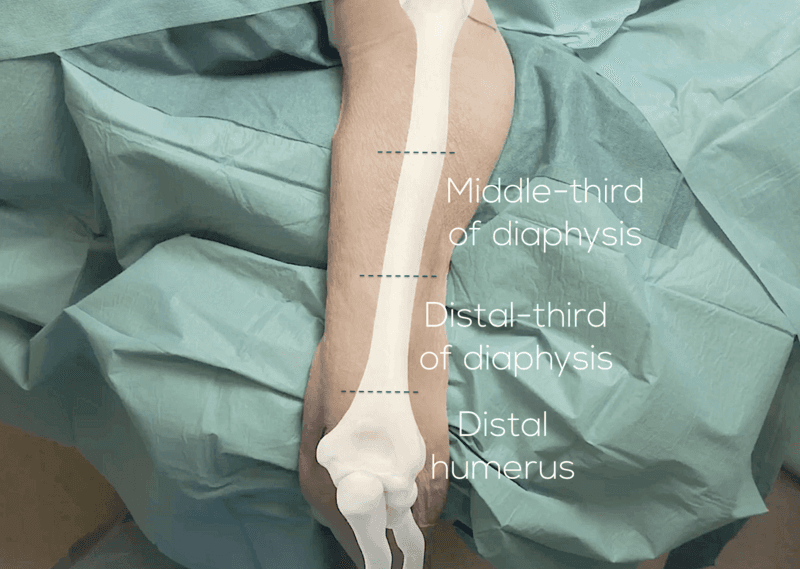
The skin incision site should allow sufficient exposure of the fracture site for reduction and fixation. With the posterior approach, the exposure can be achieved particularly to treat middle and distal diaphyseal fractures and distal humeral fractures.
In practice, the exposure possible to achieve starts from the level of the deltoid muscle and extends to the humero-ulnar joint level. The exact extent of the exposure needed depends on the fracture's location, fixation method, and the length of the plate used.
Surrounding neurovascular structures need to be preserved during the procedure.
The skin incision is placed in the middle of the posterior arm, using the epicondyles, the humeral shaft, and the olecranon as landmarks.
The incision can start from the level of the deltoid muscle inferior border and extend in line with the humeral shaft towards the olecranon. Distally, the incision can curve towards the lateral epicondyle for additional exposure.
For uncomplicated healing, the incision is made curving to avoid the olecranon. The curve is made laterally as the ulnar nerve runs medially.
Log in or subscribe to access full content and see all the images.
Skin Incision
The skin is incised with a scalpel, following the planned line, down to the subcutaneous fat. There are no critical structures directly underneath the skin.
The incision progresses sharply through the subcutaneous layer along its full length until the brachial fascia. Hemostasis is performed as needed.
The subcutaneous tissue can be slightly mobilized from the fascia surface if needed.
Opening the Fascia
Using scissors, the fascia is incised following the placement and length of the skin incision.
A retractor or retraction sutures can be placed to hold the fascia and subcutaneous layer aside to achieve better visualization.
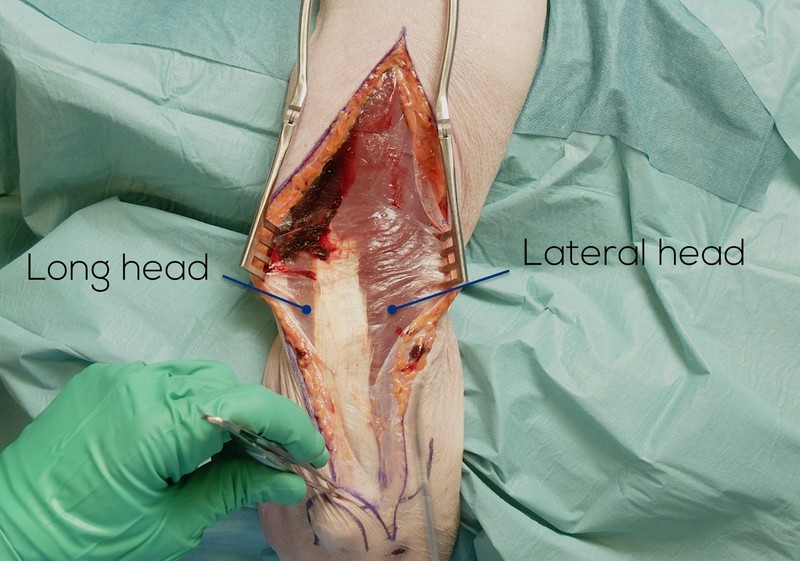
Once the fascia is opened fully, the long and lateral head of the triceps, along with their joined distal tendinous portion, become visible.
The long and lateral triceps heads overlay the deeper medial head and radial nerve.
Log in or subscribe to access full content and see all the images.
Advancing to Bone Surface Lateral to Triceps
The aim is to achieve exposure to the middle and distal thirds of the posterior humeral diaphysis by retracting the triceps muscle medially, while preserving the radial nerve.
Using the lateral epicondyle as a landmark, the release of the lateral head of the triceps is started distally with a blunt technique.
In the distal part of the upper arm, the radial nerve runs in the anterior compartment. Proximally, it is found in the posterior compartment, near the bone surface, crossing the humerus from medial to lateral. The level at which it pierces the lateral intermuscular septum can vary, thus necessitating careful and blunt advancement.
The radial nerve is often palpable through the muscle, making it easier to locate.
When the radial nerve is visible, it is carefully exposed. As the nerve is traction-sensitive, caution is needed. The accompanying deep brachial artery should also be preserved.
When the radial nerve is exposed and protected, the humeral bone surface can be safely exposed distally using, for example, a rasp to detach the medial head of triceps from the bone surface.
Proximal exposure of the bone surface can be continued up to the deltoid muscle level.
Here, the posterior humeral shaft is visible from the deltoid muscle level distally to provide extensive exposure to the middle and distal third of the shaft. The radial nerve is preserved and the plate can be tunneled beneath it.
Distal Extension Laterally
If the fracture is located distally, the plate typically needs to extend to the level of the lateral epicondyle, and the approach needs to be extended distally.
The incision is extended distally, next to the triceps tendon, to prevent injury to the forearm extensor tendon attachment site or the lateral collateral ligament complex, which attach to the lateral epicondyle.
The distal continuation of the approach is sufficient when the distal humerus bone surface is exposed and there is adequate room to position the plate distally.
Additional Medial to Triceps Approach
For distal third fractures, additional medial plate insertion may be needed. The goal of the approach is to safely access the medial epicondyle and the posteromedial side of the distal humerus.
The skin incision is extended a bit further to facilitate the advancement medially.
The skin-subcutis flap is mobilized to provide access to the medial side.
The mobilization is sufficient when the olecranon is exposed.
The ulnar nerve runs tightly along the surface of the bone in its own groove (ulnar groove, sulcus nervi ulnaris) medial to the triceps tendon and can be palpated in that area.
The triceps tendon is retracted laterally and the ulnar nerve exposed with a blunt technique.
The ulnar nerve can be exposed proximally depending on the exposure needed.
Distally, in the sulcus area, the ulnar nerve is surrounded by tighter ligament structures that need to be carefully released in line with the triceps tendon in order to move the nerve medially aside.
When the ulnar nerve is released, it can be gently retracted using, for example, vessel loops, thereby exposing the bone surface of the medial epicondyle.
With the ulnar nerve protected, a finger or a rasp can be used to make room for the plate on the bone surface.
The bone surface posteromedially is exposed and the ulnar nerve kept protected.
Proximal Extension Medially
If more exposure on the medial side is needed, based on the fracture type, it can be achieved by extending the approach proximally.
The medial side of the triceps muscle can be released from the fascia and the ulnar nerve exposed carefully in the proximal direction.
The ulnar nerve, once secured, can be carefully displaced to reveal the proximal bone surface. Awareness of the radial nerve's path beneath the triceps muscle is important during proximal bone surface exposure, such as with a rasp.
The proximal exposure from the medial side is less extensive due to the limitation set by the radial nerve, compared to the lateral side exposure, where it can reach up to the deltoid muscle.
Joint Access
If joint access is needed, the ulnar nerve can be moved aside to safely incise the joint capsule.
The structures to avoid damaging in this area are the medial collateral ligament and the forearm flexor tendons insertion site on the medial epicondyle.
The visibility to the tip of the olecranon and the articular surface of the humerus is achieved. In cases of intra-articular fractures, an olecranon osteotomy is usually necessary to gain more extensive exposure of the articular surface.
Triceps Split Approach
The goal is to safely expose the fracture site on the mid or distal diaphysis, by laterally retracting the lateral head of the triceps and medially retracting the long head, while preventing radial nerve damage.
The gap between the lateral and long head of the triceps muscle is palpable proximally and space can be developed bluntly between the heads.
Retractors should be placed carefully, especially on the medial side, not to injure the radial nerve underneath.
A finger can be used to advance with caution, in alignment with the muscle fibers, to the tendinous area of the muscle. The radial nerve is located beneath the muscle layer, crossing medial to lateral in this area.
By blunt dissection, the radial nerve and the accompanying deep brachial artery are carefully exposed.
After securing the radial nerve, the tendinous part of the triceps is incised sharply towards the olecranon.
The bone is exposed by dissecting through the deeper muscle layer distally.
The triceps split approach is completed, enabling access from the level of the deltoid muscle to the olecranon fossa. The radial nerve is visible and intact at the proximal part of the wound.
Closure
The muscle layer of the triceps split approach can be closed with, for example, single X-sutures using absorbable suture type, such as Vicryl 0 or 1. The closure is started from the tendinous portion.
In the middle part of the wound, it is important not to take too deep bites to avoid damaging the underlying radial nerve.
In the proximal muscular region, it is sufficient to approximate the heads of the triceps muscle with a single take.
The fascia is closed using absorbable sutures. The position of the ulnar nerve can be confirmed with extension-flexion tests. It should stay securely in its groove and not dislocate medially.
The subcutis is closed with interrupted or continuous absorbable sutures and the skin can be closed with sutures or staples.
To access the full video and additional content on this subject, log in or subscribe
Piftalls and Complications
Pitfalls
Incorrect Site of Incision
If the skin incision is done on the medial side of the olecranon, the ulnar nerve is at risk. A skin incision made over the olecranon leads to more tension on the wound and might hinder wound healing.
To avoid these issues, the incision is extended distally on the lateral side of the olecranon.
Proximally, the skin incision and the approach are limited by the axillary nerve running under the deltoid muscle.
Careless Tissue Handling
Excessive tension on the radial and ulnar nerves should be avoided while they are being protected. The radial nerve, in particular, is easily affected by stretching, which may result in temporary paralysis. Gentle handling of the nerves is vital.
These nerves can also be damaged by a scalpel, scissors, or a retractor. Nerve damage usually occurs due to improper visualization. A sufficiently long skin incision can help to operate under direct visibility and avoid nerve damage.
Careless Placement of the Plate
Inadequate exposure of the radial nerve and/or careless placement of the plate may result in the plate ending up on the radial nerve in the posterior humeral aspect. When placing the plate, it is vitally important to avoid trapping the radial nerve between the plate and the bone.
In the area of the medial epicondyle, the ulnar nerve may be trapped if it is not moved aside when the plate is being placed.
Complications
Radial Nerve Injury
The radial nerve is particularly sensitive to stretch injuries, making gentle handling of the nerve vital. If the nerve is not adequately exposed, or if the plate is placed carelessly, the nerve may become compressed under the plate. Throughout the procedure, the course of the radial nerve should always be acknowledged.
Ulnar Nerve Injury
At the area of the medial epicondyle, the ulnar nerve runs in a narrow groove. To avoid nerve injury, it is vital to carefully move the nerve aside medially, if exposure of the medial side is needed.
Vascular Complications
Major vessels run anterior to the humerus, so vascular complications are rare when using the posterior approach to the humerus. In the posterior approach, the plate is placed over the fracture on the posterior aspect of the humerus, and drilling is performed through both cortices of the humerus in the PA direction. Vascular wall injury may occur when drilling the holes for the plate or fastening the screws.
Aftercare
General Guidelines
Postoperative movement and stress limitations should be considered case by case depending on underlying illnesses, patient cooperation, and fracture type.
FAQ
What is the goal of the posterior humerus approach?
The goal is to safely gain adequate posterior exposure of the humeral fracture site for reduction and fixation.
Which fractures can this approach expose?
With the posterior approach, exposure can be achieved particularly for middle and distal diaphyseal fractures and distal humeral fractures.
Why is prone positioning commonly used?
The patient usually lies prone with the affected arm raised laterally. Lateral or semi-prone positioning can also be used, but prone positioning facilitates easier use of fluoroscopy.
Which nerves need particular protection during this approach?
The radial nerve and ulnar nerve need particular protection. The radial nerve is traction-sensitive and may be affected by stretching, while the ulnar nerve is at risk medially around the olecranon and medial epicondyle.
When may a medial extension be needed?
For distal third fractures, additional medial plate insertion may be needed to safely access the medial epicondyle and the posteromedial side of the distal humerus.
When is joint access considered?
Joint access may be needed when access to the articular surface is required. The ulnar nerve can be moved aside to safely incise the joint capsule.
When is an olecranon osteotomy usually necessary?
In cases of intra-articular fractures, an olecranon osteotomy is usually necessary to gain more extensive exposure of the articular surface.
What is the purpose of the triceps split approach?
The triceps split approach is used to safely expose the fracture site on the mid or distal diaphysis by laterally retracting the lateral head of the triceps and medially retracting the long head, while preventing radial nerve damage.
What should be checked during closure?
During closure, the position of the ulnar nerve can be confirmed with extension-flexion tests. It should stay securely in its groove and not dislocate medially.
How should postoperative movement and stress limitations be planned?
Postoperative movement and stress limitations should be considered case by case depending on underlying illnesses, patient cooperation, and fracture type.
To access the full video and additional content on this subject, log in or subscribe