How to Perform Quadriceps-Tendon Repair
Source
Surgeon:
Lasse Rämö (orthopedic surgeon)
To access the full video and additional content on this subject, log in or subscribe
Summary
Focus: Reattachment of the torn quadriceps tendon to the patella to enable extension of the knee.
Key elements: Supine positioning, transpatellar tunnels, Krackow tendon sutures, capsular closure when needed, layered wound closure, and postoperative protection in extension.
Indications and Clinical Context
General
Medical expert: Lasse Rämö, orthopedic surgeon
Name of procedure: Quadriceps tendon repair
Goal of Operation
Reattachment of the torn quadriceps tendon to the patella to enable extension of the knee.
Problem
Quadriceps tendon rupture that leads to loss or weakness of knee extension.
Diagnosis
Quadriceps tendon rupture, Ruptura tendinis quadricipitis femoris (ICD-10: S76.1)
Short Pathophysiological Description
Quadriceps tendon rupture is typically seen in middle-aged individuals. The tendon rupture happens in a sudden jump or unexpected loading of a partially flexed knee. Natural degeneration of the tendon with aging makes the tendon prone to injuries. The rupture is typically located at the superior border of the patella. Diagnosis of quadriceps tendon rupture is not always easy. Delay of the diagnosis may cause difficulties in the reattachment of the tendon to patella.
Key Anatomical Structures
Quadriceps tendon
Patella
Patellar tendon
Vastus medialis muscle
Vastus lateralis muscle
Step-by-Step Technique
Patient Positioning, Anesthesia, and Preparation
Patient is in supine position.
Spinal or general anesthesia can be used.
We recommend placing the knee in slight flexion. This is helpful when drilling the transpatellar tunnels for the sutures. Too much flexion will complicate the tendon repair because of extra tension.
Planning of the Skin Incision
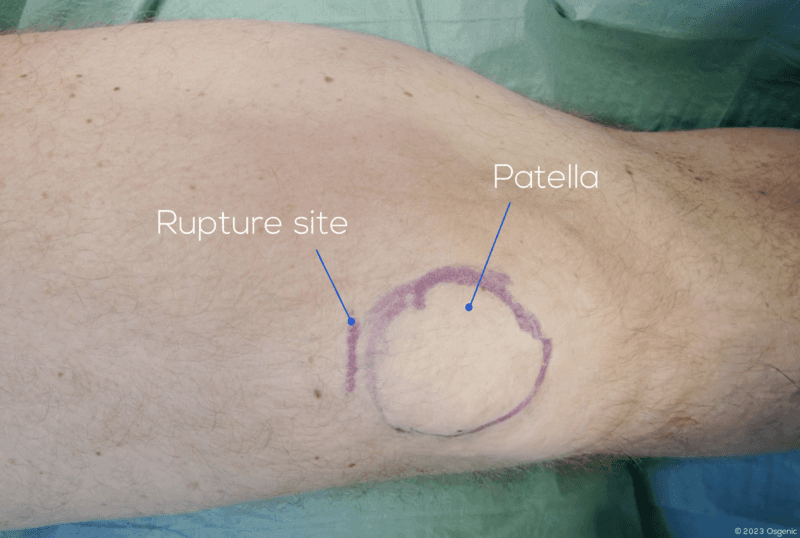
In the transpatellar technique, the skin incision is placed anteriorly in the midline. The incision should be long enough to allow suturing of the quadriceps tendon as well as drilling the K-wires through the patella.
Palpate and mark the edges of the patella and the suspected level of the rupture. Use a soft marker, not a pen, to avoid breaking the surface of the skin.
The incision should extend a few centimeters below the distal border of the patella, to leave room for the drilling of the K-wires, as well as 5–10 cm above the proximal edge of the patella to allow reliable suture bites to be taken of the quadriceps.
Log in or subscribe to access full content and see all the images.
Skin Incision and Exposure of the Rupture Site
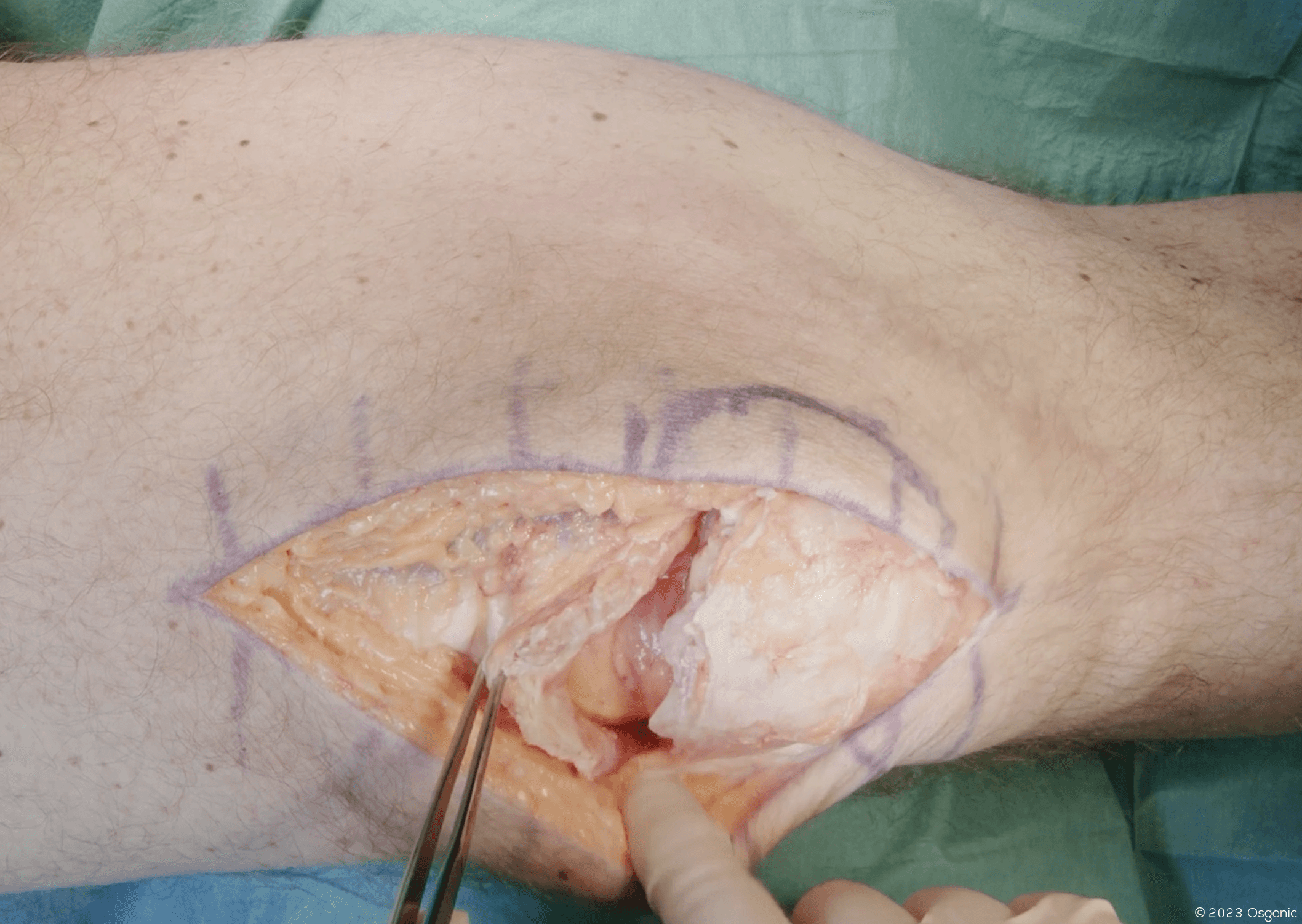
Incise the skin with a scalpel longitudinally as planned. There are no critical structures directly underneath the skin.
Advance through the prepatellar subcutaneous and bursal tissue to the patellar surface. Make sure to cauterize bleeding vessels.
Expose the patellar tendon distally and the torn quadriceps tendon proximally. Also, expose the vastus medialis muscle belly medially and the vastus lateralis muscle belly laterally. The tendon rupture site is most commonly right next to the superior border of the patella.
Explore the site of the injury. Most of the time, the tear extends from the medial to the lateral side, from the vastus medialis insertion to the vastus lateralis insertion, causing a significant retraction of the entire quadriceps tendon. However, sometimes an isolated tear of the rectus femoris tendon can be observed and the tendon is retracted only in the midline. Nevertheless, this is still a tendon rupture which should be recognized and treated early on to maintain the optimal extension of the knee.
Log in or subscribe to access full content and see all the images.
Reattachment of the Tendon — Quadriceps Side
The goal is to have two separate sutures on each side of the quadriceps tendon. Ends of the sutures are then pulled through the bony tunnels drilled through the patella and tied together on the distal side of patella. The entry and exit points of the two tendon sutures should be planned in line with the upcoming transpatellar tunnels.
To start the suturing, first place a retractor securely to have better exposure to the whole rupture site.
There are several techniques we can use for the tendon sutures, for example, Krackow, Kessler, and Bunnell sutures. Here we use Krackow sutures.
Sutures are placed by advancing about 5 cm proximally from the rupture site and returning in the distal direction along the midline of the tendon. A braided nonabsorbable suture, for example size 5 FiberWire, is used. We start the first tendon suture slightly medial in comparison to the lateral edge of the patella. Keep in mind that the lateral or medial tunnel should not be placed too close to the bone margin as not to risk fracture of the patella.
Make sure to pass the sutures through the entire tendon thickness for maximum hold and to leave enough suture thread distally to account for the transpatellar attachment.
We advance about 5 cm proximally from the rupture site and then return in the distal direction along the midline of the tendon.
The medial suture is done the same way by starting slightly lateral to the medial edge of the patella and exiting in the midline of the tendon.
Reattachment of the Tendon — Patellar Side
The goal is to create three longitudinal drill holes in the patella for the sutures to pass through and tie together on distal side of the patella. This method aims to ensure a reliable attachment of the quadriceps tendon to the patella.
Prepare the attachment site by debriding the superior border of the patella for a more secure reattachment of the tendon. You can do this with a rongeur, for example.
Plan sites for three longitudinal bone tunnels in the patella. For the middle tunnel, the patellar ridge can be used as a landmark to find the midline. The lateral and medial tunnels should not be placed too close to the bone edge as not to cause a fracture of the patella.
The guidewire is drilled from proximal to distal direction. To bring the sutures through the patella, use a guidewire with a loop on the other end. Make sure not to perforate the articular surface but stay in the middle between the anterior cortex and the patella’s dorsal articular surface.
Also take care not to damage the skin on the proximal tibia and consider using an instrument, for example a chisel, a Semb rasp, or a Langenbeck retractor, to protect the skin from the tip of the guidewire.After drilling through the patella from the proximal to the distal end, place the suture in the loop or eyelet and finally pull the guidewire with the now attached threads retrogradely back through the patella. Use oscillating mode to avoid twisting the sutures.
Bring one thread from both the lateral and medial tunnels and two threads from the central tunnel. Make sure that the threads in the middle portion of the tendon are brought through the central tunnel and the lateral and medial threads are brought through the respective tunnels. This prevents twisting of the tendon.
Tie the sutures securely at the distal side of the patella. Make sure to tie multiple, 5–7, knots so as to ensure the attachment will not fail. Keeping the lateral and medial sutures separate will prevent twisting the tendon.
Make sure that the distal end of the quadriceps tendon is firmly attached to the proximal edge of the patella so the tension on the tendon is optimal. Sometimes you need to perform a proximal tissue release to help pull the distal end of the tendon to the proximal end of the patella.
Suturing the Lateral and Medial Structures
Often, the rupture extends to lateral and medial capsule of the knee. If so, close the capsular tear to achieve watertight closure of the joint.
Using, for instance, size 2 nonabsorbable sutures, begin the closure from the very edge of the rupture line and proceed using continuous or interrupted sutures to the other border of the rupture line.
Cut the ends of threads and test that the sutures are firm enough by bringing the knee into flexion before closing the wound.
Closing the Wound
The wound closure is done in three layers: two for the subcutis and one for the skin.
The deep subcutaneous layer is closed using absorbable size 0 sutures. Either interrupted or continuous sutures can be used.
The prepatellar bursal tissue provides a firm place for deep subcutaneous sutures and enables secure closure of the deeper part of the wound.The superficial subcutaneous layer is closed by using size 2-0 absorbable continuous sutures.
The skin is closed using single or continuous sutures or with skin staples.
Log in or subscribe to access full content and see all the images.
To access the full video and additional content on this subject, log in or subscribe
Piftalls and Complications
Pitfalls
Misplacement of the Patellar Tunnels
If the tunnels are drilled too medially or laterally, they might cause a fracture in the patella. If placed too anteriorly, there might be cut out through the anterior cortex and, in turn, if drilled too dorsally, they might damage the patellar cartilage.
Problems with Sutures
If the sutures are not passed through all the tendon layers, a sufficient grip might not be achieved, which might lead to failure of reattachment and a re-rupture.
Insufficient tightening of the knots might lead to retraction of the tendon from the superficial border of the patella. Use at least 5 tight knots to prevent loosening of the fixation.
Insufficient closure of the capsule might cause synovial fluid to leak to the soft tissue.
Mobilizing Too Early
It is important to educate your patient and tell them to avoid weight-bearing on a flexed knee as it might cause a failure of the tendon repair. Use a brace or a cylindrical cast to protect the repair. We recommend following local rehabilitation protocol and careful consideration of thromboprophylaxis.
Complications
Fracture of the Patella
Tunnels drilled too close to the bone margin might cause the patella to fracture.
Rerupture of the Tendon
Early weight-bearing on flexed knee within 6 weeks of surgery predisposes to failure of the repair.
Resisted extension training with external weight should generally start 3 months after the surgery and maximum extension force should be applied only after 9 months.
Wound Healing Problems
Careless soft tissue handling and patient-related risk factors predispose to wound healing problems and can lead to severe infections.
Aftercare
General Guidelines
There are often local protocols for the postoperative treatment of quadriceps tendon repair. Generally, weight-bearing with an extended knee is allowed. During the first 6 weeks, weight bearing on a flexed knee is not recommended. After 6 weeks, extension exercises are started first with the weight of the leg, then gradually increasing the resistance. We recommend protecting the knee with a hinged knee brace with the knee in full extension or a synthetic cylindrical cast. Thromboprophylaxis should be considered after evaluating individual risk factors. Refer your patient to physical therapy to avoid muscle loss on the affected thigh.
FAQ
What is the goal of quadriceps tendon repair?
The goal is reattachment of the torn quadriceps tendon to the patella to enable extension of the knee.
Where is the rupture typically located?
The rupture is typically located at the superior border of the patella.
What anesthesia can be used?
Spinal or general anesthesia can be used.
Why is slight knee flexion recommended during preparation?
Slight flexion is helpful when drilling the transpatellar tunnels for the sutures. Too much flexion will complicate the tendon repair because of extra tension.
How are the sutures passed through the patella?
Three longitudinal drill holes are created in the patella. The sutures pass through these tunnels and are tied together on the distal side of the patella.
What should be avoided during the first 6 weeks after surgery?
During the first 6 weeks, weight bearing on a flexed knee is not recommended. Early weight-bearing on a flexed knee within 6 weeks of surgery predisposes to failure of the repair.
To access the full video and additional content on this subject, log in or subscribe