How to Perform a Supracondylar Humerus Fracture Fixation
Source
To access the full video and additional content on this subject, log in or subscribe
Summary
Focus: Pediatric supracondylar humerus fracture fixation with closed reduction and lateral K-wire fixation.
Key elements: Restore elbow alignment, assess sagittal, coronal, and rotational reduction, confirm pin stability, monitor perfusion, and apply casting.
Indications and Clinical Context
General
Medical experts
Morten Jon Andersen, Pediatric orthopaedic trauma surgeon
Name of Procedure
Pediatric supracondylar humerus fracture fixation
Closed reduction and lateral pinning
Closed reduction and percutaneous pinning (CRPP)
Closed reduction and K-wire fixation
CRPP with lateral-only pins
Goal of Operation
To restore normal elbow alignment and prevent neurovascular injury.
Problem
Supracondylar humerus fracture
Diagnosis
Supracondylar humerus fracture (ICD-10: S42.4)
Short Pathophysiological Description
Supracondylar humerus fractures are the most common elbow fracture in children, typically occurring between ages 5–8 from a fall on an outstretched hand. The thin bone between the coronoid and olecranon fossa makes the metaphyseal region vulnerable to fracture. The distal fragment typically displaces posteriorly (extension type), disrupting sagittal alignment. If left unreduced, malunion can result in hyperextension deformity, limited elbow flexion, and cubitus varus — a cosmetically and functionally significant deformity with limited remodeling potential. In more severely displaced fractures, the brachial artery and the median nerve with its anterior interosseous branch can be at risk of compression anteriorly.
Closed reduction restores alignment and relieves pressure on neurovascular structures. Percutaneous pinning stabilizes the fracture, allowing healing in the correct position.
Key Anatomical Structures
Humerus
Capitellum (capitulum)
Olecranon fossa
Coronoid fossa
Medial and lateral epicondyle
Ulna
Olecranon
Radius
Brachial artery
Median nerve
Anterior interosseous nerve (AIN)
Radial nerve
Ulnar nerve
Brachialis muscle
Step-by-Step Technique
Procedure Goal
The goal of this procedure is to restore normal elbow alignment and prevent neurovascular injury through closed reduction and lateral K-wire fixation.
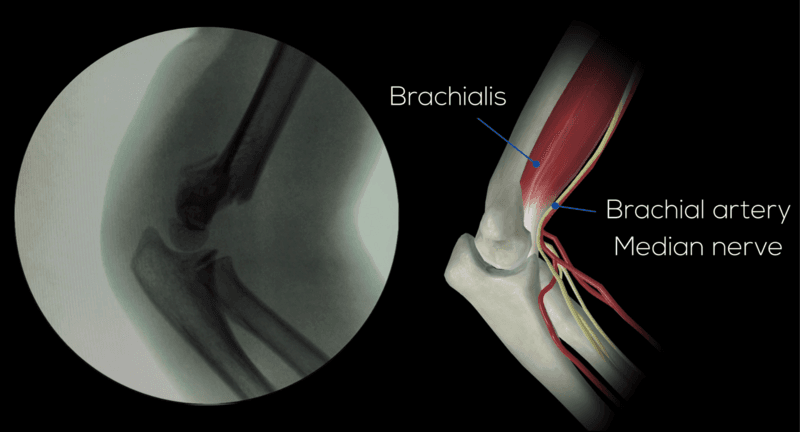
In this case, a Gartland 2A extension-type supracondylar fracture has displaced the distal fragment posteriorly. The posterior periosteum is intact and there is no marked coronal or rotational displacement of the distal fragment.
In the lateral view, the anterior humeral line (AHL) misses the capitellum, indicating the need for reduction. If the posterior angulation is not reduced, it can result in hyperextension deformity and limited elbow flexion. In the AP view, the alignment is acceptable: columns are aligned and equal in width, the Baumann angle, between the humeral axis and the lateral condylar physis, is within normal range (70–80°, ideally compared to the other side). If malalignment were present in the coronal or rotational plane and not correctly reduced, it could lead to elbow deformity — most commonly cubitus varus (increased Baumann angle).
The brachialis muscle lies anterior to the distal humerus, with the brachial artery and median nerve running along its surface. The radial nerve runs along the lateral aspect of the humerus. In more severely displaced fractures, these structures are at risk of compression or entrapment, making urgent reduction essential to restore perfusion. In type 2A fractures, neurovascular injury is rare — but awareness and intraoperative assessment remain important.
Log in or subscribe to access full content and see all the images.
Patient Positioning, Anesthesia and Preparation
The patient is positioned supine with the affected arm placed in abduction on a radiolucent table.
The limb is prepped and draped to allow elbow flexion and extension, forearm rotation, and humeral rotation, with the hand visible for intraoperative perfusion monitoring.
The C-arm is positioned to allow AP and lateral views.
The procedure is done under general anesthesia.
Closed Reduction
Closed reduction aims to restore alignment in the sagittal, coronal, and rotational planes.
In this case, sagittal alignment needs correction — in lateral view, the anterior humeral line misses the capitellum and should be restored to intersect it, ideally its middle or posterior third. Coronal and rotational alignment are acceptable — in AP view, columns are aligned, symmetric in width, with no translation of the distal fragment. The Baumann angle is normal.
If coronal or rotational displacement were present, these would be addressed first with traction of the arm and direct manipulation of the epicondyles.
To correct the posterior angulation, pressure is applied to the olecranon to push the distal fragment anteriorly.
As the elbow is progressively flexed, the intact posterior periosteum tightens and usually guides the fragment into position. If the elbow resists flexion, gentle traction and correction are repeated. Persistent difficulty achieving reduction suggests a more unstable fracture pattern or soft-tissue interposition — requiring additional maneuvers or sometimes, rarely, open reduction.
With the flexion maintained, a lateral image is taken by externally rotating the arm to assess the reduction.
The projection is first confirmed to be true lateral by the hourglass configuration of the anterior coronoid fossa and posterior olecranon fossa.
The true lateral shows the anterior humeral line now passing through the visible ossification center of the capitellum, confirming that sagittal alignment has been restored by this maneuver.
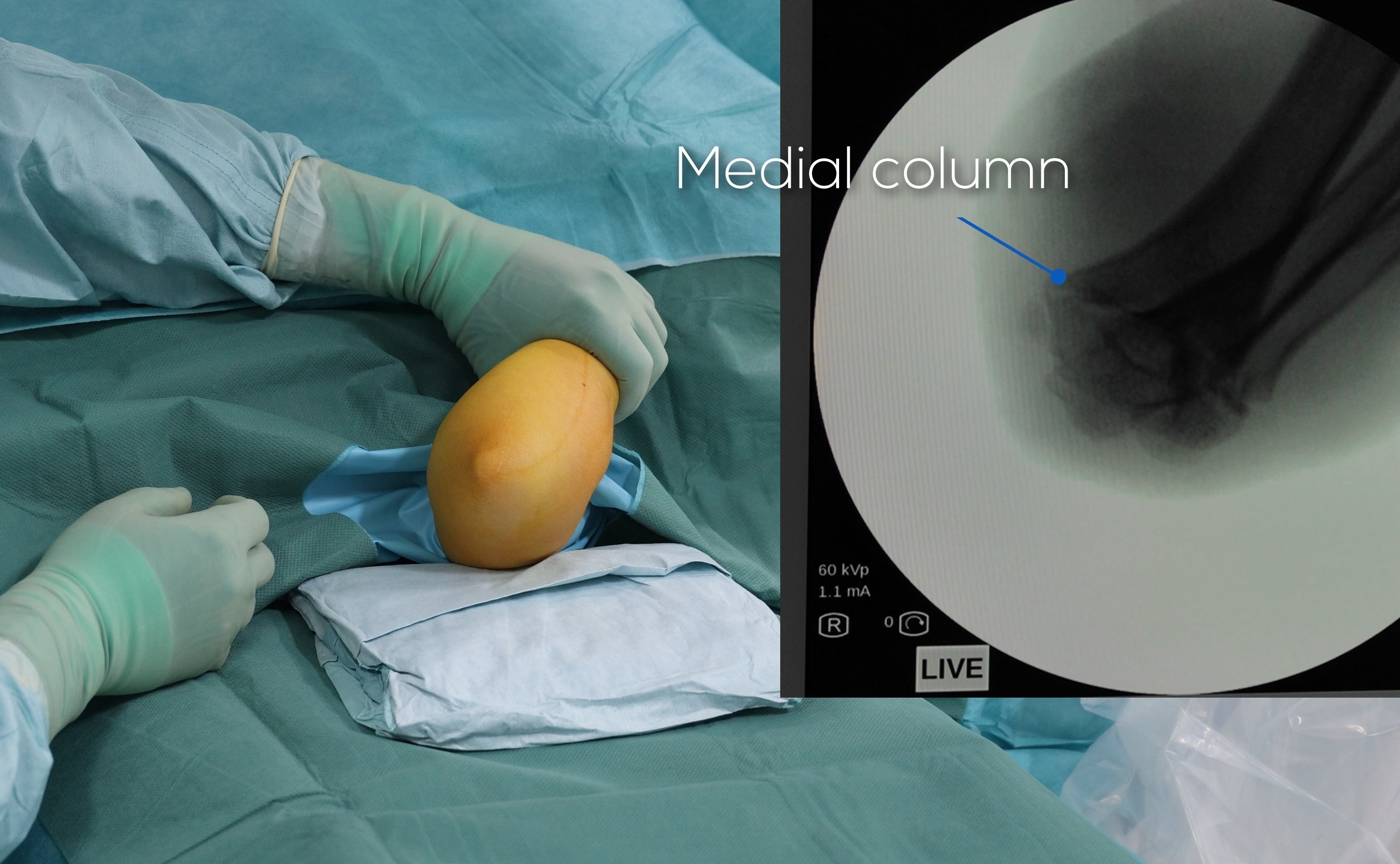
Reduction is verified on AP view also. The medial and lateral columns are aligned with no mismatch between the fragment lines.
To obtain oblique views, the humerus is rotated through external and internal rotation — confirming column alignment from additional angles and ensuring the distal fragment is not in varus. Oblique views can also be used to identify the direction of possible rotational displacement.
Changing forearm rotation and rechecking on fluoroscopy confirms the reduction is robust through supination and pronation.
Along with the anterior humeral line intersecting the capitellum, rotational alignment is also assessed on the lateral view. The proximal and distal fragment widths should match, and no anterior or posterior bone spikes should be visible.
Log in or subscribe to access full content and see all the images.
Planning Pin Insertion Sites
Pin fixation aims to stabilize the reduced fracture and maintain alignment until bone has healed. In this case, two pins are inserted from the lateral side.
A bolster is placed under the arm to stabilize it and allow proper pin trajectories.
Pin diameter is commonly 1.6 mm for smaller children and 2.0 mm for larger children. Thicker pins provide more stability but must fit without splitting bone.
The insertion sites are planned with fluoroscopy. First, a reliable AP view is obtained to plan the pin construct. The olecranon fossa should appear symmetrical, centered between the columns.
The first pin is placed on the skin medial to the lateral condyle, just lateral of the olecranon, and the trajectory simulated on fluoroscopy. The first pin captures the medial column, leaving room for the second to diverge at the fracture level and capture the lateral column.
The second pin will be aimed to capture the lateral column. Together, the pins must diverge more than one-third of the bone width at the fracture level to resist rotation. Both pins will be driven to the far cortex for secure bicortical purchase.
In the sagittal plane, the pin trajectory will be aligned with the humeral shaft axis.
The lateral epicondyle is palpated as a landmark and the first entry site is marked on the skin according to the planned trajectory. The second entry site is marked slightly lateral to the first, according to the plan, to achieve the divergence.
Pin Insertion
The first pin is started at the marked entry point.
Fluoroscopy confirms the entry point and trajectory in the coronal plane.
The sagittal trajectory is maintained by aligning the pin with the humeral shaft.
The pin is seated deeper into the drill to reduce the protruding length and maintain trajectory control.
The pin is advanced manually through the soft tissue and then engaged. Oscillation mode is used to prevent soft-tissue wind-up, avoid thermal injury, and improve control.
Fluoroscopy confirms the pin has engaged the near cortex and the trajectory is correct.
The pin is advanced towards the far cortex with slow advancement under fluoroscopic control.
Tactile feedback indicates when the pin engages the far cortex, which is confirmed by fluoroscopy. The pin should protrude just enough for secure bicortical purchase, but not so far as to risk injury to the neurovascular structures medially.
The lateral view shows the pin is intraosseous until engaging the far cortex — the trajectory appears slightly anterior but will be reassessed with both pins in place.
The second pin is placed on the skin at the marked entry point. Fluoroscopy confirms the planned entry point is valid with the first pin inserted, and the trajectory is planned to capture the lateral column and achieve the required divergence at the fracture level.
The pin trajectory is kept in line with the humeral shaft sagittally.
Similarly, the pin is advanced through the soft tissue and engaged in oscillation mode.
The second pin is inserted in the same manner as the first — advanced under fluoroscopic control until bicortical engagement is confirmed.
The lateral view confirms the sagittal position of the second pin.
The first pin appears slightly anterior, exiting the far cortex earlier than ideal — a subtle adjustment posteriorly would improve the intraosseous purchase.
On the AP view, the overall construct is assessed with the forearm extended. Adequate pin spread and divergence, bicortical purchase, and column capture are evaluated. In this case, the pin trajectories look slightly parallel — the spread at the fracture level could be improved.
The first pin is backed out and redirected. By adjusting the first pin’s trajectory while keeping the same entry site, both issues can be corrected: aimed more posteriorly on lateral view and angled on AP view to increase divergence at the fracture level.
Post-Fixation Assessment
Post-fixation assessment confirms that the reduction is maintained and that the construct resists displacement.
On lateral view, the reduction is maintained — the anterior humeral line crosses the capitellum. The pin construct is assessed: the pins are not intra-articular and do not exit anteriorly.
On AP view, coronal alignment is confirmed — the Baumann angle is acceptable, columns are aligned, and there is no translation or rotation of the distal fragment. The pin construct shows bicortical purchase, adequate divergence, and spread at the fracture level.
Stability is assessed under fluoroscopy. The humerus is rotated through internal and external rotation — the fracture should not displace.
A push-pull test is applied to the distal fragment while the humerus is stabilized — the construct should resist displacement.
The vascular status is reassessed. The pulse is palpated and hand perfusion assessed by capillary refill, color, and temperature. If the pulse is not palpable, Doppler can be used. In this fracture type, vascular compromise is rare — but reassessment at each stage should remain routine.
Pin Bending and Cutting
The pins are bent and cut to allow dressing and casting while preventing migration.
The pins are bent 90 degrees at approximately 1 cm from the skin. Bending is done carefully to avoid loosening the pins in the bone.
The pins are then cut, leaving approximately 1 cm beyond the bend. Pins cut too short may migrate beneath the skin and become difficult to remove.
If a pin tents the skin in the casting position, a small skin release can be made to prevent discomfort and skin breakdown under the cast.
Pin stability should be confirmed — a properly seated pin should resist a slight pull with fingers.
Local Anesthetic and Dressings
A long-lasting local anesthetic is injected intra-articularly into the olecranon fossa from the posterior direction under fluoroscopic guidance.
The pin sites can also be infiltrated subcutaneously.
The pin sites are protected with sterile dressings to prevent contamination and skin irritation.
The pin ends are padded or capped to prevent them from penetrating through the cast.
Casting
A long arm cast is applied to add comfort and protect the construct while the fracture heals. In this case, the cast extends from proximal humerus to wrist level, leaving the fingers free for movement and monitoring of swelling and circulation.
The assistant holds the forearm at the desired angle with the forearm in neutral rotation. In a type 2A fracture with no evident risk to perfusion, the elbow is held at 90° of flexion to help maintain reduction. However, the flexion angle should be adjusted based on the degree of swelling and perfusion status — reducing flexion if needed to avoid compromising blood flow.
A cast stockinette is applied without wrinkles.
A layer of circular cast padding is wrapped from the wrist to the upper arm.
The cast material is unrolled over the padding in overlapping layers without tension to avoid a constricting effect. Once set, the cast can be split if needed to accommodate postoperative swelling.
With the casting complete, perfusion is rechecked and neurological status assessed once the patient is awake.
To access the full video and additional content on this subject, log in or subscribe
Piftalls and Complications
Pitfalls
Inadequate Perfusion Assessment
The brachial artery runs anterior to the distal humerus and can be compressed or entrapped by the displaced fracture fragment or during reduction. Perfusion must be checked before and after reduction and pinning, and before casting — skin color, temperature, capillary refill, and radial pulse. A well-perfused hand with an absent pulse after stable reduction can often be observed. Poor or deteriorating perfusion may require exploration of the brachial artery.
Unreliable Fluoroscopic Views
A true lateral is confirmed by the hourglass configuration formed by the opposing coronoid and olecranon fossae.
If the hourglass is absent or asymmetric, the view is not a true lateral and alignment assessment — including the anterior humeral line — becomes unreliable. A non-true lateral can also mimic or mask rotational displacement.
A true AP is confirmed by the olecranon fossa appearing centered between the medial and lateral epicondyles. If the fossa appears asymmetric or off-center, the humerus is rotated.
Accepting Inadequate Reduction
If malalignment is not recognized or is accepted, pinning will fix the fracture in the wrong position, which can lead to malunion. On the true lateral view, the anterior humeral line should cross the capitellum, preferably through its middle or posterior third. No anterior or posterior bone spikes should be visible. The fracture lines should be congruent and in contact anteriorly — a mismatch can indicate rotation, a gap might suggest soft tissue interposition.
On the AP view, the columns should be aligned and symmetrical with an acceptable Baumann angle.
Failure to Escalate
If closed reduction does not succeed within a few attempts, further attempts are unlikely to produce an acceptable result. A plan for escalation should be in place before starting — sometimes, rarely, this may include open reduction to remove interposed soft tissue from the fracture gap, which often requires a second surgeon.
Wrong Entry Points
If the entry point is wrong, the pin may miss the intended column or enter the joint. The lateral condyle and olecranon can be palpated as landmarks and the entry point planned on fluoroscopy before drilling.
Careless Tissue Handling
Drilling should be performed under fluoroscopic control. Oscillation mode should be used when drilling in order to avoid damaging nerves and/or other structures. During reduction, forceful or repeated manipulation can further damage already compromised soft tissue and increase swelling, potentially worsening neurovascular status.
Wrong Trajectory of Pins
Correct and careful placement of the pins is essential in order to adequately stabilize the fracture as well as for avoiding iatrogenic damage to adjacent tissues. If the pins do not diverge sufficiently at the fracture level, the construct might not resist rotation, leading to loss of reduction. The pins should be separated by at least one-third of the bone width at the fracture level. Both pins must engage the far cortex for adequate stability. Pin trajectory should be confirmed on fluoroscopy before advancing, and the construct assessed as a whole after both pins are placed.
Repeated Drillings
Additional drilling attempts increase the risk of iatrogenic damage to the largely cartilaginous distal humerus, including the growth plates. Pin trajectory should be planned and the number of drillings kept to a minimum.
Lack of Pediatric Anatomy/Development Understanding
The distal humerus in a child is largely cartilaginous — its true dimensions are larger than what is visible on fluoroscopy. Ossification centers appear at different ages and represent only a portion of the anatomy. Depending on the age, the capitellum ossification center can appear small relative to the true cartilaginous capitellum, which can affect how the anterior humeral line intersection is interpreted. In younger children, the true size can be estimated using a circle matching the humeral shaft diameter.
Complications
Brachial Artery Injury
Vascular compromise is most often caused by the fracture displacement itself, where the fracture fragment can compress or entrap the brachial artery. Entrapment can also occur during reduction, particularly with aggressive manipulation. Compromised perfusion must be recognized. Perfusion should be monitored throughout the procedure: skin color and temperature, capillary reaction, and radial pulse.
Median/AIN Nerve Injury
Median nerve injury is the most common nerve injury associated with extension-type supracondylar fractures. It is most often caused by the fracture displacement itself, where the fracture fragment stretches or entraps the nerve. Further injury can occur during reduction, particularly with aggressive manipulation. Nerve function must be documented before and after the procedure. Depending on the extent of injury, it can present as an isolated anterior interosseous nerve palsy — affecting only thumb and index finger tip flexion — or as a full median nerve palsy including sensory loss.
Loss of Reduction
Loss of reduction can result from insufficient pin divergence at the fracture level, failure to engage the far cortex, inadequate pin diameter, or inadequate immobilization. The fracture shifts under deforming forces, particularly rotation. Adequate spread at the fracture level and bicortical purchase reduce this risk.
Malunion, Especially Cubitus Varus
Coronal plane malreduction can result in cubitus varus — a cosmetically visible reversal of the normal carrying angle that may also lead to posterolateral instability. On the AP view, the Baumann angle, between the lateral condylar physeal line and the humeral shaft axis, should fall within normal range and be compared to the contralateral side when available. The medial and lateral columns should appear aligned and symmetric. Coronal malalignment should be corrected before pin fixation as remodeling potential in the coronal plane is limited.
Sagittal plane malreduction can result in loss of flexion — the more common extension malunion — or less commonly loss of extension. On the lateral view, the anterior humeral line should cross the capitellum in the middle or posterior third, fracture surfaces should be in contact anteriorly, and no anterior or posterior bone spikes should be visible. Sagittal malalignment has some remodeling potential, particularly in younger children, but should still be corrected before fixation.
Pin-Site Infection
Skin tethering around the pin increases the risk of pin-site infection. If the skin is tethered around the pin entry point in the casting position, a small release at the base can reduce pressure and help prevent infection.
Compartment Syndrome
Compartment syndrome of the forearm is rare and mostly associated with highly displaced fracture patterns. It can present with escalating pain disproportionate to the injury, pain on passive finger extension, and in younger children, unexplained agitation. A properly pinned and immobilized supracondylar fracture should be essentially pain-free at rest. Increasing pain demands removal of immobilization and reassessment.
Physeal Injury
True physeal arrest is uncommon because the fracture line is metaphyseal. Iatrogenic injury can occur from repeated drilling through the cartilaginous distal humerus.
Aftercare
General Guidelines
The institution’s guidelines should be followed.
The cast and pins are typically removed together at three to four weeks, depending on the patient’s age, fracture stability, and healing progress.
Children often regain motion quickly, but full ROM may take weeks to a few months. Delayed recovery raises concern for stiffness from immobilization, subtle malreduction, pin-site problems, or, less commonly, neurologic issues.
FAQ
What is the goal of supracondylar humerus fracture fixation?
The goal is to restore normal elbow alignment and prevent neurovascular injury.
What alignment should be confirmed after reduction?
On the lateral view, the anterior humeral line should cross the capitellum. On the AP view, the columns should be aligned and symmetrical with an acceptable Baumann angle.
What should be assessed after fixation and casting?
The reduction, pin construct, stability, vascular status, perfusion, and neurological status should be assessed. The pulse is palpated and hand perfusion is assessed by capillary refill, color, and temperature.
When are the cast and pins typically removed?
The cast and pins are typically removed together at three to four weeks, depending on the patient’s age, fracture stability, and healing progress.
To access the full video and additional content on this subject, log in or subscribe