How to perform a tibial plateau fracture - lateral locking plate technique
Source
Surgeon:
Lasse Rämö (orthopedic surgeon)
To access the full video and additional content on this subject, log in or subscribe
Summary
Focus: Lateral locking plate fixation for a tibial plateau fracture of the proximal tibia.
Key elements: Patient positioning, anterolateral approach, articular surface exposure, fracture reduction, locking plate fixation, closure, stability assessment, pitfalls, complications, and aftercare.
Indications and Clinical Context
General
Medical expert: Lasse Rämö, orthopedic surgeon
Name of procedure: Tibial plateau fracture, proximal tibial fracture
Goal of Operation
To restore the articular surface anatomy and the alignment of the tibia with locking plate fixation.
Problem
Fracture of the lateral tibial condyle.
Diagnosis
Fracture of upper end of tibia (ICD-10: S82.1)
Short Pathophysiological Description
Fracture of the lateral condyle of the tibia is often caused by a force directed to the lateral aspect of the knee or by an axial force on the leg while the knee is in valgus, for example, following a fall. The distal femoral end presses toward the tibia, breaking the tibial articular surface.
The fracture is often associated with an articular surface depression, in which case surgery is recommended. The fracture may also result in damaged surrounding soft tissues, including ligaments and menisci. The fracture disrupts the alignment and stability of the knee joint, potentially leading to future complications like post-traumatic arthritis and knee instability.
Key Anatomical Structures
Proximal tibia
Gerdy's tubercle
Tibial tuberosity
Distal femur
Patella
Proximal fibula
Lateral meniscus
Peroneal nerve
Tibialis anterior muscle
Anterior tibial artery
Step-by-Step Technique
Patient Positioning, Anesthesia, and Preparations
The patient is in a supine position.
It is recommended to place the knee in slight flexion. A small support can be placed under the knee to facilitate the approach and the reduction.
Either general or spinal anesthesia can be used.
A tourniquet can be used. The cuff can be positioned proximally around the thigh under the drapes as a backup. It can then be swiftly inflated if necessary to improve visibility.
Landmarks and Incision Site
The skin incision should allow optimal exposure of the fracture site on the proximal tibia and articular surface for precise reduction and fixation, while simultaneously avoiding damage to the surrounding neurovascular structures.
Landmarks for the skin incision are the patella, the lateral joint line, the proximal fibula, Gerdy's tubercle, and the tibial tuberosity.
A slightly curved longitudinal skin incision is placed anterolaterally between the tibial tuberosity and the fibula, over Gerdy's tubercle.
Too posterior an incision could risk damaging the deep peroneal nerve, whereas too anterior an incision might lead to insufficient visibility of the posterolateral area of the tibial joint surface.Extend the incision approximately 5 cm proximally over the joint line to adequately expose the articular fracture. Similarly, extend it about 5 cm distally below Gerdy's tubercle. This will provide sufficient exposure of the fracture site and allow room for the placement of the plate.
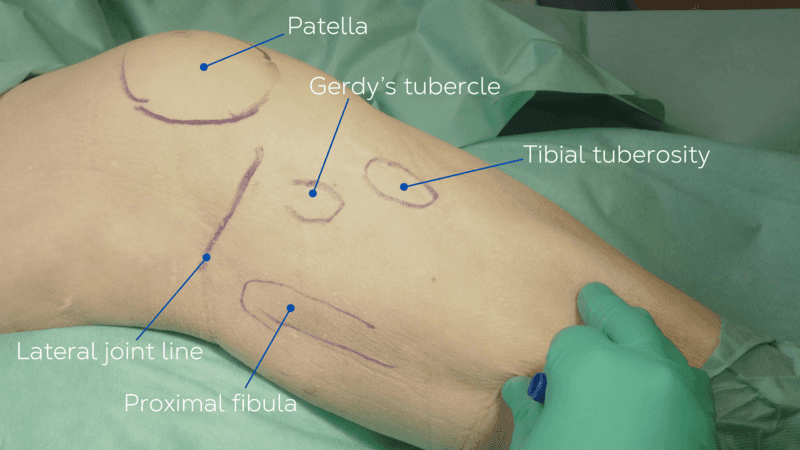
Log in or subscribe to access full content and see all the images.
Skin Incision and Advancing to the Fascia
Incise the skin with a scalpel, perpendicular to the skin, as planned. There are no critical structures directly underneath the skin.
Advance through the subcutaneous fat to the fascia surface and cauterize bleeding vessels. Use retractors to achieve better visualization.
The subcutaneous fat can be slightly released from the fascia to facilitate closure. Excess release of the subcutaneous tissue from the fascia should be avoided to ensure proper wound healing.
Palpate Gerdy's tubercle and the joint line to maintain orientation for the fascia incision.
Advancing Through the Fascia
The goal is to expose the tibialis anterior muscle and the joint capsule to enable access to the fracture site.
Incise the fascia longitudinally over Gerdy's tubercle to avoid damaging the peroneal nerve posteriorly.
The length of the fascial incision corresponds to the length of the skin incision, so about 5 cm proximal to the joint line and 10 cm distal to it.
The fascia can be detached from the tibia either with a scalpel or diathermy. Distally, leave part of the fascia intact on the tibia to facilitate final closure if the muscle fascia is closed.
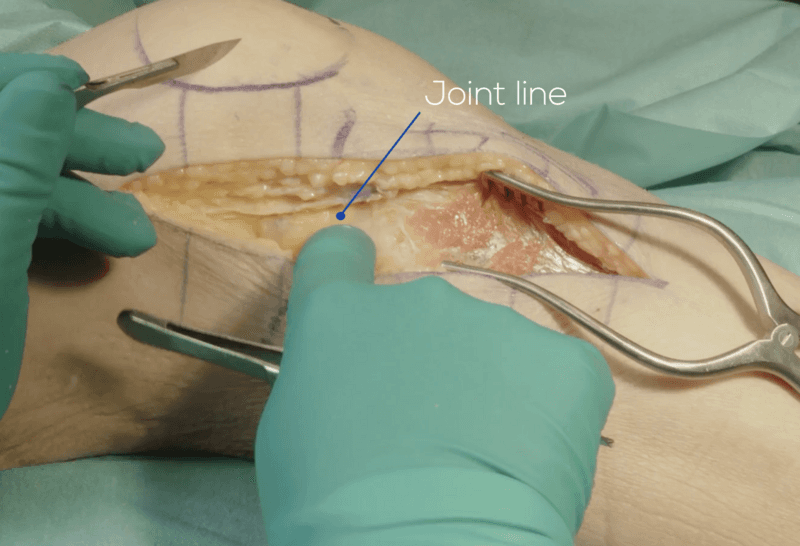
Log in or subscribe to access full content and see all the images.
Advancing to the Bone Surface
The aim is to achieve safe and effective exposure of the condylar fracture site and facilitate intra-articular access.
Locate the proximal part of the tibialis anterior muscle.
Detach the tibialis anterior muscle from the tibia from the anterior side to expose the anterolateral surface of the tibia. The detachment is done anteriorly to prevent damage to the deep peroneal nerve that runs posterior to the muscle.
Avoid detaching the muscle too far posteriorly along the tibia, as in this region the anterior tibial artery traverses through the interosseous membrane. Additionally, be cautious not to place a retractor under the tibialis anterior muscle to prevent damage to the anterior tibial artery.Continue detaching the tibialis anterior muscle distally enough for sufficient evaluation and reduction of the fracture distally.
Adjust the retractor to get better visualization of the fracture site and the joint line for the arthrotomy.
Exposing the Articular Surface
The goal is to achieve proper visualization and assessment of the intra-articular aspects of the tibial plateau fracture in addition to identifying common associated injuries, such as meniscal tears or detachment.
Palpate the joint line and make a transverse capsular incision just above the proximal tibia, below the lateral meniscus.
The arthrotomy should not extend too posteriorly to avoid damaging the popliteal tendon.Mobilize the capsule below the meniscus anteriorly and posteriorly.
To achieve visibility of the intra-articular surface, elevate the meniscus by placing 2-3 holding sutures on the meniscus. Do not take the bites too posteriorly to avoid damaging the popliteus tendon.
Pull the capsule proximally and examine whether the meniscus is detached from the capsule. If so, the meniscus needs to be attached to the capsule during closure.
The assistant turns the knee to the varus position while the sutures are pulled proximally. This exposes the articular surface.
The posterolateral surface is usually hardest to visualize but can be assessed with a dissector.
Reduction of the Fracture
The aim is to restore the normal anatomy of the tibial plateau by repositioning the displaced bone fragments and elevating the depressed segment.
In case of an articular surface depression, the depression should be elevated to its anatomical position. This can often be achieved by opening a longitudinal fracture line like a book, and then using, for example, an elevator to reduce the fragments back to their anatomical position.
If there is residual bone deficit after elevation of the articular surface depression, the empty space can be filled with autogenic or allogenic bone graft or artificial bone.When the articular surface appears flush inside the joint, the reduction can be secured temporarily in place with horizontal K-wires under the articular surface.
Reduce the longitudinal fracture line under visual control using condyle reduction forceps, for example.
Confirm the reduction with fluoroscopy. The articular surface should be even in AP and lateral views. K-wires should be positioned just under the articular surface. Also, the possible longitudinal fracture line should be aligned in its anatomical position.
Placement of the Locking Plate
The goal is to accurately position the lateral locking plate on the tibia, ensuring the screw holes are correctly aligned for optimal fixation. The plate is designed to restore the anatomy and provide angular stability.
Place the locking plate on the tibial surface underneath the tibialis anterior muscle. Make sure that the plate is long enough to extend distally past the fracture line.
The plate should be positioned so that the locking screws in the proximal row can be directed under the depressed area of the articular surface. The initial K-wires can be drilled deeper, piercing through the medial side, if they get in the way of placing the locking plate.
Fix the plate temporarily in place with a K-wire and forceps.
Verify correct placement with fluoroscopy. In the AP view, ensure the locking plate sits nicely on the tibial surface for stability. The proximal part of the plate should be just below the articular surface, providing support but without risking penetration by the proximal screws.
On the lateral view, the plate should be placed in the midline of the tibia so that the distal screws can be placed securely. Adjust the plate, if necessary.
Plate Fixation
The aim is to secure the plate and the repositioned bone fragments. The screws, inserted below the articular surface, should be of appropriate length and correctly oriented to provide optimal support and stability, and to avoid complications such as intra-articular screw penetration.
Depending on the fracture morphology and bone quality, the plate can be initially secured with a cortical screw in the metaphysis-diaphysis area, followed by the locking screws. Alternatively, use only locking screws, starting from the proximal end. If the proximal screws are already in place, do not use a cortical screw, since this can dislocate the fracture.
Drill a hole for the screw. Depending on the fracture, the screws should ideally extend to the medial condyle or the medial cortex, but not beyond. Be careful not to drill through the articular surface. To ensure correct orientation of the proximal screws, drill parallel to the K-wires.
Measure the length and insert the screw. Manually tighten all screws to avoid damage to the interface between the screw head and the plate.
After inserting two proximal screws to provide stability and reduce the risk of rotational instability, place a distal screw.
If there is any doubt whether the reduction is still in place, it is advisable to verify the reduction with fluoroscopy.
Insert the rest of the screws in place. Depending on the fracture type, aim for a minimum of four screws in the proximal part, with three out of four in the most proximal row, to prevent depression of the articular surface. The second most proximal row should be used without hesitation, especially in cases of osteoporosis. Distal to the fracture line, aim for 3-4 screws to ensure a reliable hold.
The distal screws can be inserted with an external drill guide. If this is not available, the distal screws might need a separate skin incision. Fluoroscopy can be used to determine the incision site. If there is risk of compartment syndrome, the initial fascial incision should be extended distally. Carefully expose the plate under the tibialis anterior muscle with a rasp and insert the screws.
Verify the fixation with fluoroscopy after all screws are in place. In the AP images, ensure that the articular surface is flush and that the proximal screws do not pierce the articular surface. All screws should extend to the medial cortex to provide optimal fixation. The distal four screws should be placed distal to the fracture.
In the lateral view, the plate should be placed between the cortices, and the articular surface should be even, with its anatomical aspects restored. This includes the appearance of the medial and lateral condylar surfaces and the tibial slope.
Closure
Remove the meniscal holding sutures. If there is a vertical tear in the meniscus, it should be sutured with, for example, PDS No. 0 using the inside-out meniscal repair technique.
Attach the joint capsule through the plate holes with Vicryl No. 0, for example.
Close the fascia over the proximal plate, using No. 0 Vicryl, for example. The fascia should be closed at least to cover the joint line and the proximal part of the plate to provide a protective layer over the plate. Distally, the plate is covered by the muscle layer.
Evaluate the risk of compartment syndrome. If the anterior compartment of the leg shows no significant tension or swelling, the fascia can be closed over the muscle area. However, in cases of noticeable swelling and potential compartment syndrome, leave the fascia open over the muscle area. If needed, the fascia can be further opened distally.The subcutis is closed using continuous sutures with 2-0 Vicryl, for example.
The skin is closed using single or continuous sutures or with skin staples.
Assessing the Stability of the Knee
The goal is to examine if there are any ligament injuries associated with the proximal tibial fracture which can be difficult to repair during the primary operation but should be identified.
This includes checking the knee's range of motion and testing the integrity of the medial and lateral collateral ligaments, as well as the anterior and posterior cruciate ligaments. Stable endpoints during these tests indicate intact ligaments.
To access the full video and additional content on this subject, log in or subscribe
Piftalls and Complications
Pitfalls
Incorrect Site of Incision
If the skin incision is too anterior, it may reduce the visibility to the posterolateral area of the articular surface. The incision is made longitudinally from the lateral side of the tibial tuberosity over Gerdy's tubercle to the lateral aspect of the distal femur.
The fascia should be opened longitudinally over Gerdy's tubercle, so that the peroneal nerve stays posterior and stays unharmed.
Careless Tissue Handling
Excessive mobilization of the subcutis from the fascia can lead to wound healing problems. Approximately 1 cm from the planned site of the fascia incision in each direction is usually sufficient.
When mobilizing the proximal attachment of the tibialis anterior muscle, it is important to be careful of the peroneal nerve, which runs posterior to it, and the anterior tibial artery, which runs through the interosseous membrane.
When performing a capsulotomy under the meniscus, remember that the popliteal tendon, which runs posterior to it, may be injured if the incision is extended too far posteriorly.
When inserting the proximal screws, it is important to make sure they do not puncture into the joint. A drill guide and the K-wires, used for temporary fixation of the plate, can be used to aid positioning.
Reduction Problems
Incomplete reduction and a residual articular surface depression predispose the patient to post-traumatic osteoarthritis. If there is residual bone deficit after elevation of the articular surface depression, for example in osteoporotic bone, the empty space can be filled with autogenic or allogenic bone graft or artificial bone.
Complications
Peroneal Nerve Injury
If the incision is too posterior, there is a risk of peroneal nerve injury, particularly if the fascia is opened over the fibula. The deep peroneal nerve branch may be injured if the tibialis anterior muscle is detached from the fibular side and not from the tibial side.
Anterior Tibial Artery Injury
When detaching the tibialis anterior muscle from the tibia, advancing too posteriorly to the interosseous membrane area may result in damaging the anterior tibial artery, which runs through it. A gap of 1-1.5 cm is adequate for assessing the extent of the fracture distally.
Compartment Syndrome
Compartment syndrome may develop postoperatively. It should be diagnosed swiftly, and fasciotomy of the compartments should be performed.
Infection
The severity of the injury, individual risk factors, and careless tissue handling make the wound prone to healing problems, possibly even resulting in refractory infection.
Aftercare
General Guidelines
An elastic bandage is applied to the leg. The knee can be protected with a hinged knee brace or a tubular orthosis. The joint is mobilized as quickly as possible.
Depending on the fracture morphology, bone quality, and fragmentation of the articular surface, touch-down weight-bearing is usually applied for 6 weeks, after which weight-bearing is gradually increased. Thrombosis prophylaxis should be considered based on individual risk factors.
FAQ
What is the goal of lateral locking plate fixation for a tibial plateau fracture?
The goal is to restore the articular surface anatomy and the alignment of the tibia with locking plate fixation.
Which landmarks are used for the skin incision?
The landmarks for the skin incision are the patella, lateral joint line, proximal fibula, Gerdy's tubercle, and tibial tuberosity.
Why should the arthrotomy not extend too posteriorly?
The arthrotomy should not extend too posteriorly to avoid damaging the popliteal tendon.
How is postoperative weight-bearing usually managed?
Depending on fracture morphology, bone quality, and fragmentation of the articular surface, touch-down weight-bearing is usually applied for 6 weeks, after which weight-bearing is gradually increased.
To access the full video and additional content on this subject, log in or subscribe