How to perform a toe amputation
Source
Surgeon:
Jenni Holmström (vascular surgeon)
To access the full video and additional content on this subject, log in or subscribe
Summary
Focus: Toe amputation, toe disarticulation, or toe exarticulation for removal of an infected or gangrenous toe.
Key elements: Circulation assessment, incision planning near the MTP joint, exarticulation, tendon and nerve handling, sampling when infection is suspected, tension-free closure, and postoperative weight-bearing restrictions.
Indications and Clinical Context
General
Medical expert: Jenni Holmström (vascular surgeon)
Names of procedure: Toe amputation, toe disarticulation, toe exarticulation
Goal of operation
To remove a toe.
Problem
An infected or gangrenous toe.
Diagnosis
Atherosclerosis of arteries of extremities (ICD-10: I70.2)
Type 2 diabetes mellitus with peripheral circulatory complications (ICD-10: E11.5)
Short pathophysiological description
The most common reasons for a need of toe amputation are diabetes and peripheral atherosclerosis.
Atherosclerosis in the peripheral vascular structures, which leads to impaired circulation in the forefoot, can result in a minor wound that progresses into tissue necrosis. If left untreated over time, the necrosis can spread to a larger area.
An infection associated with diabetic neuropathy can spread undetected from the wound in the numb toe, potentially compromising the entire toe or even the foot.
Before proceeding with a toe amputation, it is imperative to make sure that there is sufficient circulation for the healing process. A toe pressure value >50 mmHg is considered optimal. If necessary, steps to re-establish blood flow, or revascularization, are implemented before carrying out the amputation.
In case of a severe infection where delaying amputation is not possible, the procedure can still be performed. However, the wound is left open until the inflammation has been treated and blood flow is re-established through revascularization. The closure is performed in a second surgery.
Key anatomical structures
Digital bones: metatarsal, proximal and distal phalanx
MTP joint
Digital arteries and veins
Digital nerves
Step-by-Step Technique
Patient positioning, anesthesia and preparation
The patient is in supine position with the affected foot exposed. An assistant can gently pull the adjacent toe aside to provide room for the procedure.
With an amputation at the MTP joint level, a nerve block is typically sufficient. This could be an ankle or popliteal block. However, in some cases, spinal or general anesthesia may also be considered.
Typically, a tourniquet is unnecessary, as these patients often have poor peripheral circulation.
Landmarks and incision site
The skin incision site is at the base of the toe, slightly distal to the MTP joint line, not directly on it, aiming to preserve soft tissue to facilitate tension-free closure. However, all devitalized tissue should be removed.
A horizontal curve-shaped incision is planned around the toe using a marker.
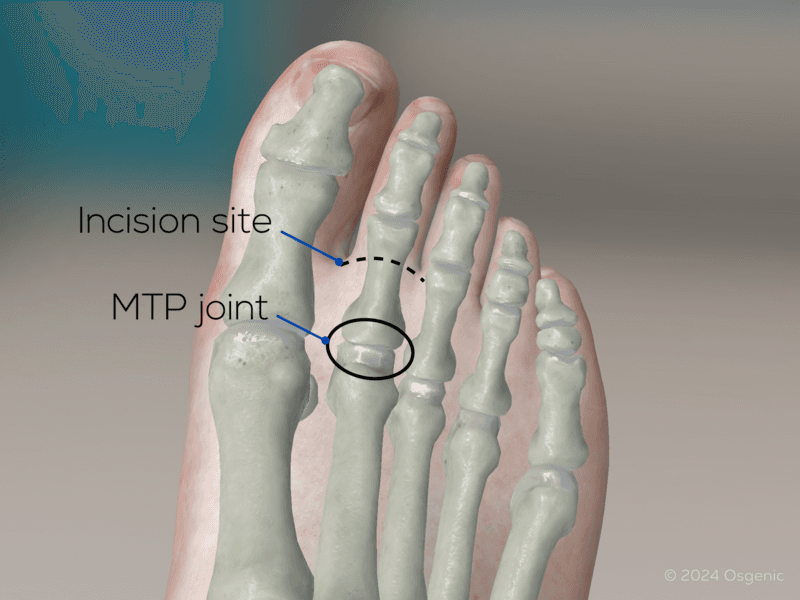
Log in or subscribe to access full content and see all the images.
Skin incision
The skin is incised using a size 10 scalpel following the traced line dorsally and plantarly.
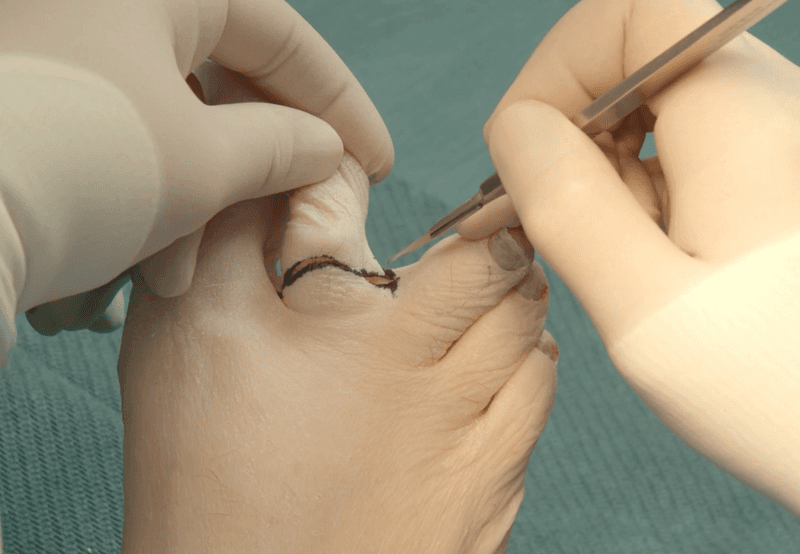
Log in or subscribe to access full content and see all the images.
Advancing to bone surface
Using a scalpel, proceed through the soft tissues to the bone surface at the base of the toe. When performing the dissection, always have the scalpel face the bone to prevent harm to the surrounding tissues.
The nerve and the vascular bundles run on both sides of the toe. If there is any bleeding, hemostasis should be performed with diathermy.
Divide the tendons with the scalpel and allow them to retract. The same principle can be applied to the nerves to prevent painful neuromas.
Locate the MTP joint by palpating with a finger, then proceed by advancing with a scalpel along the surface of the bone.
When the MTP joint is exposed, the toe is ready for amputation.
Exarticulating the toe
Proceed with the scalpel into the MTP joint space and detach the toe along it.
Tendon shortening, sampling and hemostasis
Shorten the tendons to the level of the distal metatarsal bone.
Check the end of the distal metatarsal before moving on. If the bone feels soft, it may indicate infection, requiring tissue samples to exclude osteomyelitis. Use a rongeur for bone sampling and also sample the soft tissue.
If the distal part of the remaining metatarsal feels soft, it may need to be shortened with bone cutters or a rongeur. If so, make sure to check that no sharp bone edges are left in contact with the soft tissue.
Perform final hemostasis with diathermy.
Closure
Bring the wound edges together to assess the closure. Excess skin or soft tissue can be excised at this point.
After the toe is removed, it leaves extra space, or dead space, in the soft tissue, which is closed with deep bites using absorbable sutures, for example Vicryl 2-0, with a small needle.
For the skin, a 3-0 monofilament is used for interrupted sutures, ensuring that the skin edges achieve a tension-free closure.
To access the full video and additional content on this subject, log in or subscribe
Piftalls and Complications
Pitfalls
Too distal level of amputation
With too distal an amputation level and unhealthy tissue left behind, the wound might not heal, and additional amputation may be required in a revision surgery.
Too proximal incision site
If there is insufficient skin for closure and tension is present, it could compromise the circulation, leading to necrosis at the wound edges.
Careless tissue handling
A wound left too tight due to tissue deficit, tension, or too frequent stitches heals poorly, or can lead to wound edge necrosis.
Neglecting to assess circulation
If the surgery is performed in an elective setting, it is imperative to make sure preoperatively that there is sufficient circulation for the healing process. Revascularization should be performed before the amputation, if possible.
In case of a severe infection where delaying amputation is not possible, the procedure can still be performed. However, the wound is left open until the inflammation has been treated and blood flow is re-established through revascularization. The closure is performed in a second surgery.
Complications
Wound edge necrosis
This is often a result of poor circulation but can also occur due to overly tight sutures restricting blood flow or insufficient skin for proper wound closure. This complication can delay the healing process and may necessitate intensive wound care or even further treatment to facilitate tissue repair and growth.
Wound healing problems
Poor circulation can also lead to general wound healing problems, as adequate blood flow is necessary for the healing process. In cases where poor circulation is the cause, revascularization may be an option.
Neuroma
Neuromas can form when digital nerves are left too long after an amputation. This happens because the cut end of the nerve can re-grow in a disorganized manner onto the skin surface, leading to a painful condition. One method to potentially reduce the risk of neuroma formation involves sharp, proximal-level nerve cutting, allowing the nerve to retract deeper into the tissue.
Aftercare
General guidelines
No weight bearing for 2 weeks, after which partial weight bearing is allowed with gradual progression to full weight bearing. The stitches are removed at three weeks.
FAQ
What are the most common reasons for toe amputation?
The most common reasons for a need of toe amputation are diabetes and peripheral atherosclerosis.
What toe pressure value is considered optimal before toe amputation?
A toe pressure value >50 mmHg is considered optimal.
When may the wound be left open after toe amputation?
In case of a severe infection where delaying amputation is not possible, the procedure can still be performed, but the wound is left open until the inflammation has been treated and blood flow is re-established through revascularization. Closure is performed in a second surgery.
When are the stitches removed after toe amputation?
The stitches are removed at three weeks.
To access the full video and additional content on this subject, log in or subscribe