How to Perform a Total hip arthroplasty (uncemented) - posterior approach
Source
Surgeon:
Joni Serlo (orthopedic surgeon)
To access the full video and additional content on this subject, log in or subscribe
Summary
Focus: Total hip arthroplasty with an uncemented endoprosthesis using the posterior approach.
Key elements: Lateral decubitus positioning, posterior approach exposure, acetabular and femoral preparation, component trialing and implantation, closure, pitfalls, complications, and aftercare.
Indications and Clinical Context
General
Medical experts: Joni Serlo (orthopedic surgeon), Jenni Liikanen (orthopedic resident)
Name of procedure: Total hip arthroplasty (uncemented) - posterior approach
Goal of Operation
Total hip replacement with endoprosthesis. The objective is to restore adequate function of the hip joint and to allow rapid postoperative weight-bearing as well as mobilization.
Problem
Advanced hip joint osteoarthritis causing pain and reduced range of motion that interferes with daily activities, when nonsurgical treatments have not helped or are no longer effective at relieving the symptoms.
Diagnosis
Osteoarthritis of the hip joint (ICD-10: M16.x)
Short Pathophysiological Description
Damage to the joint cartilage can lead to osteoarthritis. It can be classified into two categories: primary (idiopathic) osteoarthritis and secondary osteoarthritis. Secondary osteoarthritis can be caused by, for example, avascular necrosis (idiopathic or secondary), dysplasia of the hip joint, or trauma. The typical symptoms include pain and functional impairment, including reduced range of motion and/or joint stiffness. Failure of conservative treatment indicates the need for assessment of surgical intervention.
Key Anatomy and Landmarks
Key Anatomical Structures
Greater and lesser trochanter of femur
Anterior superior iliac spine (ASIS)
Posterior superior iliac spine (PSIS)
Gluteus maximus, medius, and minimus
Short external rotators of the hip:
Piriformis
Superior and inferior gemelli
Obturator internus
Quadratus femoris
Joint capsule
Sciatic nerve
Acetabulum:
Acetabular fossa
Anterior/posterior wall
Step-by-Step Technique
Patient Positioning, Anesthesia, and Preparation
The patient is positioned in the lateral decubitus position.
The pelvis should be in a neutral position, avoiding common misalignments such as anterior/posterior tilts and inward rotation.
Possible inward rotation of the pelvis can be assessed from the foot of the table and corrected by adjusting the supports.
The pelvis can also be tilted in a lateral direction, upward or downward, which can be observed from behind the patient.
Ignoring the need to check and understand the pelvis position could result in misalignment of the acetabular component, increasing the risk of complications related to cup positioning, such as posterior dislocation.The position of the pelvis is stabilized by 3 pads: 2 positioned on the anterior side on the anterior superior iliac spines (ASIS), and 1 positioned on the posterior side on the sacrum.
Any pre-existing limb length discrepancy should be checked before the procedure, for example by comparing the level of the knees.
The drapes are placed high enough to enable inspection and palpation of the bony landmarks. The lower limb is draped so that it is freely movable.
Both general and spinal anesthesia are applicable.
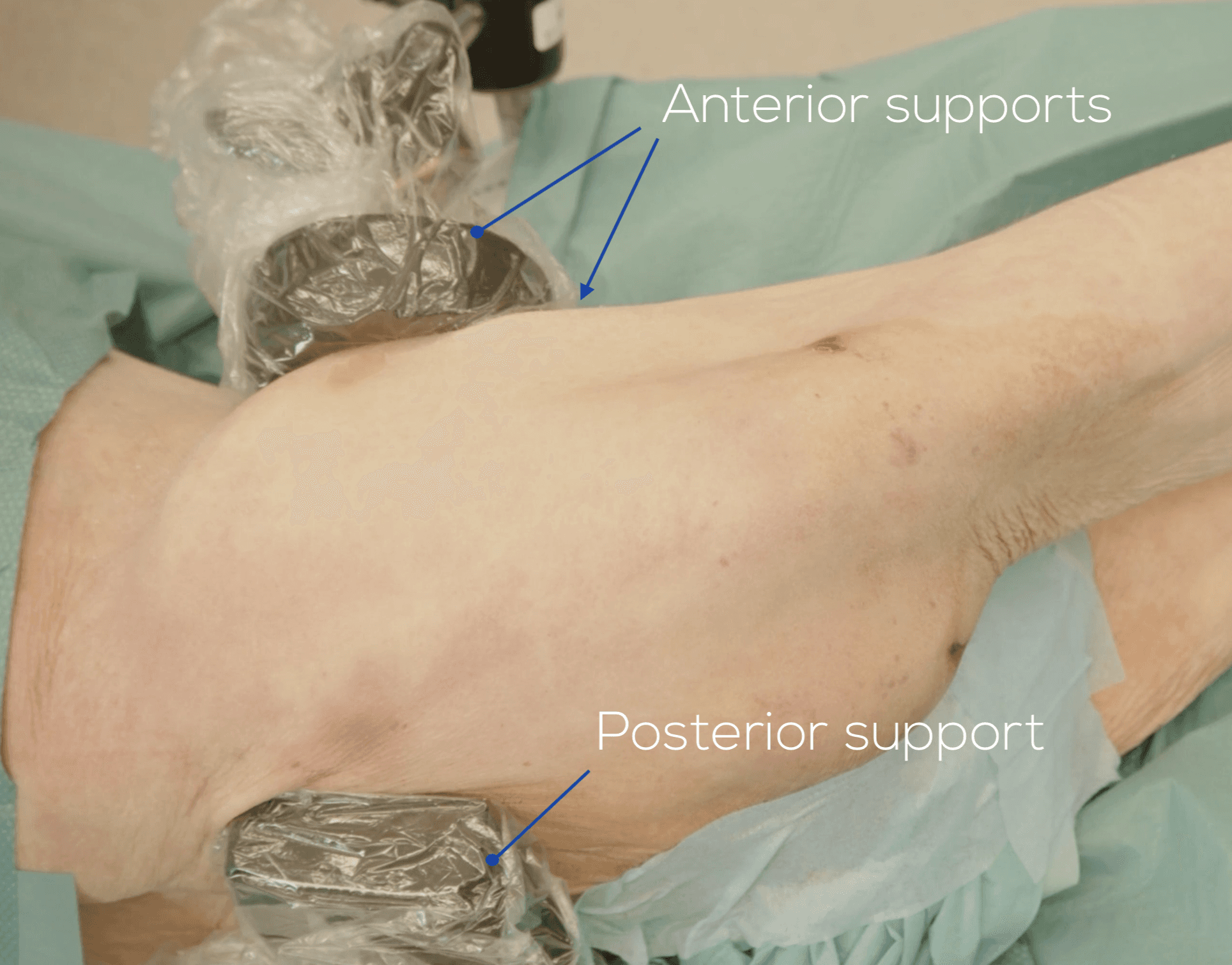
Log in or subscribe to access full content and see all the images.
Landmarks and Incision Site
The goal is to plan an incision that will provide adequate exposure and allow proper instrument maneuverability in the acetabulum and femur while minimizing damage to the surrounding tissues.
Landmarks for the skin incision are the greater trochanter, shaft of femur, and posterior superior iliac spine (PSIS).
The incision is positioned at the posterior aspect, the posterior third, of the greater trochanter.
An incision that is planned too anteriorly can lead to inadequate exposure, making the procedure technically more demanding.The length of the incision can vary, but it needs to be long enough to provide adequate exposure. Starting from the level of the trochanteric tip, the incision extends proximally 5-10 cm toward the PSIS, and distally about 10 cm along the line of the femoral shaft.
A more substantial layer of subcutis requires a longer incision than thinner subcutis.
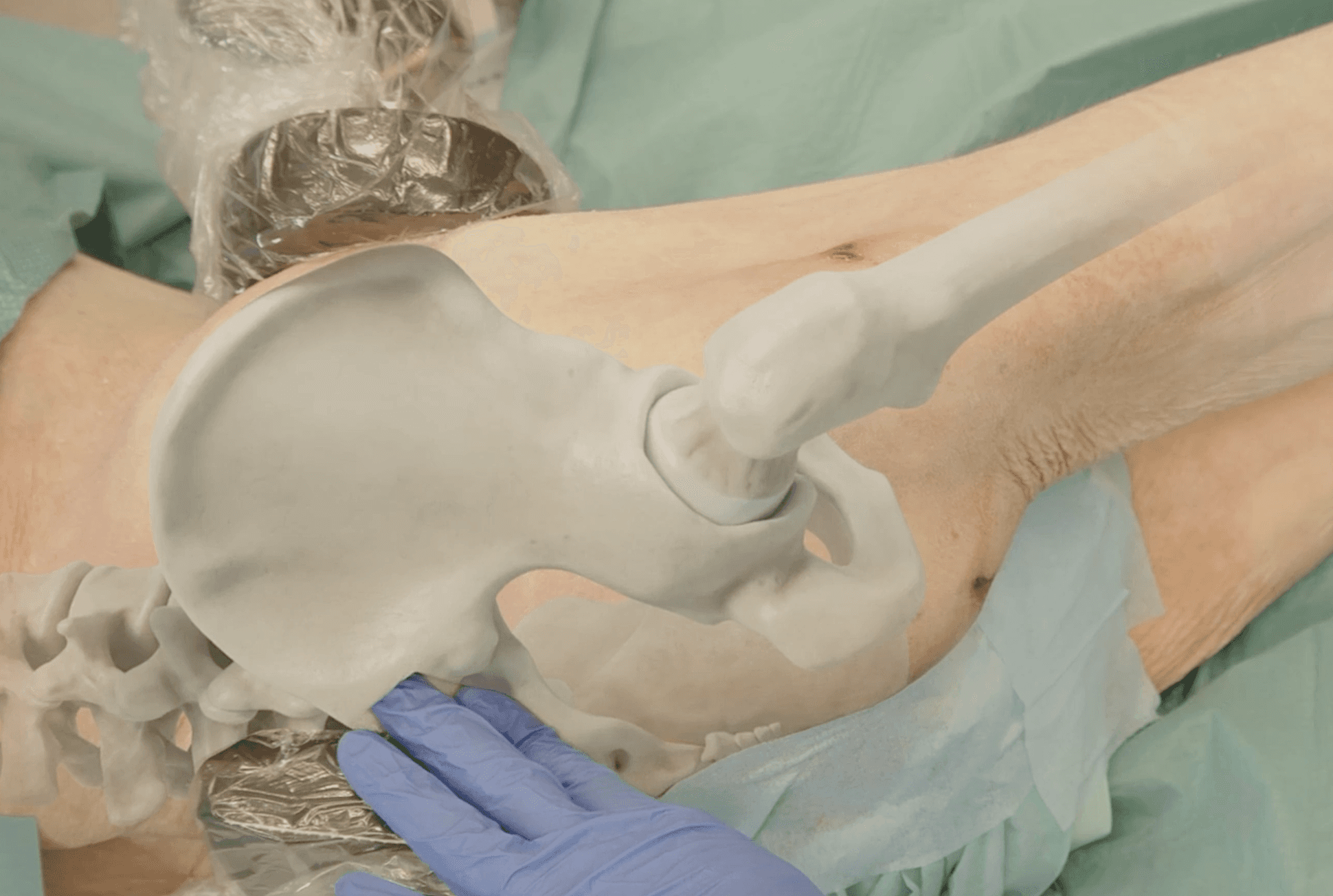
Log in or subscribe to access full content and see all the images.
Skin Incision and Proceeding to Fascia Lata
The skin incision is made using a scalpel or diathermy. There are no specific structures to be cautious of directly under the skin.
Proceeding through the subcutaneous tissue is done using a scalpel or diathermy. An Adson retractor or finger hooks can be used to ensure good visibility, particularly with a thicker subcutaneous layer.
Verification by palpation is usually necessary to ensure advancement toward the posterior margin of the greater trochanter. Otherwise, especially in cases with a significant amount of subcutis, there might be a tendency to drift too posteriorly.Proceeding through the subcutaneous tissue should be continued until the fascia lata is visible.
To facilitate later closure, it is useful to expose about 1 cm of the fascia anteriorly and posteriorly from the planned incision site before opening it.
Opening the Fascia and Placing the Charnley Retractor
The goal is to access the surgical area through a sufficiently large fascia incision and create good visibility to the insertion of the short external rotators of the hip joint.
The fascia lata is incised in line with and through the entire length of the skin incision, using scissors, a scalpel, and/or diathermy.
Proximally, the fascial incision should follow the line of fibers in the gluteus maximus.The gluteus maximus is split bluntly in line with its fibers.
The bursal tissue is incised along with possible bursal adhesions.
Before placing the Charnley retractor, it is important to locate the sciatic nerve coursing posterior to the external rotators.
The retractor is placed at the level of the trochanteric tip, typically around the midpoint of the incision, grasping only the fascia and muscle layer, making sure not to catch the sciatic nerve under the retractor or even too close to it to prevent iatrogenic sciatic nerve injury.
After placing the retractor, it should be checked that the sciatic nerve runs freely.
The exposure to the short external rotator area should be sufficient proximally and distally. If not, widen the incision by opening all the layers: skin, subcutis, and fascia to avoid any constriction in the area.
Detaching the Short External Rotators and Opening the Joint Capsule
The goal is to detach the short external rotators from the trochanter and make a sufficiently large joint capsulotomy to be able to dislocate the femoral head. An inadequate joint capsule opening makes it difficult or even prevents dislocation of the femoral head.
Exposure to the short external rotators and posterior capsule area is enhanced by placing the patient's foot on a Mayo stand and internally rotating the hip.
The posterior border of the gluteus medius muscle is identified.
A Hohmann retractor is used to retract the gluteus medius muscle anteriorly, which enhances visibility of the surgical area and protects the muscle.Any remaining bursal tissue or fat is incised near the attachment site of the short external rotators.
Short external rotators of the hip should then be identified: piriformis, superior and inferior gemellus, obturator internus, and quadratus femoris. The tendinous proportion of these muscles may vary a lot, as well as the extent of fatty atrophy.
For improved exposure and later reattachment, tagging sutures can be placed on the piriformis tendon and other short external rotators before or after detaching them.
The short external rotators and the posterior capsule beneath them are detached from their insertions with a scalpel or electrocautery as close to the greater trochanter surface as possible. The incision is done from the piriformis level to the lesser trochanter.
Detaching the rotators too far from the bone might lead to difficulties in reattaching them during the closure step. This could potentially result in compromised muscle function and elevate the risk of postoperative dislocation.The joint capsule underneath the rotators can be incised simultaneously with the rotators or using a separate incision.
Distally, the incision should reveal the lesser trochanter.
Proximally, the incision curves posterosuperiorly along the piriformis tendon, making sure not to damage the gluteus minimus.
The incision is continued until the bony acetabular rim is reached, with the labrum also being incised in the same direction as the incision.The capsulotomy is now sufficient to allow for dislocation of the femoral head.
Dislocating the Joint
The aim is to displace the femoral head out of the acetabulum to provide access to the joint and allow for removal of the femoral head.
The hip is flexed to relax the surrounding ligaments and muscles.
Next, the femur is adducted and internally rotated to dislocate the hip. Gentle traction can be applied if needed.
The use of excessive force might lead to fractures or soft tissue damage. If there is resistance when dislocating, it may indicate the need for further capsular release or removal of possible obstructing osteophytes.
Femoral Neck Resection
The aim is to remove the femoral head at a correct level and direction. This prepares the femur for the upcoming preparation for the prosthetic stem and facilitates access to the acetabulum.
A Hohmann retractor is placed under the femoral neck to protect the soft tissues.
The position of the limb is checked: the heel should be directed upward toward the ceiling. This gives good access to the dislocated neck and stabilizes the limb.
The correct level of the resection is determined from the preoperative plan. The reference point can be the lesser trochanter or other bony landmark, such as the piriformis fossa. Consider also the saw angle in respect to the neck of the femur. The aim is to have the porous surface on the prosthesis inside the femoral bone.
An oscillating saw is used to perform the initial cut along the planned line. Ensure the saw is held at the correct angle and that the cut is straight.
The resection can be completed with a chisel, or osteotome. The chisel should be directed away from the greater trochanter. Leverage toward the greater trochanter with the instrument should also be avoided to prevent iatrogenic fracture of the greater trochanter.
The femoral head is removed with forceps by twisting the head and cutting the remaining anterior capsule adhesions.
Once the femoral head has been removed, it is important to assess the anteversion of the femoral neck. Typically, the anteversion angle ranges between 10 and 15 degrees. If the observed angle deviates from this range, this variation should be taken into consideration when determining the placement of the cup component in the acetabulum.
Preparing the Acetabulum
The aim is to gain good visibility to the acetabulum and also to clear it of any remaining soft tissue for reaming.
The limb position is adjusted to improve access to the acetabulum by flexing the hip and introducing some internal rotation. The foot can be lifted onto a Mayo stand to facilitate the position.
A long curved Hohmann retractor is placed behind the anterior column, typically at the 1-2 o’clock position in a right hip, and the femur is retracted anteriorly with it.
Placing the retractor directly medially, at 3 o’clock, should be avoided as it might cause an acetabular fracture due to thinner bone.
When placing the retractor, it should be introduced carefully close to the bone surface, not to cause damage to adjacent tissues: the medially located femoral nerve, artery, and vein.To retract posterior structures out of the way, the inferior capsule is split with diathermy/scalpel. Cauterize any bleeding.
Placing a Steinmann pin to the ischium, between the capsule and the labrum, keeps the posterior soft tissues retracted.
When using a Steinmann pin, it is important to position it within the ischium to ensure sufficient bone support for stability while being cautious to avoid damage to nearby structures.If achieving sufficient visibility for reaming proves challenging, the following things might help:
Checking if the limb’s rotation/flexion needs adjusting.
Checking if the superior capsule needs more detaching from the superior acetabular rim.
If tension at the gluteus maximus insertion exists, 1-2 cm of the superior tendon can be incised, but this also needs to be closed later on during closure.
The labrum is removed along the bony rim of the acetabulum using a scalpel directed inside the acetabulum.
Retained labrum may interpose bone and the cup and prevent the cup from stabilizing.The true, or anatomical, floor of the acetabulum, the acetabular fossa, is identified to determine the right depth of reaming. The soft tissue and possible osteophytes are removed to visualize the true floor.
Osteophytes are resected using a chisel and rongeur.
Particularly, anterior osteophytes can cause levering against the neck of the femoral component and thus increase the risk of posterior dislocation. Preoperative images often provide information about the presence of osteophytes.Sufficient exposure and visibility have been achieved when the bony landmarks of the acetabulum, the transverse acetabular ligament (TAL), acetabular fossa, anterior and posterior walls of the acetabulum, and superior acetabular dome, are visible, and the soft tissues have been cleared for reaming.
Acetabular Reaming
The goal of reaming the acetabulum is to remove the damaged cartilage and create a bleeding bone surface to promote bone ingrowth for secure fixation of the acetabular implant. Reaming shapes the acetabulum to fit the prosthetic cup, and the correct depth and orientation during reaming ensure optimal alignment and stability of the prosthesis.
Before starting the reaming, the preoperative plan should be checked: the planned cup size and the planned reaming depth, which gives a rough idea of how much bone needs to be removed. Usually, the desired depth of reaming is the “teardrop” seen in the x-ray.
Commonly, underreaming by 1 mm compared to the final implant size is desirable, but in the case of sclerotic bone, which is denser and less compressible, line-to-line reaming may be preferable to ensure an optimal fit of the implant.The important landmarks for reaming and cup placement are identified: the transverse acetabular ligament (TAL), acetabular fossa, anterior and posterior walls of the acetabulum, and superior dome.
The reaming is started with approximately a 2-6 mm smaller reamer than the planned cup.
The direction of the first reamer is medially and toward the acetabular fossa, depending on the plan. Sometimes medialization is not desirable, and in such a situation the reamer should be aimed at the desired target.Ream carefully until just shy of the desired depth, i.e. the floor has been reached and the edges of the fossa are no longer visible.
It is crucial not to advance too deep medially. Perforating the medial wall could potentially lead to significant complications such as pelvic fractures, prosthetic loosening, neurovascular damage, and increased risk of dislocation.The reamer size is then increased, typically in 1-2 mm steps, which helps to ensure maintenance of the desired shape and avoids removing too much bone. The direction of the reamer should be adjusted to follow the desired cup position, typically 40-45 degrees of inclination and 20-25 degrees of anteversion.
The acetabulum should be frequently assessed during reaming, both visually and by palpation, to ensure the correct direction and depth. The preoperative plan serves as an initial guide for the cup size, but ultimately, the anatomical landmarks will dictate the final size.
When increasing the reamer diameter, the anterior or posterior walls must be assessed to prevent over-reaming.The final reamer size achieves a peripheral rim fit, removing bone uniformly around the socket. This typically results in an increase in resistance during the reaming process, accompanied by a change in sound.
It creates a round socket, where no cartilage remains, and with a bleeding bony cancellous bed to allow for osseointegration between the host bone and porous surface of the cup.
Trialing the Acetabular Component
With the trial component, the aim is to check that the reaming is done correctly by checking the fit, stability, and position of the component. The aimed positioning of the trial and final cup is usually 40-45 degrees inclination and 20-25 degrees anteversion. Note: The specific implantation instructions provided by the manufacturer should be known and followed.
The trial acetabular component is tapped into the reamed acetabulum using a surgical mallet. The goal is to seat the trial component, not to force it.
The position is assessed by using the bony landmarks and the transverse acetabular ligament (TAL) as references to aim for an inclination of 40-45 degrees and an anteversion of 20-25 degrees.
The position of the cup can also be evaluated using alignment guides, or guide whiskers. However, it is important to comprehend the influence of pelvis position when utilizing these guides.
Stability is tested by slightly turning and rotating the trial shell.
The soft tissue and labrum have to be completely removed from the acetabular edges as they might prevent cup stabilization.
If the trial cup feels loose and there is still enough bone on the medial wall of the acetabulum, increasing the contact surface of bone and the implant might be considered. This is achieved by reaming a bit deeper by taking a 1 mm smaller reamer than the last one used and reaming 1-2 mm deeper. Then the 1 mm larger reamer is used again and reamed to the new depth and trialed again.
Sometimes it is possible to increase the reamer diameter to get better stability, but more often the answer is to go a bit deeper, not wider. It is crucially important to assess the anterior and posterior walls if deciding to go wider.If the initial press-fit stability is not satisfactory after these steps, or if the bone quality is poor, e.g. osteoporotic, the stability could be enhanced by screws that help to secure the cup in place, preventing it from moving or loosening before bony ingrowth can occur.
The trialing is considered done when satisfactory trialing is achieved, meaning stability of the trial cup is sufficient in the correct cup position.
Placing the Acetabular Components
The objective is to implant the final acetabular component in the correct depth and position and ensure sufficient stability is reached.
The final component of the correct size can be implanted by holding the cup to the rim and adjusting the inclination and anteversion, and rotation if a cluster hole cup is selected. These adjustments should be maintained while the component is implanted through carefully controlled mallet blows.
Confirmation of the implant reaching the correct depth can be obtained by noting a sound change as the shell settles and by verifying it through the screw holes.
Verification of the correct positioning of the cup is done by referencing it to the anatomical landmarks and possibly with the external alignment guide.
While individual circumstances may vary based on the surgical plan, the following points typically indicate that the cup is well positioned:The anteroinferior edge of the cup aligns with the transverse acetabular ligament (TAL) or is slightly more anteverted.
The anterior edge of the shell is flush with the anterior wall edge, or the bone slightly protrudes. Note: Osteophytes may obscure the true anterior rim edge, so they should be carefully removed.
The posterosuperior edge of the shell slightly protrudes beyond the posterosuperior acetabulum.
If screws are necessary for achieving stability, their alignment with the acetabular safe zones, specifically the superoposterior region, should be ensured before proceeding with drilling.
Wrong screw placement might lead to neurovascular injury.
Once the screw placement has been confirmed, holes should be drilled, and screws should be inserted based on the measurements. Note that the primary goal is to achieve stable fixation, and this can usually be accomplished without the screws penetrating the far cortex.Any remaining osteophytes should be removed, especially from the anterior wall to prevent impingement and thus reduce the risk of dislocation.
The liner is inserted, and it should be ensured that no soft tissue remains between the liner and the cup.
The manufacturer's instructions should be followed to ensure optimal fit and function. Improper liner placement or selection could potentially lead to complications such as dislocation, wear, or loosening.
Femoral Preparation
The aim is to accurately shape and size the femoral canal to securely accommodate the femoral component of the prosthesis, ensuring optimal alignment and stability. It is important to understand the planned anteversion, valgus/varus angle, and depth of the component.
Before starting the preparation, the preoperative plan should be reviewed: the size of the femoral implant and the planned depth of implantation, with the lesser trochanter serving as a typical landmark, should be checked.
For an accurate determination of the anteversion of the femoral component, the limb should be positioned in such a way that the femur is flexed and internally rotated, and the knee is flexed more than 90 degrees, which positions the heel upward.
A curved Hohmann retractor or Mueller retractor is placed under the calcar area and the lesser trochanter to gain clear visualization of the calcar and to protect the soft tissues.
Any residual soft tissue should be cleared from the piriformis fossa to ensure an unobstructed area to locate the correct starting point of the femoral canal preparation.
Also, any residual femoral neck should be carefully resected, as incomplete removal of the lateral neck could lead to varus mispositioning of the femoral component.The femoral canal is opened using a box osteotome. The starting point is posterolaterally, close to the greater trochanter, which prevents varus malalignment. Anteversion angle is also important to consider.
A canal finder is used to open the femoral canal in line with the shaft.
It is important to follow the manufacturer’s instructions when using reamers and broaches for canal enlargement and shaping. The smallest size is typically used first to minimize the risk of fracturing the bone.
The planned degree of anteversion should be established from the smallest broach onward, using the cortical bone as a reference. As progression is made through larger broach sizes, maintaining awareness of the correct anteversion is crucial.Each broach is used only to the intended depth. The depth can be verified by referencing the lesser trochanter and/or the piriformis fossa, as well as the tip of the greater trochanter when the trial neck is in position.
Caution should be exercised when removing the broach to avoid striking the greater trochanter, as this could lead to an iatrogenic fracture.The broach size should be continuously increased until secure rotational stability is achieved at the planned depth level. While the preoperative plan should be kept in mind, it is not uncommon to end up with a stem that is 1-2 sizes larger than originally planned.
In cementless stems, the aim is not to remove all the cancellous bone but to pack it tight. You do not have to get cortical contact on the calcar, though you should get pretty close. If you do, the final implant of the same size tends to stick too high, so you cannot get it to the planned depth.
Trialing and Implantation of Femoral Components
The goal of trialing is to ensure that the chosen prosthetic components are the correct size and fit for the patient, and that they will provide the best possible function and stability of the hip joint once implanted. With the trial components, the main parameters to assess are leg length, range of motion, stability, offset, and soft tissue tension.
Once the final broach size has been determined, a trial neck and head are inserted according to the preoperative plan.
The hip is reduced by external rotation, extension, and slight traction. It is important to verify that no soft tissue is interposed.
The determination of leg length, general laxity, offset, and stability is accomplished with the use of trial implants. The following tests are intended to be used together, supplementing each other. If all of them consistently show the same result, it can be relatively confirmed as accurate. However, if a discrepancy is found in one measure, an assessment should be made to determine the cause and to decide which results are most trustworthy.
Leg length: The aim is to ensure that the leg lengths are equal, or as close to equal as possible, to prevent limping or discomfort post-surgery.Can the hip be fully extended?
Does the knee kick to extension when extending the hip?
Are the patellas on the same level or how they were initially planned?
Stability: The aim is to ensure that the hip joint remains stable and does not dislocate during normal ranges of movement.
How much flexion and internal rotation can the hip tolerate before dislocation occurs, testing posterior stability?
Additionally, external rotation should also be tested to evaluate anterior stability.
Combined anteversion: The femur is placed in extension and internal rotation is performed until the femoral head is flush with the acetabular cup. The degree of internal rotation achieved, angle between tibia and horizontal line, equates to the combined anteversion.
Approximately 40 degrees, 25-50 degrees, is considered within the acceptable range. If the angle is significantly lower, indicating less internal rotation in the femur when the femoral head and the cup are aligned, it suggests an increased risk of posterior dislocation. Conversely, if the degree significantly exceeds 40, it indicates a higher risk for anterior dislocation.
Range of motion: The aim is to restore as much of the patient's natural range of motion as possible, ensuring the patient can move their hip joint freely and comfortably in daily activities post-surgery.
General laxity/tightness: The aim is to achieve a balance where the hip joint is neither too tight, which can restrict movement and cause discomfort, nor too loose, which can lead to instability.How was the reduction?
Is there a lot of telescoping with a push-pull test? Usually, several millimeters in flexion and none or minimal in extension.
Offset: The aim is to evaluate the distance from the center of rotation of the hip to the longitudinal axis of the femur. This is crucial for restoring the normal biomechanics of the hip joint.
Can you set the posterior capsule and external rotators back to their place?
Once satisfaction with the trial is achieved, the hip is dislocated, and the trial implants are removed.
Many stems tend to protrude a couple of millimeters compared to the broach. In such situations, it is advisable to hit the broach a few more times before removal to position it 1-2 mm deeper. This assists in aligning the final implant at the same level as the trial.Before proceeding with implantation, the calcar should be inspected to detect any potential fissures.
Unlike when cementing a stem, pulse lavage is not beneficial or recommended. Fixation of a cementless stem needs biological bone ingrowth, and pulse lavage has been proposed to possibly wash away potentially beneficial components of bone tissue.
The chosen stem is inserted using firm hammer blows.
If it appears too high, it may be necessary to revert to broaching or remove some bone with a rasp.The final stem is once more trialed with the trial head to verify the correct positioning and level of the stem and the size of the head.
Once the correct size of the trial head is confirmed, the final head component is implanted. The chosen head is positioned and secured with a mallet strike, followed by hip reduction.
Again, care should be taken to ensure no tissue interferes between the cup and the head.Finally, the joint is irrigated to remove any debris.
Closure
The aim is to achieve a secure, watertight closure that promotes healing, minimizes the risk of infection, and, importantly, reduces the likelihood of dislocation. This involves layer-by-layer closure. It is important to ensure that there is no undue tension on the wound edges, as this can compromise blood supply and healing. There are many ways to do a proper closure, and here only one is introduced.
The closure process starts with securing the posterior capsule and piriformis tendon via two bony tunnels in the greater trochanter for anatomical alignment.
Non-absorbable sutures are passed through the tunnels and tied together, resulting in neatly aligned posterior structures.Verification of the sciatic nerve's free passage is essential. Care must be taken to ensure that the nerve is not inadvertently included in the closure sutures or that sutures are not positioned too close to it, as this could cause tension.
The rest of the external rotators can also be reattached to their anatomical locations for additional support.
The fascia and the muscular part of the gluteus maximus are closed with, for example, running sutures, such as Vicryl 2. Repositioning the limb by abducting it slightly can help to approximate the tissue layers together.
The subcutaneous layer is closed with a running absorbable suture, usually in two layers. Creating dead space should be avoided, as it might lead to seroma or hematoma formation and potentially increase the risk of infection.
The sutures in the subcutis should not be too tight to prevent fat necrosis.The skin is closed with, for example, interrupted sutures or skin staples.
To access the full video and additional content on this subject, log in or subscribe
Piftalls and Complications
Pitfalls
Insufficient Knowledge of Anatomy and Lack of Planning
Correct positioning of the components is crucial for a satisfactory functional outcome and requires preoperative planning and understanding of both hip anatomy and biomechanics.
Incorrect Site of Incision
A misplaced incision can make it difficult or even impossible to gain access to the hip joint. To avoid this, palpate the greater trochanter and femoral shaft with care before making the incision. The incision should be positioned at the posterior aspect, or posterior third, of the greater trochanter.
Careless Tissue Handling
Careless retractor placement can lead to damage of the sciatic nerve when placing the Charnley retractor under the fascia. Always palpate the sciatic nerve before and after Charnley placement to prevent the sciatic nerve from ending up trapped under the retractor and thus causing even permanent damage to the sciatic nerve.
As a general rule, when placing retractors, such as Hohmann retractors, make sure to introduce them along the bone to avoid damage to adjacent soft tissues.
If repeated assessment of acetabular wall thickness is not done, there is a risk of reaming through the medial, anterior, or posterior wall of the acetabulum. This also may cause fracture of the acetabulum and protrusion of the cup, in both cases leading to extensive additional surgeries.
Excessive force when broaching the femur or impacting the stem risks femoral fracture. To prevent iatrogenic fractures to the greater trochanter, always mallet away from the greater trochanter and avoid unnecessary stress through bending forces on the greater trochanter. In both cases, this can lead to extensive additional surgeries.
Disorientation During Surgery
Disorientation during surgery can happen, especially in obese patients. After the incision, make sure to keep going in the direction of the greater trochanter by palpating it frequently.
In addition, you should always be aware of the orientation of the limb, especially when preparing the femoral canal, to enable the right assessment of anteversion.
Complications
Sciatic Nerve Injury
The route and anatomical position of the sciatic nerve make it prone to iatrogenic damage and is the most severe complication and a risk especially when using the posterior approach. Therefore, it must be kept in mind in many steps of the surgery. Especially erroneous placement of the Charnley retractor can lead to damage of the sciatic nerve. To avoid this, always carefully palpate the sciatic nerve before and after placing the retractor and place the retractor right beneath the fascia.
Hip Dislocation
The risk of dislocation after total hip replacement is nowadays quite rare, less than 1%, but still a typical mechanical complication. Dislocation risk is greatly dependent on patient-related factors: substance or alcohol abuse, chronic conditions, stiff spine, etc. Still, good implant placement is an important technical factor to avoid dislocations.
Common signs of a good cup placement:
The anteroinferior edge of the cup is in line with the TAL or slightly more anteverted.
The anterior edge of the shell is flush to the anterior wall edge, or the bone slightly protrudes. NOTE: Osteophytes may hide the true anterior rim edge, so remove osteophytes carefully.
The posterosuperior edge of the shell is slightly proud of the posterosuperior acetabulum.
Guide whiskers can also be used, but remember that the pelvis is usually a bit flexed, and tilting is not uncommon. Therefore, usually you should aim about 5 degrees more anteversion when using the posterior approach compared to anterior or direct lateral approaches.
Calcar Area and Greater Trochanter Fracture
When preparing the femur, the calcar area may suffer fractures. It is important to inspect the calcar area during and after broaching to notice the fracture, as it may require fixation. If a difference in resistance is felt during the stem insertion, it could potentially indicate a fracture.
Also, the greater trochanter can fracture when preparing the lateral femur. To prevent this, try to avoid unnecessary stress through bending forces on the greater trochanter. Reduction of the hip with a stem, trial or implant, that is too small and rotationally unstable causes stress forces to the calcar area and may also cause a fracture. You should always suspect a fracture if a broach or the stem implant goes deeper than expected.
Acetabular Fracture
Fracture of the acetabulum is a potential complication upon implanting the shell component. Excessive underreaming and sclerotic bone increase this risk. A stable fracture may be treated with a multi-hole cup and screw fixation to both sides of the fracture and a weight-bearing limitation for the first 3-6 weeks. A dislocated fracture requires plating.
The posterior wall may be fractured if excessive force is used in dislocating the native hip. If large osteophytes prevent dislocation, use an osteotome to remove them or make the femoral neck osteotomy with the hip still in place.
Failed Implant Component Positioning
Incomplete removal of the lateral neck of the femur can lead to varus misplacement of the femoral component. This can predispose to selecting a too-small femur component, impact biomechanics, and can increase the risk of dislocation if it is combined with substantial change in length and/or offset. In addition, varus misplacement of the stem may increase the risk of periprosthetic fracture in case of falling. To avoid varus misplacement, make sure to start laterally enough with the box osteotome and broaching.
Also be aware that incorrect internal/external rotation in the lower limb can lead to failure in determining an optimal angle of anteversion. Make sure that the assistant holds the leg in the right position.
If the cup is placed in a wrong inclination/anteversion, there is an increased risk of dislocation. In addition, a misplaced cup predisposes to shearing of the insert, irritation of the iliopsoas tendon, and even detachment of the cup, especially if the cup is not properly attached in the first place.
Infection
Infection is a potential complication of every surgical procedure. Periprosthetic infection is a devastating complication that increases morbidity and causes significant consumption of health care resources, requiring reoperation(s), long hospitalization times, and long antibiotic treatments. The role of appropriate aseptic measures is emphasized. Prolonged operation time increases the risk of infection, so if for some reason the operation does not proceed well, you should not be afraid to request senior assistance early on.
Aftercare
General Guidelines
Follow the guidelines of your own institution. Postoperative x-rays, pelvis AP and lateral view, are obtained as soon as possible for verification of correct placement of the prosthesis and to rule out any complications. Full weight bearing is usually allowed immediately.
FAQ
What is the objective of total hip arthroplasty?
The objective is to restore adequate function of the hip joint and to allow rapid postoperative weight-bearing as well as mobilization.
What problem does this procedure address?
This procedure addresses advanced hip joint osteoarthritis causing pain and reduced range of motion that interferes with daily activities, when nonsurgical treatments have not helped or are no longer effective at relieving symptoms.
What position is used for the patient?
The patient is positioned in the lateral decubitus position. The pelvis should be in a neutral position, avoiding anterior/posterior tilts and inward rotation.
Which landmarks are used for the skin incision?
The landmarks for the skin incision are the greater trochanter, shaft of femur, and posterior superior iliac spine (PSIS).
Why is the sciatic nerve checked when placing the Charnley retractor?
Before placing the Charnley retractor, it is important to locate the sciatic nerve coursing posterior to the external rotators. After placing the retractor, it should be checked that the sciatic nerve runs freely.
What is the usual target position for the acetabular cup?
The aimed positioning of the trial and final cup is usually 40-45 degrees of inclination and 20-25 degrees of anteversion.
What postoperative imaging is obtained?
Postoperative x-rays, pelvis AP and lateral view, are obtained as soon as possible for verification of correct placement of the prosthesis and to rule out any complications.
Is full weight bearing usually allowed after the procedure?
Full weight bearing is usually allowed immediately.
To access the full video and additional content on this subject, log in or subscribe